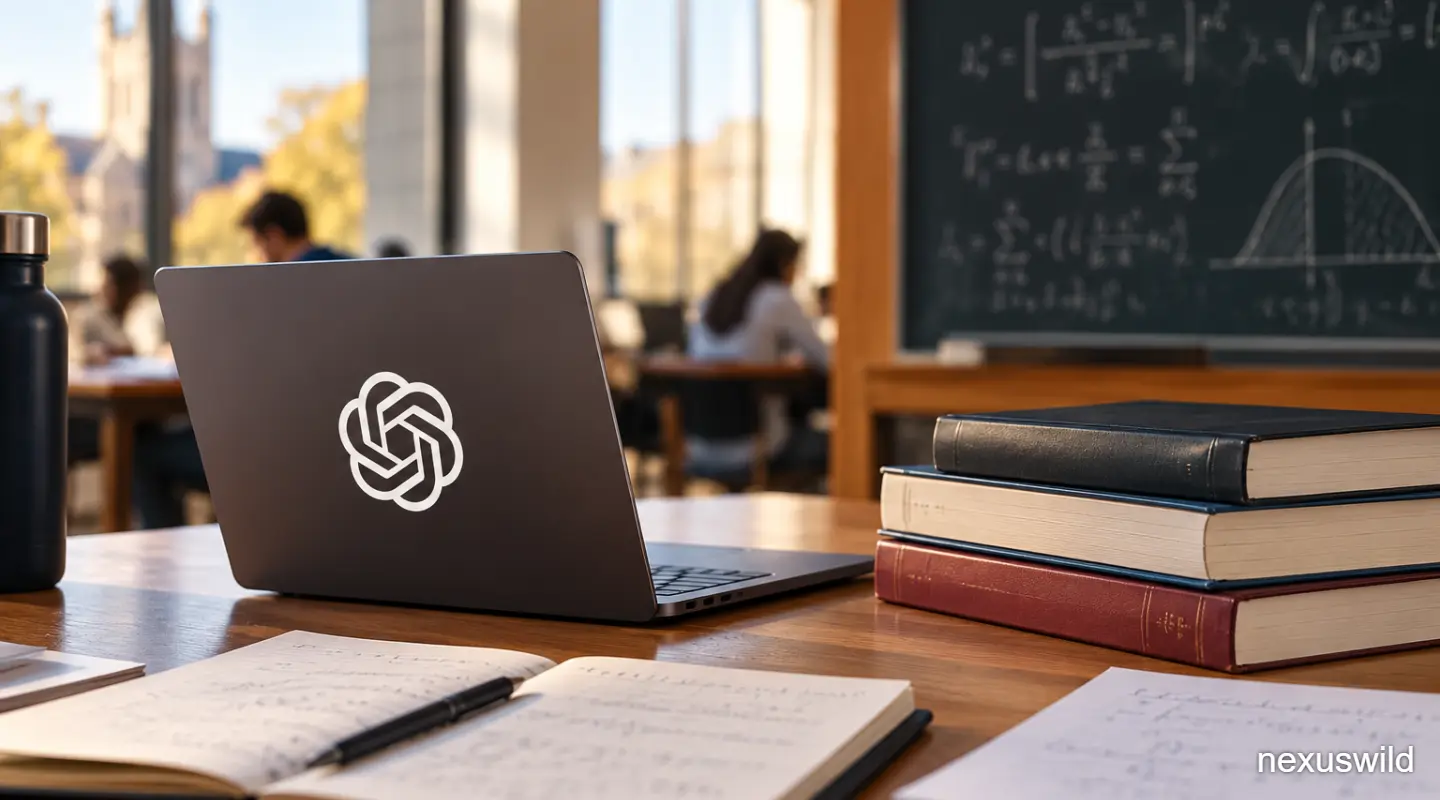

OpenAI’s release of hundreds of AI-generated mathematical manuscripts has sparked concern among researchers, with a New York University professor warning that the findings have abruptly disrupted research programmes that early-career mathematicians had been pursuing.
The company published more than 700 mathematical manuscripts on GitHub on October 6, presenting results generated by an internal artificial intelligence model. The work spans several areas of mathematics and theoretical computer science, including number theory, geometry and mathematical physics.
Tristan Buckmaster, a mathematics professor at New York University, said the scale and speed of the release had left some researchers facing a sudden change in the status of their work. Speaking to CNBC, he said entire research programmes had effectively been wiped out by the publication.
The episode highlights a growing challenge for academia: AI systems are producing mathematical results at a pace that can outstrip the time researchers need to understand, verify and build upon them. <Cite refs={["turn343884news0","turn343884search6"]} />
Hundreds of Mathematical Results Released at Once
OpenAI described the publication as a broad release of mathematical progress produced by an internal frontier model. Its announcement grouped the work into 372 families of findings, represented across 722 manuscripts.
The company said the results address difficult open problems and aim to help mathematicians and scientists make further progress. It published the material through a GitHub repository with procedures for revisions and citations.
The announcement drew attention because some findings concern questions that mathematicians have studied for years. However, the release should not be interpreted as a collection of independently verified, final solutions. Researchers still need to examine the arguments, establish whether the proofs support the stated conclusions and determine how the results fit into existing literature.
The distinction is important in mathematics, where a claim's significance depends not only on reaching a result but also on providing a rigorous argument that other experts can scrutinise.
Why Early-Career Researchers Are Particularly Concerned
For doctoral students and junior researchers, a research project can form the foundation of a dissertation, grant application, job application or longer academic programme. If another researcher publishes a result that answers the same question first, the original project may lose some of its novelty or require substantial revision.
The concern is especially pronounced when hundreds of results appear simultaneously. Researchers may have little time to assess whether their work overlaps with the new findings, whether an existing approach remains useful or whether a different question should become the focus of their research.
Buckmaster's warning reflects this uncertainty. The release does not mean every affected project has become worthless, and a mathematical result can still provide valuable methods, context or new questions even when a similar result appears elsewhere. Nevertheless, researchers face the difficult task of determining what remains original and useful.
The debate also raises questions about how academic credit should be assigned when AI systems contribute substantially to research. Universities and scientific communities will need to consider how to evaluate human contributions, verify AI-generated work and recognise researchers whose ideas overlap with machine-produced results.
Questions About Verification and Research Standards
The volume of material has also created a practical challenge for mathematicians who want to assess its quality. Reading a manuscript is only one step: specialists must check its assumptions, follow its reasoning, compare its claims with established work and, where possible, verify the proof formally.
Some of the released work includes Lean formalisation, a computer-assisted approach that can help verify mathematical arguments. However, the presence of formalisation does not automatically establish that every claim in a manuscript has been correctly represented or that every result in the wider release has been independently validated.
Reporting on the release has documented concerns about unclear exposition, incomplete verification and the time required to assess the findings. These issues make it difficult for researchers to determine quickly which results are reliable and which may need correction or further investigation. <Cite refs={["turn343884news2","turn343884search6"]} />
OpenAI Says It Wants to Support Further Research
OpenAI said its objective is to share progress from its AI systems and enable researchers to build on the results. The company has also acknowledged the need to improve how the manuscripts are presented, including their citations, mathematical explanations and overall readability.
The company said it had consulted the independent Advisory Group on Mathematics and Artificial Intelligence at the Institute for Advanced Study while developing its approach to releasing the work. It also outlined plans to improve future publications and support workshops to help researchers engage with AI-generated results. <Cite refs={["turn343884search7","turn343884news0"]} />
Those commitments address part of the problem, but they do not remove the wider question of how such releases should be handled. A publication can make knowledge available to everyone while still placing a heavy burden on the people expected to check and interpret it.
A Turning Point for Academic Mathematics?
The dispute reflects a broader transition in scientific research. AI tools may help mathematicians explore difficult problems, test approaches and discover connections that would otherwise take much longer to identify. At the same time, rapid advances could put pressure on traditional research timelines and the systems used to recognise academic achievement.
The central challenge is not simply whether AI can produce mathematical proofs. It is how the research community can establish their reliability, distribute credit fairly and ensure that human researchers have meaningful opportunities to understand and extend the findings.
OpenAI's release has made that challenge immediate. For early-career mathematicians, the consequences will depend on how much of the new work stands up to scrutiny, how closely it overlaps with existing projects and whether the research community develops effective ways to respond.
Nexuswild welcomes factual corrections. Email contact@nexuswild.com with evidence and the article URL.