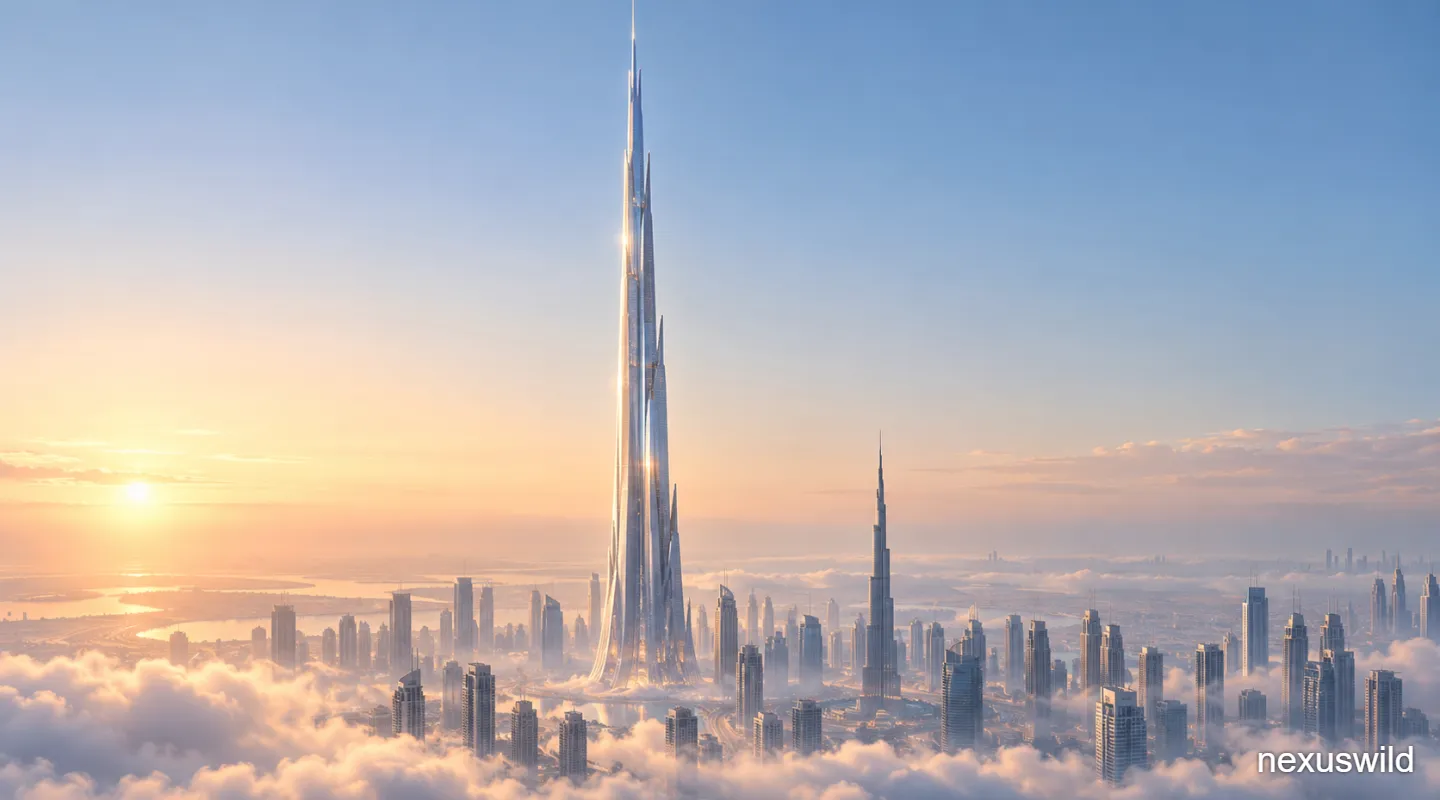

For more than 15 years, Dubai’s Burj Khalifa has defined what it means to build into the sky. At 828 metres, the tower remains the tallest completed building on Earth.
Saudi Arabia is considering something on an entirely different scale.
A proposed skyscraper in northern Riyadh, widely known as Rise Tower, is being planned at roughly two kilometres in height. If the project is ultimately built to that scale, it would stand more than twice as high as the Burj Khalifa and establish an unprecedented new benchmark for high-rise construction.
But there is an important distinction between ambition and reality: Rise Tower remains a proposed project. Construction has not begun, and a final height, completion date and main construction contract have not been publicly confirmed.
A tower that would stretch two kilometres into the sky
Rise Tower is associated with a wider development known as Project Rise, planned as part of a new central business district in northern Riyadh.
In June 2025, construction intelligence publication MEED reported that Saudi Arabia’s Public Investment Fund had received offers from international firms for a project-management consultancy contract covering the district and its proposed two-kilometre tower.
The request was reportedly issued through the Tower District Real Estate Development Company, a PIF subsidiary. Firms invited to participate included Aecom, Jacobs, Parsons, Turner and the UK’s Mace.
Foster + Partners has been reported as the architectural firm working on the tower after winning a design competition launched in late 2022.
At 2,000 metres, the scale is difficult to put into perspective.
The Burj Khalifa reaches 828 metres. Rise Tower, if completed at its proposed height, would therefore be approximately 1.17 kilometres taller.
It would also substantially surpass Saudi Arabia’s other record-breaking skyscraper project, Jeddah Tower, which is under construction and planned to exceed one kilometre.
Why building this high changes the engineering equation
Building a skyscraper two kilometres tall is not simply a matter of extending existing tower designs.
Wind becomes one of the defining engineering challenges. At extreme heights, a building must withstand substantial lateral forces while limiting movement to levels that remain safe and comfortable for occupants.
Structural weight presents another problem. Engineers need a system capable of carrying enormous loads while avoiding excessive amounts of steel and concrete that would make the building economically or physically impractical.
Then there is vertical transportation.
A two-kilometre tower would require an elevator system capable of moving potentially thousands of people efficiently across extraordinary distances. Traditional lift arrangements consume valuable floor area as towers get taller, forcing designers to rethink elevator shafts, transfer floors and passenger movement.
Water pressure, fire evacuation, electrical systems, climate control and maintenance would all become more complex at this scale.
That is why a successful two-kilometre tower would represent more than a new architectural record. It could become a test bed for technologies that influence future high-density cities.
Part of a much larger development
The tower is expected to become the centrepiece of a broader masterplanned district in northern Riyadh, often referred to in reports as the North Pole development.
The wider plan reflects Saudi Arabia’s effort to expand Riyadh into a larger international business, tourism and investment hub.
Rather than functioning solely as an observation tower, Rise Tower has been described as a mixed-use project potentially incorporating hospitality, offices, leisure facilities and observation spaces.
Industry estimates cited by MEED suggest a tower of this scale could cost around $5 billion, although the final figure would depend heavily on the approved design, engineering requirements and construction programme.
It is not a finished deal yet
Much of the online discussion surrounding Rise Tower presents the project as though construction is already underway. That overstates its current status.
As of September 2026, project tracking sources describe Rise Tower as announced but not yet under construction, with no confirmed opening date.
Detailed specifications circulating online also need caution. Reports have mentioned figures such as 678 floors, but publicly confirmed final technical documentation remains limited.
That distinction matters for projects of this scale. Megatall skyscrapers frequently undergo significant redesigns before construction, and some ambitious concepts never move beyond planning.
What makes Rise Tower notable is that the concept has progressed beyond a simple architectural rendering. Procurement activity for project-management work indicates that professional planning around the proposed development has taken place.
Still, the decisive milestones will be a finalized design, financing structure, major construction contracts and an official groundbreaking.
Until then, Dubai's Burj Khalifa remains the tallest completed skyscraper in the world.
Rise Tower represents what could come next: a building so tall that it would not merely break the current record, but potentially redefine the engineering limits of the skyscraper itself.
Nexuswild welcomes factual corrections. Email contact@nexuswild.com with evidence and the article URL.