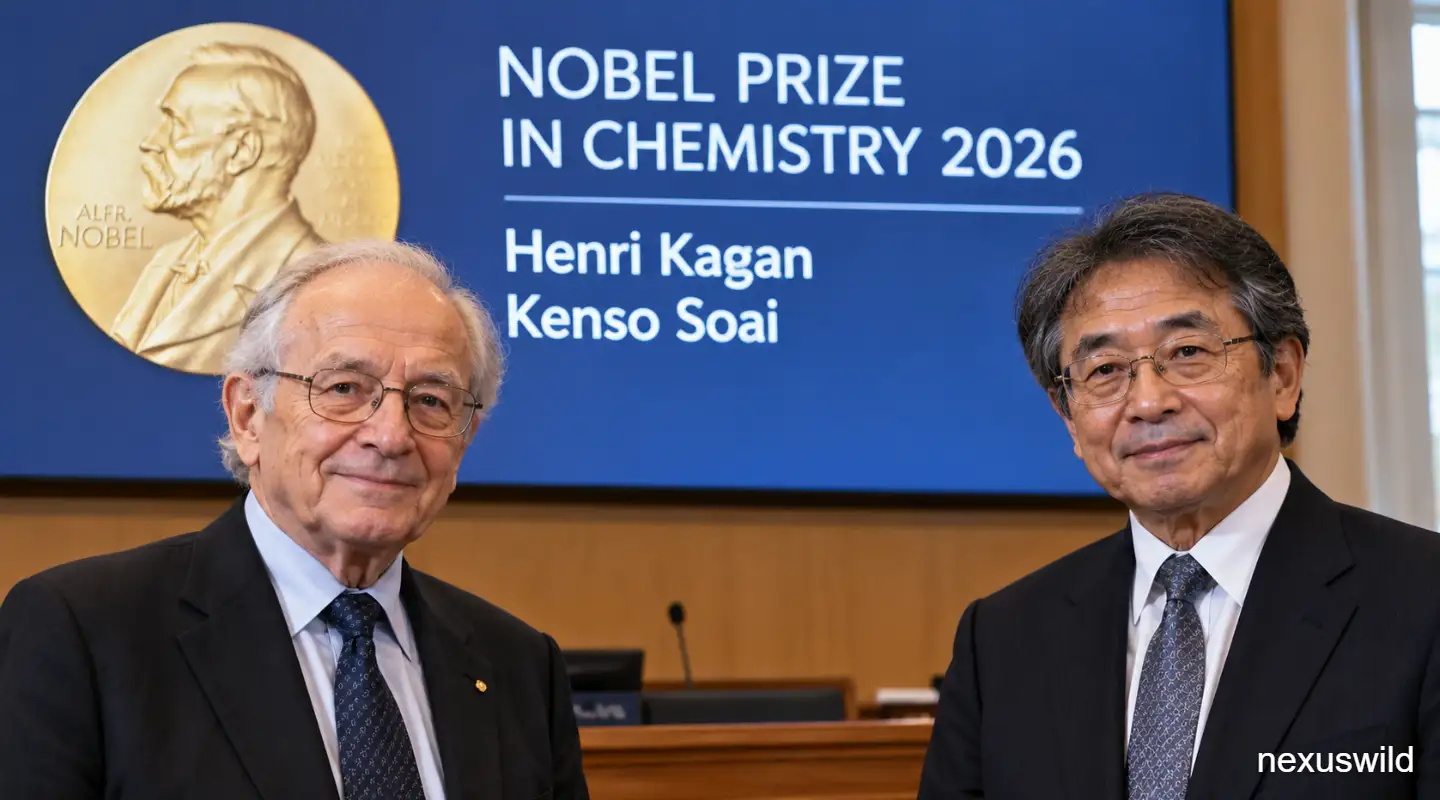

French chemist Henri B. Kagan and Japanese chemist Kenso Soai have won the 2026 Nobel Prize in Chemistry for discoveries that helped explain and control one of chemistry’s most important forms of molecular asymmetry.
The Royal Swedish Academy of Sciences announced the award in Stockholm on October 7, honoring the pair “for the discovery of non-linear effects and autocatalysis in asymmetric organic synthesis.”
Their work helped chemists understand how reactions can strongly favor one mirror-image form of a molecule over another, an issue with major implications for drug development, biological chemistry and modern organic synthesis.
Why Mirror-Image Molecules Matter
Many molecules can exist in two forms that contain the same atoms but are arranged as mirror images of one another.
Chemists call this property chirality.
A common analogy is the human hand: a left hand and a right hand have the same basic structure, but they cannot be perfectly superimposed.
The same principle applies to chiral molecules.
In biology, the difference can be extremely important because one molecular form can interact with enzymes, receptors or other biological systems differently from its mirror image.
That makes it important for chemists to control which version of a molecule is produced during a chemical reaction.
Kagan Helped Reveal Powerful Non-Linear Effects
Henri Kagan became a major figure in asymmetric synthesis through work showing that relatively small differences in the handedness of catalysts could produce much larger effects in the handedness of reaction products.
These non-linear effects helped reveal that asymmetric chemical systems do not always behave in a simple proportional way.
Instead, interactions among catalysts and molecules can amplify a small initial imbalance and strongly favor one chiral form.
That insight became an important part of the theoretical and practical foundation of asymmetric catalysis.
Kagan’s work also helped chemists design more effective methods for producing specific molecular forms selectively.
Soai Discovered Asymmetric Autocatalysis
Kenso Soai made another major advance with the discovery of asymmetric autocatalysis.
In an autocatalytic reaction, the product of a reaction helps catalyze the production of more of itself.
Soai demonstrated a remarkable system in which a slight initial excess of one chiral form could be amplified dramatically as the reaction proceeded.
This became known as the Soai reaction.
The discovery provided a chemical mechanism showing how a very small initial asymmetry could potentially grow into a much larger preference for one molecular handedness.
That made the reaction important not only for synthetic chemistry but also for research into one of the deepest questions in chemical biology: why life overwhelmingly uses only one handedness for many key molecules.
Their Work Addresses the Mystery of Homochirality
Living organisms display a striking property known as homochirality.
For many biologically important molecules, nature overwhelmingly uses only one of the two possible mirror-image forms.
Amino acids used in proteins, for example, predominantly have one handedness, while sugars in DNA and RNA predominantly have the opposite orientation.
Scientists have debated for more than a century how such asymmetry first emerged.
Kagan and Soai did not solve the origin of life itself, but their discoveries demonstrated mechanisms through which a very small chiral imbalance can be amplified by chemical reactions.
That makes their work highly relevant to understanding how homochirality could arise.
The Nobel Builds on a Question First Explored by Louis Pasteur
The scientific story reaches back to the 19th century.
French chemist Louis Pasteur discovered that some molecules could exist in mirror-image forms after studying crystals of tartaric acid.
He also showed that biological systems could distinguish between those forms.
That discovery laid the foundation for stereochemistry, the study of how the three-dimensional arrangement of atoms affects molecular behavior.
More than a century later, Kagan and Soai helped explain how chemical reactions could actively favor and amplify one of those forms.
Why Asymmetric Synthesis Matters in Pharmaceuticals
The ability to manufacture a specific chiral form is crucial in the pharmaceutical industry.
Two mirror-image versions of the same molecule can behave very differently in the human body.
One form may provide the desired medical effect, while the other may be less effective or produce unwanted effects.
Peter Somfai of the Nobel Committee for Chemistry said the laureates’ work provided chemists with important tools for selectively producing the desired molecular form.
That is one reason asymmetric synthesis has become central to modern drug manufacturing.
The Thalidomide Case Illustrates the Importance of Chirality
The Nobel Committee highlighted the historical example of thalidomide, a sedative associated with severe birth defects when it was widely used in the late 1950s and early 1960s.
Research later demonstrated how different chiral forms of a drug can have very different biological effects.
The thalidomide case became one of the best-known examples used to explain why stereochemistry matters in pharmaceutical development.
Modern drug design therefore places far greater emphasis on understanding and controlling molecular handedness.
Kagan Was Previously Overlooked in the Same Field
Kagan’s 2026 Nobel also closes a long-running historical chapter in chemistry.
His work had been considered highly influential for decades.
In 2001, the Nobel Prize in Chemistry went to William Knowles, Ryoji Noyori and K. Barry Sharpless for work on chirally catalyzed reactions.
At the time, French officials publicly questioned why Kagan had not been included despite his major contributions to asymmetric catalysis.
Twenty-five years later, the Nobel Committee recognized Kagan for a different but closely related body of work involving non-linear effects in asymmetric synthesis.
Henri Kagan Is 95
Kagan was 95 years old when the 2026 prize was announced, making him one of the oldest Nobel laureates in history.
Reuters reported that he became the third-oldest person ever awarded a Nobel Prize.
His research career spans several generations of modern organic chemistry.
Kagan’s work has influenced asymmetric catalysis, ligand design and stereoselective synthesis, fields that are now routinely used in academic laboratories and industrial chemistry.
Kenso Soai Learned of the Prize While Shopping
Soai, 76, received news of the award while he was out grocery shopping.
Speaking by telephone during the Nobel announcement, he said he was delighted to share the prize with Kagan.
Soai is best known internationally for the autocatalytic reaction bearing his name.
The reaction has been studied extensively because it demonstrates how an initially tiny imbalance between two chiral forms can become strongly amplified through repeated reaction cycles.
What Is a Non-Linear Effect?
In a simple chemical system, scientists might expect the relationship between catalyst purity and product purity to be roughly proportional.
A non-linear effect occurs when that relationship behaves differently.
For example, a catalyst with only a moderate excess of one chiral form might produce a product with a much larger excess of the same form.
Kagan’s work helped establish that these effects could reveal important information about how asymmetric catalysts interact and operate.
That made non-linear effects useful both scientifically and practically.
What Is Asymmetric Autocatalysis?
Autocatalysis means that a product helps accelerate its own formation.
In Soai’s asymmetric system, the product does more than accelerate the reaction.
It also helps determine which chiral form becomes dominant.
A tiny initial imbalance can therefore become larger with each reaction cycle.
This kind of chemical amplification is one reason Soai’s work attracted interest far beyond traditional synthetic chemistry.
It provides a plausible mechanism for how small random or externally induced asymmetries might become chemically dominant.
The Prize Recognizes Both Practical and Fundamental Chemistry
The 2026 chemistry award bridges two different areas of scientific importance.
On one side, asymmetric synthesis has direct commercial value because it helps chemists manufacture pharmaceuticals and other complex molecules with high selectivity.
On the other, the underlying work addresses fundamental questions about molecular symmetry and the origins of biological handedness.
That combination of practical usefulness and basic scientific insight is central to the significance of the award.
Kagan and Soai Will Share 12 Million Swedish Kronor
The two laureates will share the Nobel Prize award of 12 million Swedish kronor, worth roughly $1.2 million at current exchange rates.
They will also receive Nobel medals and diplomas.
The formal award ceremony is scheduled for December 10 in Stockholm, the anniversary of Alfred Nobel’s death.
Sweden’s King Carl XVI Gustaf traditionally presents the science prizes during the ceremony.
Chemistry Nobel Follows Medicine and Physics Awards
The Chemistry Prize was the third Nobel announced during the 2026 Nobel week, following the awards in medicine and physics.
The Nobel Prize in Chemistry has been awarded since 1901.
Past prizes have recognized discoveries ranging from nuclear chemistry and molecular biology to catalytic methods and materials science.
In 2025, the chemistry prize went to Susumu Kitagawa, Richard Robson and Omar Yaghi for the development of metal-organic frameworks.
Why the 2026 Nobel Matters
Kagan and Soai’s work changed how chemists think about molecular handedness.
Kagan demonstrated how asymmetric systems can generate unexpectedly large chiral effects through non-linear behavior.
Soai showed that chemical systems can go even further by amplifying their own chirality through autocatalysis.
Together, those discoveries provided both practical tools for synthetic chemistry and experimental insight into how one molecular form can become dominant.
Their work now underpins research ranging from pharmaceutical synthesis to investigations into the chemical origins of life.
Conclusion
Henri B. Kagan and Kenso Soai have won the 2026 Nobel Prize in Chemistry for discoveries involving non-linear effects and autocatalysis in asymmetric organic synthesis.
Their research demonstrated important mechanisms through which chemical reactions can favor and amplify one mirror-image form of a molecule over another.
That ability is essential in modern pharmaceutical chemistry, where different chiral forms can produce very different biological effects.
The discoveries also helped scientists investigate the long-standing mystery of homochirality, or why living systems overwhelmingly rely on only one handedness of many key molecules.
Kagan and Soai will share 12 million Swedish kronor and receive their Nobel medals in Stockholm on December 10.
The award recognizes work that connects one of chemistry’s deepest theoretical puzzles with techniques that have become central to the practical manufacture of complex molecules.
Nexuswild welcomes factual corrections. Email contact@nexuswild.com with evidence and the article URL.