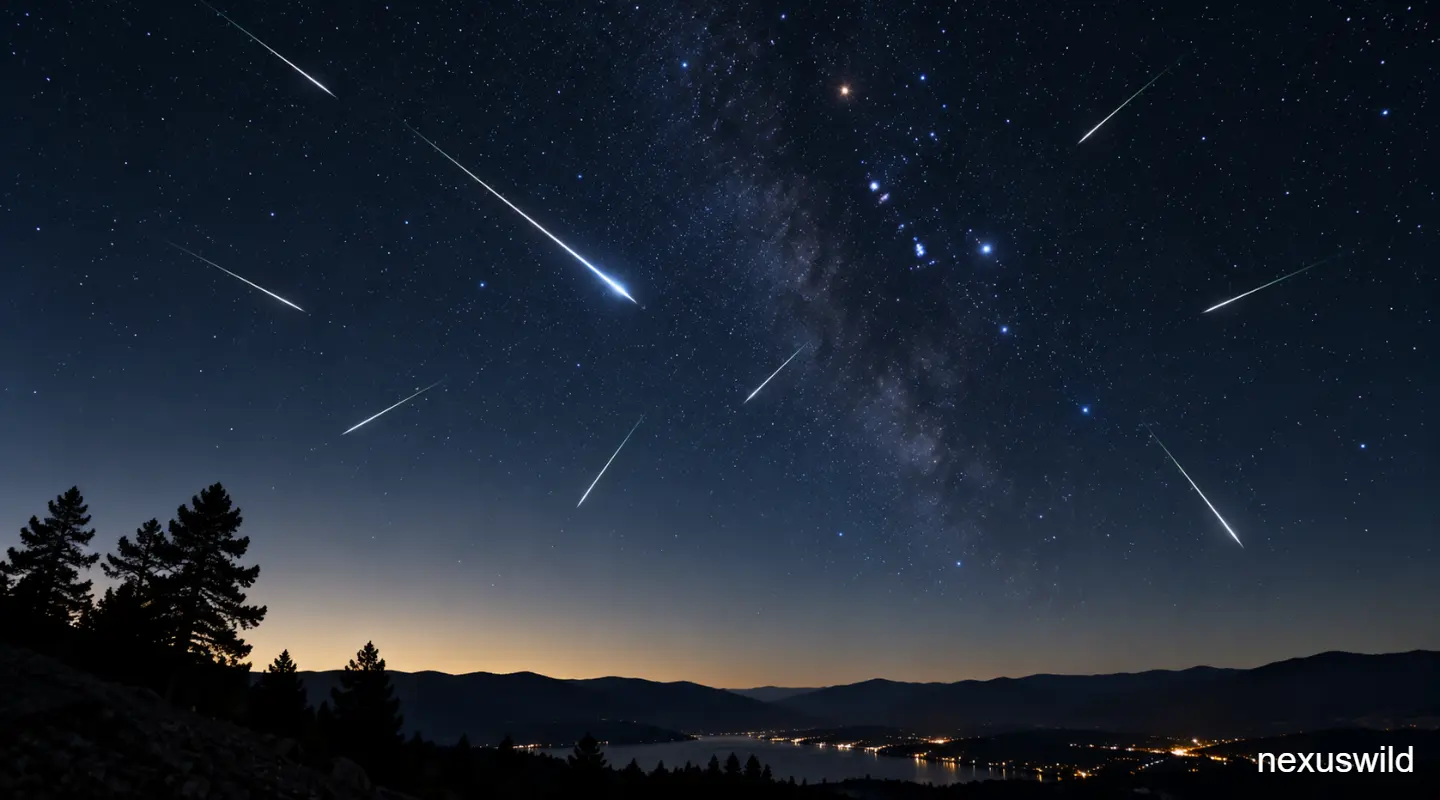

The Orionid meteor shower is active in October 2026, giving skywatchers another opportunity to see fast-moving meteors produced by debris left behind by Halley’s Comet.
The annual shower is expected to build through October before reaching its peak later in the month, when Earth passes through a denser part of the debris stream associated with the famous comet.
The Orionids are known for relatively swift meteors and occasional bright streaks, although the number visible from any location depends on cloud cover, light pollution, moonlight and the observer’s position.
When the Orionids Peak in 2026
The Orionids are typically active from early October into early November, with the strongest activity occurring around October 21-22.
Astronomy organizations generally expect the 2026 peak during the overnight hours around that period.
The exact moment of maximum activity is less important for most observers than having a clear, dark sky during the late-night and pre-dawn hours around the peak.
Meteor showers do not switch on and off at a precise minute. Activity normally rises gradually, reaches a broad maximum and then declines.
How Many Meteors Could Be Visible
Under ideal dark-sky conditions, the Orionids can produce roughly 15 to 20 meteors per hour near maximum.
That figure is an idealized rate rather than a guarantee of what an individual observer will see.
Urban light pollution, haze, clouds and moonlight can reduce the visible count significantly.
Observers should also expect periods with few meteors followed by short bursts of activity, rather than a perfectly steady rate.
The Orionids Come From Halley’s Comet
The meteors are caused by tiny particles left along the orbit of Comet 1P/Halley.
As Earth moves through that debris stream, the particles enter the atmosphere at very high speed and heat the surrounding air, producing the brief streaks of light commonly called shooting stars.
The particles themselves are generally small, often comparable in size to grains of sand or small pebbles.
The Orionids are not pieces of Halley’s Comet falling directly toward Earth in 2026. They are fragments shed by the comet during previous passages through the inner solar system.
Why the Shower Is Called the Orionids
Meteor showers are named for the constellation from which the meteors appear to radiate.
For the Orionids, that apparent point lies near Orion, one of the easiest constellations to recognize in the night sky.
The meteors can appear almost anywhere overhead, however.
Observers do not need to stare directly at Orion. In fact, looking broadly across a large section of dark sky usually gives a better chance of seeing longer meteor trails.
Best Time to Watch
The most favorable viewing period is usually after midnight and before dawn.
During those hours, the observer’s side of Earth is rotating into the incoming stream of meteoroid debris, which tends to increase the number of visible meteors.
The radiant also climbs higher in the sky as the night progresses.
For the best chance of seeing Orionids:
- move away from city lights;
- choose a location with an open view of the sky;
- allow at least 20 to 30 minutes for your eyes to adapt to darkness;
- avoid looking at phone screens or other bright lights;
- watch a wide area of sky rather than focusing only on Orion.
No telescope or binoculars are needed.
Moonlight Can Affect the 2026 Display
The Moon is one of the biggest factors determining how impressive a meteor shower appears.
Bright moonlight washes out faint meteors in much the same way as urban lighting.
For the 2026 Orionid peak, observers should check the Moon’s phase and position for their location before heading outside.
Even when moonlight is present, brighter Orionids can still be visible, particularly from darker locations and when the Moon is low in the sky.
The shower should therefore not be described as guaranteed to produce a spectacular display everywhere.
Orionid Meteors Are Among the Faster Annual Meteors
One reason the Orionids are popular with skywatchers is their speed.
They strike Earth’s atmosphere at roughly 66 kilometers per second, making them among the faster meteors associated with major annual showers.
Fast meteors can produce bright, brief streaks and sometimes leave glowing trails that remain visible for a short period after the meteor disappears.
Those persistent trains are one of the characteristics often associated with the Orionids.
Viewing From the Northern and Southern Hemispheres
The shower can be observed from both hemispheres.
Observers in the Northern Hemisphere generally see Orion rise during the late evening and become better placed after midnight.
Southern Hemisphere viewers can also see the shower, though the constellation’s orientation and height differ by latitude.
The most important requirements remain a clear sky and as little artificial light as possible.
Weather Matters More Than Forecast Meteor Rates
Meteor-shower forecasts describe what might be visible under ideal conditions.
Local weather can completely override those expectations.
Cloud cover, humidity, smoke, dust and haze may reduce visibility even during the predicted peak.
For that reason, observers should check a short-term local weather forecast before making viewing plans.
If peak night is cloudy, the Orionids remain active for several days around maximum, so nearby nights can still provide useful opportunities.
Halley’s Comet Creates Another Annual Shower
The Orionids are not the only meteor shower linked to Halley’s Comet.
The Eta Aquariids, which peak around May, are produced by another part of the same comet’s debris trail.
Earth crosses the comet’s orbital debris twice each year, creating two separate annual meteor showers.
Halley itself is not currently close to Earth.
Its next return to the inner solar system is expected in 2061.
No Risk to People on the Ground
Meteor showers do not pose a significant threat to people watching from Earth.
Most Orionid particles are extremely small and burn up high in the atmosphere.
The visible flash occurs because of the speed at which the particles interact with the atmosphere, not because large rocks are routinely reaching the ground.
The Orionids are therefore primarily an observational event rather than a hazard.
Conclusion
The 2026 Orionid meteor shower is underway, with activity expected to strengthen before peaking around October 21-22.
The shower originates from debris left behind by Halley’s Comet and can produce roughly 15 to 20 meteors per hour under ideal dark-sky conditions near maximum.
Its fast meteors and occasional bright trails make the Orionids one of the more recognizable annual meteor showers, but viewing quality in 2026 will depend on moonlight, weather and local light pollution.
Observers do not need special equipment. A dark location, a broad view of the sky and patience during the late-night and pre-dawn hours around the peak offer the best chance of seeing the display.
Nexuswild welcomes factual corrections. Email contact@nexuswild.com with evidence and the article URL.