
A Simple Cable Could Address One of Spaceflight’s Biggest Problems
Humanity has developed sophisticated rockets, reusable spacecraft and orbital laboratories, yet one fundamental problem remains: the human body is not designed to live for long periods without gravity.
In microgravity, astronauts can experience muscle weakening, bone-density loss, changes in blood and other bodily fluids, balance problems and vision-related complications. Exercise and other countermeasures help, but they do not eliminate every risk associated with extended spaceflight. NASA continues to identify altered gravity as a major human-spaceflight hazard. (NASA: The Human Body in Space)
One proposed solution is artificial gravity: creating an environment in which astronauts experience a force similar to the weight they feel on Earth.
A traditional approach would involve a large rotating wheel or cylindrical space station. But building a huge, rigid structure in orbit would require substantial material, transportation capacity and assembly work.
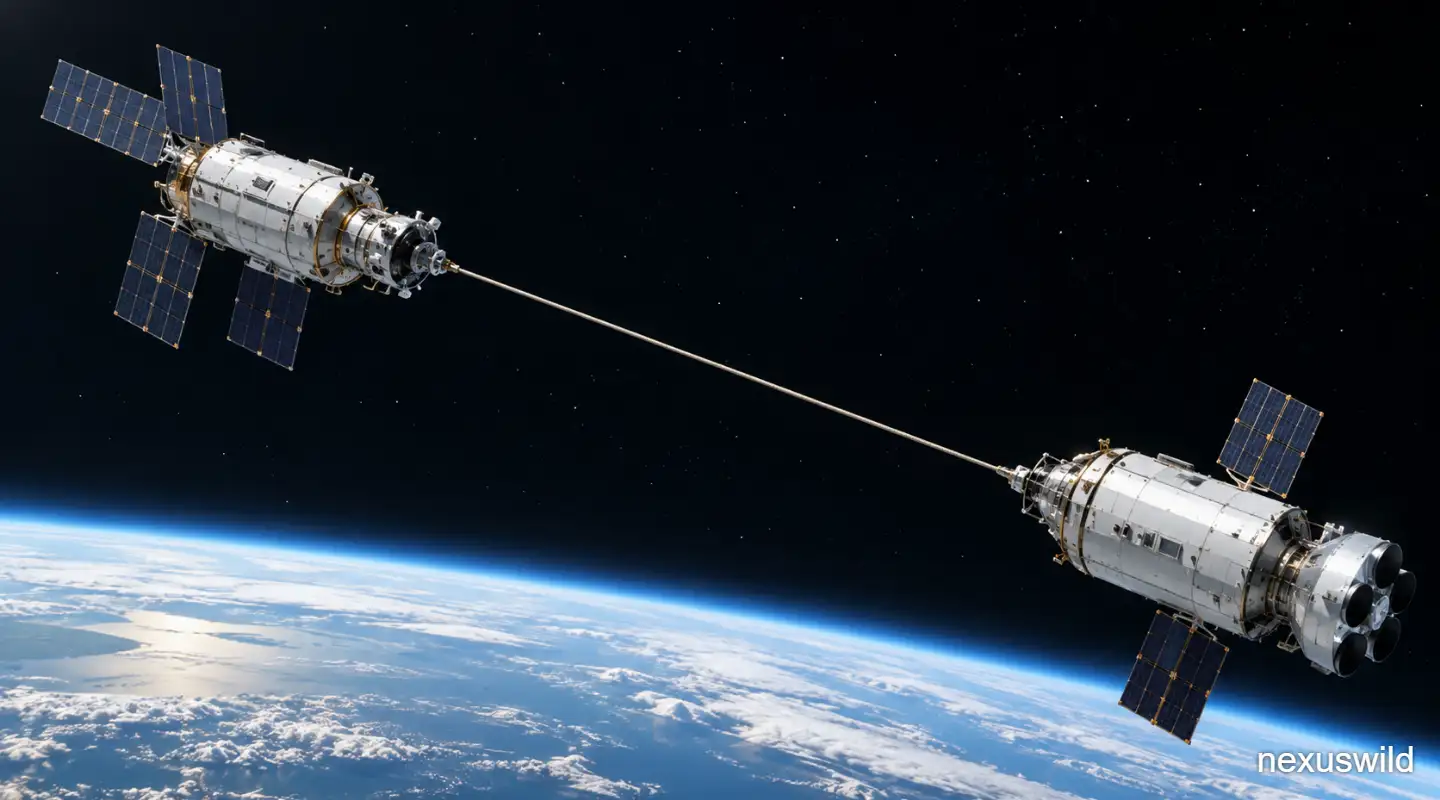
A more economical concept uses two spacecraft connected by a long tether. Once the system begins rotating, each capsule follows a circular path around their shared centre of mass. The rotation produces an apparent outward force against the interior of each capsule, allowing occupants to experience a gravity-like sensation.
Astrophysicist Ethan Siegel explored this idea in his October 9, 2026, Big Think column, Ask Ethan: Can a Kevlar tether create artificial gravity in space? The central question is whether a relatively inexpensive cable could provide an effective alternative to a large artificial-gravity habitat.
The short answer is yes, in principle. The harder question is whether the system can be built, controlled and operated comfortably enough for astronauts to live in it.
How Two Tethered Spacecraft Could Simulate Gravity
Imagine two capsules with equal masses connected by a cable. They are separated by a fixed distance and set rotating around their common centre of mass.
The tether constrains their motion, continually pulling each capsule toward the centre of rotation. That inward force provides the centripetal acceleration required to keep the capsules moving in a circle.
For an astronaut inside a rotating capsule, the floor can provide a supporting force in the same way that the ground supports a person standing on Earth. The astronaut experiences a sensation resembling weight, even though the system is not generating an additional gravitational field.
The relationship between rotational motion and acceleration is expressed as:
[ a=\omega^2r ]
Here, (a) is the centripetal acceleration, (r) is the distance from the centre of rotation, and (\omega) is the angular velocity.
To reproduce approximately Earth's surface gravity, the acceleration should approach (9.81) metres per second squared. A spacecraft designer can achieve that target by adjusting the radius of rotation and the speed of the spin.
The key trade-off is straightforward: a smaller system must rotate faster, while a larger system can achieve the same acceleration with fewer revolutions per minute.
This makes the tether attractive as a concept. It replaces the need for a complete rigid wheel with two main masses and a connecting structure.
However, the cable cannot create gravity simply by being deployed. The spacecraft must be placed into the correct motion, the tether must sustain the resulting forces, and the rotating system must remain stable.
How Long Would the Cable Need to Be?
The required tether length depends on how quickly the spacecraft rotates and how much acceleration the astronauts need.
For two equal-mass capsules, the centre of rotation lies approximately halfway between them. The radius in the equation is therefore half the total separation between the capsules.
The following examples illustrate the relationship, assuming the system is designed to provide approximately (1g) at each capsule.
Total separation
Radius of rotation
Approximate rotation rate
20 metres
10 metres
9.5 rpm
200 metres
100 metres
3.0 rpm
2,000 metres
1,000 metres
0.95 rpm
These are illustrative calculations, not tested specifications for a crewed vehicle. They assume equal masses, a stable circular rotation and a target acceleration close to Earth's gravity.
The numbers reveal why a short tether is not necessarily the most practical solution. A 20-metre separation would require the capsules to complete almost ten revolutions every minute to simulate (1g).
At a separation of 200 metres, the rotation rate drops to roughly three revolutions per minute. Extending the separation to two kilometres reduces it to approximately one revolution per minute.
A longer tether can therefore make the rotation more comfortable from some physiological perspectives. But it also introduces new engineering challenges, including greater structural loads, more complicated deployment and more demanding control of the system's motion.
There is no single cable length that solves every problem. Designers must balance acceleration, rotation rate, human comfort, structural strength and spacecraft stability.
Why Artificial Gravity Matters for Astronaut Health
Gravity is more than the sensation of being pulled towards the ground. On Earth, it continuously loads the muscles and bones, influences how bodily fluids are distributed and helps the brain interpret movement and orientation.
In microgravity, those normal conditions change.
NASA reports that astronauts can lose approximately 1% to 1.5% of bone density per month in weight-bearing bones during four-to-six-month missions, although individual outcomes vary. Muscles can also weaken because they no longer work against Earth's gravity in the usual way. (NASA: Risk of Spaceflight-Induced Bone Changes)
Fluid distribution changes as well. Without the familiar downward pull, bodily fluids shift towards the head. These changes are associated with several effects, including alterations to the eyes and visual system. NASA identifies spaceflight-associated neuro-ocular syndrome, or SANS, as an important concern for long-duration missions. (NASA: Risk of SANS)
A rotating habitat could restore some of the mechanical loading that astronauts experience on Earth. Standing, walking and moving inside the capsule would generate forces that are absent in conventional microgravity environments.
That could make artificial gravity valuable for future missions to Mars, long-duration orbital expeditions and other journeys where astronauts cannot quickly return to Earth.
But the benefits should not be overstated. A rotating habitat would not automatically eliminate radiation exposure, isolation, confinement or every physiological effect of spaceflight. Researchers would still need to determine how much artificial gravity is required, how long astronauts must experience it, and whether partial gravity could provide meaningful health benefits.
The concept offers a possible countermeasure, not a complete solution to every challenge of living in space.
The Biggest Human Challenge: Motion Sickness and the Inner Ear
The main biological difficulty with a compact rotating habitat is how humans perceive motion.
The inner ear contains a vestibular system that helps the brain interpret rotation, balance and changes in orientation. Its sensory structures respond to movement of fluid within the inner ear, providing information that works alongside visual cues and signals from the body.
In a rapidly rotating spacecraft, these systems may receive conflicting information. The astronaut's eyes can indicate one kind of movement while the vestibular system responds to rotation and head movements in another way.
This mismatch can lead to disorientation, nausea and discomfort.
The effect is especially important when astronauts turn their heads or move around inside a rotating capsule. The problem is not simply that the spacecraft is moving quickly through space; it is that the person is living in a rotating reference frame, where movement can produce additional apparent accelerations.
These effects are commonly associated with Coriolis acceleration. In a rotating environment, moving an object—or moving one's head—can produce forces that differ from the familiar sensations experienced in a stationary room.
NASA recognises altered sensorimotor and vestibular function as a spaceflight risk, including dizziness, motion sickness and problems with coordination. (NASA: Risks of Spaceflight)
The faster the rotation, the more challenging the environment may become for many people. Slowing the rotation by increasing the radius can reduce some of these effects.
That is why a much longer tether may be preferable to a compact one, even if the shorter version is easier to transport and deploy.
The exact tolerable rotation rate is not a universal number. Individual responses, adaptation, movement patterns, habitat design and the level of artificial gravity all matter. A design intended for long-term human habitation would require dedicated human-factors testing rather than relying on one threshold alone.
Why a Two-Kilometre Tether Still Has Limitations
At first glance, separating two capsules by two kilometres seems to address much of the rotation problem. At approximately 0.95 revolutions per minute, the system would rotate far more slowly than a 20-metre arrangement designed to provide the same acceleration.
However, the acceleration also changes with distance from the centre of rotation.
In a rotating system, the astronaut's feet would be slightly farther from the centre than their head if they stood along the direction of the apparent gravity. Their feet would therefore experience a slightly greater acceleration.
For a person approximately 1.7 metres tall in a system with a 1,000-metre radius, the difference would be around (0.017) metres per second squared. That is a small fraction of Earth's gravity.
In a much smaller system, the difference becomes more noticeable. With a 100-metre radius, the head-to-foot difference would be roughly ten times larger. With a 10-metre radius, it would be roughly one hundred times larger than in the 1,000-metre-radius example.
These calculations illustrate why large rotating habitats are attractive for human comfort: they can reduce both the rotation rate and the variation in acceleration across the body.
Nevertheless, a two-kilometre tether does not automatically make a suitable habitat. Engineers would still need to address vibration, cable dynamics, deployment, communications, power, emergency procedures and the behaviour of the connected spacecraft during routine operations.
A longer system also means that a relatively small change in one capsule's motion can affect the overall rotation and require corrective action.
Can Kevlar Withstand the Forces?
Kevlar is a high-strength synthetic fibre used in applications where tensile strength and low mass are important. Its properties make it an intuitive candidate for a lightweight tether, but selecting a cable for a rotating spacecraft requires much more than comparing headline strength figures.
The tether would need to support the tension created by the rotating masses while accounting for the spacecraft's mass, rotation rate, cable length, attachment points and dynamic loads.
The design would also need to account for fatigue, manufacturing defects, radiation exposure, thermal cycling, micrometeoroid impacts and damage over time. A cable that performs well in a laboratory test is not automatically suitable for years of exposure in orbit.
The complete tether assembly matters as much as the fibre itself. Connections, joints, deployment mechanisms and attachment structures can become weak points if they are not designed and tested as part of the system.
A single failure could be catastrophic. If the tether broke or its attachment failed, the capsules would no longer follow the intended shared rotation. The crew could lose the artificial-gravity environment, while the separated components might enter trajectories that complicate recovery or rescue.
For that reason, a practical system would need robust monitoring, fault detection, redundancy where feasible and a way to manage emergencies.
Kevlar could be one candidate material, but the available information does not establish that a particular Kevlar cable is ready for this specific mission. That would require detailed engineering analysis and testing.
The Engineering Problem: Keeping the Spacecraft Balanced
Even if the cable is strong enough, maintaining a stable rotation presents another major challenge.
In an idealised system, the two capsules have equal masses, the tether remains straight, and the spacecraft rotate around a predictable centre of mass. Real spacecraft are more complicated.
Astronauts move around. Equipment is used or repositioned. Supplies are consumed, and waste is stored. A change in the distribution of mass can alter the system's moment of inertia and affect its rotational behaviour.
A rotating structure must manage these changes without allowing small disturbances to develop into large oscillations or unwanted motion.
Consider a familiar example: a washing machine with an unbalanced load. The uneven distribution can cause vibration during the spin cycle. A tethered spacecraft faces a more complicated version of the problem, with the added consequences of operating in orbit and supporting a crew.
The engineering response could involve carefully planned layouts, controlled movement of equipment, sensors, thrusters and active adjustments to the spacecraft's rotation. The system would also need to cope with disturbances caused by docking, manoeuvres and other operations.
The longer the tether, the more complicated the overall structure and its dynamic behaviour may become. A longer radius helps reduce rotation-related discomfort, but it does not remove the need for precise control.
This is one reason a rigid rotating wheel or a more elaborate habitat could ultimately be preferable for some missions. A structure designed around a more distributed mass can offer different stability and operational characteristics, although it would also be more complex and expensive to build.
Space Tethers Are Not a New Idea
The use of tethers in space is not purely speculative. NASA's Gemini programme used a tether between the Gemini 11 spacecraft and an Agena target vehicle during a 1966 mission.
That historical example demonstrates that spacecraft can be connected by a tether in orbit. It does not, however, demonstrate that a long-duration, crewed artificial-gravity system has been successfully operated.
The proposed two-capsule habitat would require a different set of capabilities: sustained rotation, precise control, reliable life-support systems and an environment that humans can tolerate over extended periods.
Historical tether experiments can provide useful engineering knowledge, but they should not be confused with a demonstration of a complete artificial-gravity habitat.
Researchers have also studied artificial gravity for decades. NASA technical literature has examined how the radius of a rotating vehicle affects human performance, including the trade-offs associated with rotation rate and Coriolis forces. (NASA Technical Reports Server: An Overview of Artificial Gravity)
The underlying physics is well understood. The challenge is translating that knowledge into a safe, economical and practical spacecraft.
What Would Need to Happen Before Astronauts Could Live in One?
A realistic development programme would begin with simulations and structural testing, followed by uncrewed demonstrations of tether deployment and rotational control.
Engineers would need to show that the cable and its attachments could withstand expected loads and that the connected masses could remain stable while the system rotated. Tests would also need to evaluate how the spacecraft responded to disturbances and how much propellant or other resources were required for corrections.
Human-factors research would be equally important. Crews would need to evaluate whether the rotation rate allowed them to work, sleep, exercise and move around without unacceptable discomfort. Testing could examine different rotation rates, levels of artificial gravity and patterns of movement.
A successful demonstration would need to go beyond showing that the system can rotate. It would have to establish that the habitat can operate safely and reliably for the duration of a real mission.
Designers would also need to consider whether both capsules should be habitable or whether one should serve primarily as a counterweight carrying equipment, supplies or other payloads. Different configurations would create different requirements for mass balance, life support and crew operations.
Finally, the system would need to demonstrate a meaningful advantage over alternatives. If the tether requires extensive propellant, frequent intervention or complicated emergency procedures, its lower initial construction cost may not translate into a lower total mission cost.
Conclusion: Artificial Gravity Is Possible, but the Cable Is Only the Beginning
A Kevlar tether connecting two rotating spacecraft could, in principle, provide artificial gravity. The physics is straightforward: rotation creates centripetal acceleration, and a sufficiently large radius allows the system to reproduce Earth-like acceleration at a lower rotation rate.
The concept is appealing because it could avoid the need to construct a huge, rigid rotating station. It may offer a relatively lightweight approach to reducing some of the health risks associated with long-duration microgravity exposure.
But the engineering and human challenges are substantial. Rapid rotation can cause disorientation and nausea, longer tethers create demanding structural and control problems, and the system must remain stable as astronauts and equipment move around.
The right question is therefore not simply whether Kevlar is strong enough. It is whether the entire spacecraft can be built, balanced, controlled and operated in a way that protects its crew.
For now, tether-based artificial gravity remains a promising engineering concept rather than an established solution for long-duration spaceflight. Turning it into a practical habitat will require careful testing of materials, spacecraft dynamics and human tolerance.
The idea does not violate physics. Its future depends on whether engineering can make it safe, stable and comfortable enough for people to live with it.
Nexuswild welcomes factual corrections. Email contact@nexuswild.com with evidence and the article URL.