
The race for critical minerals is moving to the Pacific seabed
Thousands of metres beneath the Pacific Ocean lies a resource that governments and mining companies increasingly view as strategically important.
Across parts of the abyssal seabed, polymetallic nodules contain manganese, nickel, copper and cobalt.
These metals can be used in batteries, electrical systems, industrial equipment, defence technologies and the infrastructure supporting the energy transition.
To supporters of deep-sea mining, the deposits offer another potential source of critical minerals at a time when countries are trying to diversify supply chains away from concentrated terrestrial production.
To many Pacific governments and scientists, however, the same seabed represents an ecosystem that humanity barely understands and may not be able to restore once industrial extraction begins.
That disagreement is becoming more urgent.
The United States says it wants to move toward issuing deep-sea mining permits within months.
The International Seabed Authority is still negotiating the international rules that would govern commercial exploitation of mineral resources beyond national jurisdiction.
And Pacific governments remain divided between countries calling for a moratorium and others maintaining exploration or sponsorship relationships with seabed-mineral contractors.
The result is one of the most consequential environmental debates emerging around the global critical-minerals race.
Forty-six countries now support a pause or moratorium
The International Seabed Authority says 46 countries have formally supported a moratorium, precautionary pause or similar position on commercial deep-sea mining.
Several are Pacific countries.
Fiji, the Federated States of Micronesia, Palau and Samoa formed a moratorium alliance.
The Marshall Islands and New Zealand have also supported moratorium positions concerning mining in international waters.
Tuvalu and Vanuatu support a precautionary pause.
The exact legal language differs between countries, but the underlying argument is similar: commercial exploitation should not begin until environmental risks are better understood and an adequate regulatory framework exists.
Palau has been one of the most vocal advocates.
Its government has connected the position not only to environmental science but to the traditional concept of BUL, a form of conservation in which extraction is stopped to protect resources and allow ecosystems to recover.
Fiji has similarly argued that short-term mineral gains should not come at the cost of potentially irreversible damage to ocean systems.
But there is no single Pacific position
It would be inaccurate to describe the Pacific as unanimously opposed to seabed mining.
The ISA itself identifies Cook Islands, Kiribati, Nauru and Tonga as Pacific sponsoring states involved in the deep-seabed minerals system.
The Cook Islands has granted exploration licences inside its own jurisdiction and is studying polymetallic nodule resources.
Its Seabed Minerals Authority stresses that an exploration licence is not permission to begin commercial harvesting.
Nauru has historically sponsored Nauru Ocean Resources Inc., or NORI, in the Clarion-Clipperton Zone.
Tonga has also been associated with an ISA exploration contractor.
These positions reflect the difficult economic choices confronting small island states.
Their enormous ocean jurisdictions can contain potentially valuable mineral resources while their land areas, tax bases and opportunities for large-scale industrial development remain limited.
Some governments therefore see seabed minerals as a possible source of future revenue and strategic leverage.
Others believe the ecological and financial risks are too great.
The Clarion-Clipperton Zone sits at the center of the debate
Much of the commercial interest focuses on the Clarion-Clipperton Zone, or CCZ, across the central and eastern Pacific.
The abyssal plains there contain extensive fields of polymetallic nodules.
These dark, potato-sized mineral formations sit on or near the sediment surface thousands of metres below sea level.
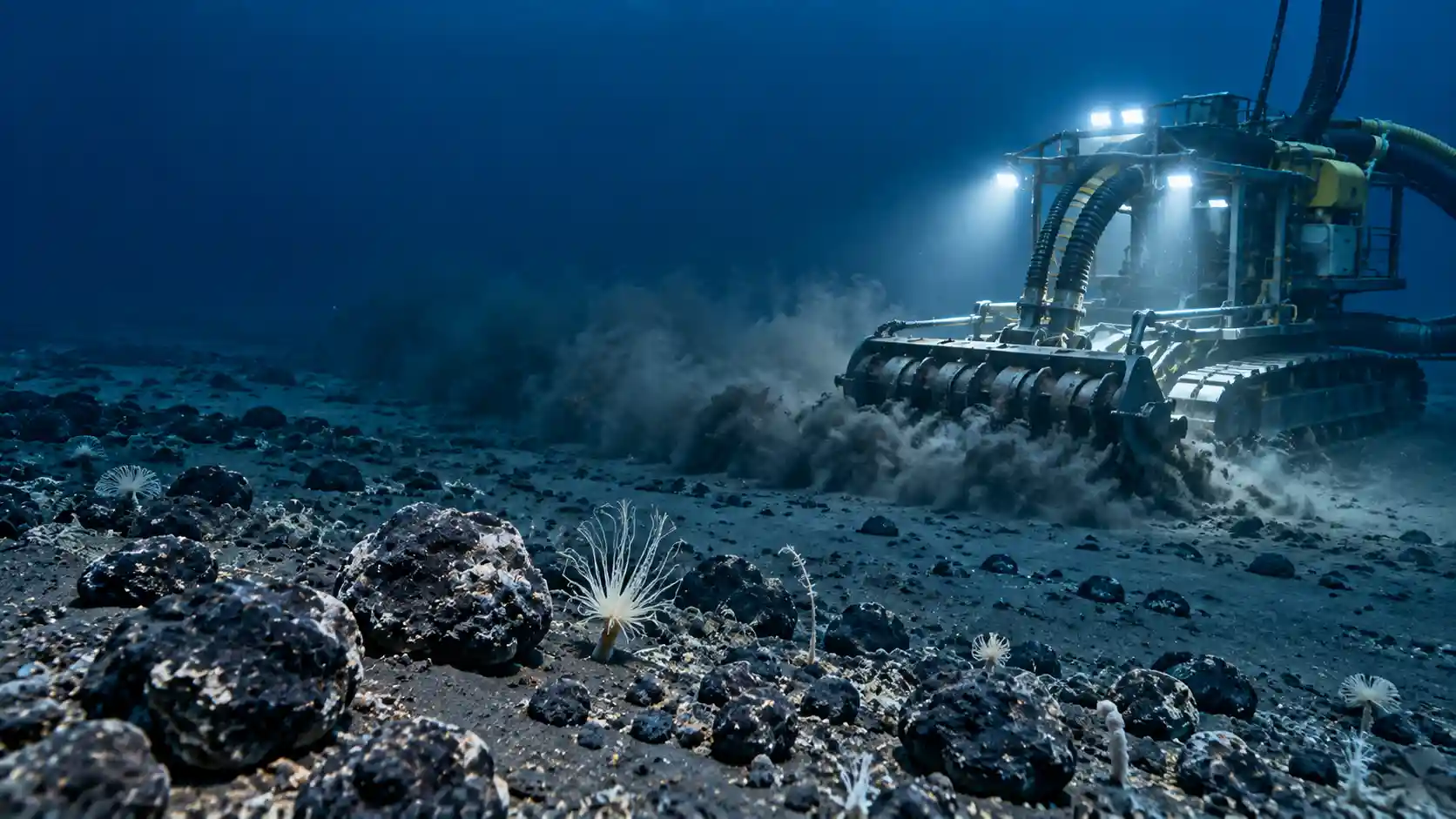
Mining concepts generally involve large collector vehicles moving across the seabed, gathering nodules and transporting them through riser systems to surface vessels.
The physical concept is relatively straightforward.
Its ecological consequences are much harder to predict.
The deep ocean is characterized by extreme pressure, darkness, low temperatures and slow biological processes.
Many species are poorly documented.
Some organisms use the nodules themselves as hard substrate in an environment otherwise dominated by soft sediment.
Removing the nodules therefore does not simply remove mineral ore.
It removes habitat.
A modern mining trial produced measurable biodiversity losses
One of the strongest recent datasets comes from a 2022 industrial-scale collection test in the eastern Pacific.
A prototype commercial mining system operated at approximately 4,280 metres depth and recovered more than 3,000 tonnes of polymetallic nodules.
Researchers later compared biological conditions before and after the trial.
A study published in Nature Ecology & Evolution in 2026 found that macrofaunal density inside the mining tracks fell 37% following the test.
Species richness declined by 32% directly inside the tracks.
Researchers did not find evidence of reduced overall faunal abundance in the nearby plume-affected area during the short observation period, but they did find changes in community dominance relationships.
The experiment does not tell scientists everything that would happen during years of commercial mining.
Its footprint was smaller and its observation period much shorter than a full commercial operation.
But it provides direct evidence that industrial-style nodule collection substantially changes communities living in the mined seabed.
Damage can remain visible more than four decades later
Another study produced an even more striking result.
Researchers returned to the site of an experimental Pacific nodule-mining test conducted in 1979.
Forty-four years later, the physical mining tracks remained visible on the seabed.
Some groups of organisms had begun recolonizing disturbed areas.
Other biological impacts persisted.
The researchers concluded that directly disturbed deep-sea communities can remain altered for at least decades even where partial biological recovery occurs.
The study also found that some plume-affected areas outside the directly mined tracks had recovered more substantially.
This distinction matters.
The strongest long-term evidence does not show that every ecological effect remains equally severe forever.
It does show that physical alteration of the seabed and impacts in directly mined areas can persist on timescales far longer than ordinary industrial planning cycles.
For Pacific governments asking whether damage could become effectively irreversible on human timescales, that finding is central.
Commercial mining would operate at a much larger scale
Experimental mining tests disturb relatively limited areas.
A commercial operation would need to collect vastly larger quantities of nodules to sustain industrial mineral production.
That means collector vehicles could traverse enormous areas of abyssal seabed over many years.
The environmental question is therefore not simply what happens along one mining track.
It is what happens when thousands of kilometres of tracks become an industrial landscape.
Scientists would need to understand cumulative impacts, connectivity between populations, recolonization, sediment transport and the amount of unmined habitat required to support recovery.
Those questions remain active areas of research.
Sediment plumes could extend the disturbance beyond mining tracks
A collector does not operate cleanly like a machine on a factory floor.
Moving across soft abyssal sediment creates suspended particles.
Additional material can also be produced when collected nodules are processed aboard the surface vessel and residual water or sediment is discharged.
A 2025 Nature Communications study examined the possible consequences of midwater discharge.
Researchers found that mining-associated particles could dilute the nutritionally useful particles forming the base of deep midwater food webs.
Because many zooplankton feed directly on particles and many micronekton feed on zooplankton, researchers identified potential for bottom-up disruption extending into higher parts of the marine food web.
The exact impact would depend on mining technology, discharge depth, current patterns and the scale of operations.
But it shows why environmental assessments increasingly look beyond the seafloor itself.
The newest IUCN assessment raises another warning
In July 2026, the International Union for Conservation of Nature reported that 62% of the world's assessed endemic hydrothermal-vent molluscs were considered at risk of extinction from deep-sea mining threats.
That represented 125 of 201 assessed species.
Hydrothermal-vent mining is different from collecting polymetallic nodules across the abyssal plains of the CCZ.
The ecosystems and minerals involved are not identical.
But the assessment illustrates the vulnerability of highly localized deep-sea species.
Some vent organisms occur in extraordinarily restricted habitats.
Destroying one vent field can therefore carry a different biological significance from disturbing a habitat occupied by a species across a much larger range.
The IUCN continues to support a moratorium unless environmental risks are understood and the marine environment can be effectively protected.
Scientists are also discovering how closely animals depend on nodules
Research published in September 2026 provides additional evidence that polymetallic nodules themselves help shape deep-sea biological communities.
A study of the northwest Pacific found pronounced changes in large-animal communities associated with differences in nodule cover.
That reinforces a fundamental challenge for environmental management.
The commodity being targeted can simultaneously be part of the habitat supporting the ecosystem.
Once a nodule is removed and processed for metal, it cannot simply be returned as a functioning geological structure on a meaningful ecological timescale.
Climate effects remain less certain than direct habitat destruction
Some Pacific leaders and environmental groups also warn that disturbing seabed sediments could alter carbon cycling or other ocean processes relevant to climate regulation.
This issue deserves more cautious wording than direct biodiversity impacts.
Scientists have strong evidence that mining physically disturbs habitat and changes biological communities.
The magnitude of potential global climate effects from commercial nodule mining is less certain.
Deep-sea sediments participate in carbon processing, and experiments have documented changes in microbial and faunal communities following disturbance.
But translating those changes into a quantified effect on global atmospheric carbon remains scientifically difficult.
The uncertainty itself is one reason opponents invoke the precautionary principle.
It should not be presented as proof that deep-sea mining would necessarily produce a major global climate effect.
Fisheries are economically central to Pacific states
Pacific governments also worry about what seabed activity could mean for fisheries.
Tuna and other migratory species underpin government revenue, food security and employment across much of the region.
Large commercial nodule operations would take place far below the surface habitat occupied by most commercially targeted fish.
But sediment discharge, noise, ship traffic and changes in midwater food webs create possible pathways for broader effects.
The scale of those consequences remains uncertain.
That creates a difficult policy problem.
Waiting for complete certainty may mean waiting until industrial activity has already begun.
Acting before all evidence exists may prevent an industry that could potentially create economic value and mineral supply.
The economic argument for mining cannot be dismissed
Supporters of deep-sea mining argue that the environmental comparison should not be between seabed mining and doing nothing.
The world already mines enormous quantities of nickel, copper, cobalt and manganese on land.
Terrestrial mining can drive deforestation, habitat fragmentation, tailings risks, pollution and impacts on local communities.
A 2026 Nature Ecology & Evolution study examining future nickel production found that large amounts of projected terrestrial nickel supply could come from areas important for biodiversity and carbon storage.
Its modelling estimated that polymetallic nodules could potentially supply 21% to 28% of nickel required under one modeled energy-transition scenario.
The researchers warned that preventing deep-sea mining without simultaneously reducing mineral demand and improving terrestrial mining could increase reliance on environmentally sensitive land-based resources.
That does not establish that seabed mining is environmentally preferable.
It shows that the real comparison is complicated.
Battery chemistry is also changing the mineral equation
The argument that electric vehicles require deep-sea nickel and cobalt has weakened as battery technology evolves.
Lithium iron phosphate batteries contain neither nickel nor cobalt and have gained substantial market share.
Recycling can also return increasing quantities of battery metals to supply chains as the existing fleet of batteries ages.
At the same time, nickel remains important in many battery chemistries, stainless steel and other industrial uses.
Copper demand is expected to grow substantially through electrification.
Mineral requirements therefore remain large even if individual technologies become less dependent on specific metals.
The question is not whether the world needs minerals.
It is which resources should be developed, where they should come from and what environmental cost is considered acceptable.
Pacific history makes promises of mining wealth politically sensitive
Opponents frequently point to the region's previous extractive-industry experience.
Nauru's phosphate mining generated substantial revenue but left large portions of the island environmentally degraded.
Papua New Guinea's attempted Solwara 1 seabed-mining project became another cautionary example.
The Papua New Guinea government invested about $120 million for a stake in the project before developer Nautilus Minerals collapsed.
Commercial mining never began.
For critics, those examples show that projected resource wealth can leave governments carrying financial or environmental costs when projects fail.
Supporters argue that modern regulation and different financing structures could produce different outcomes.
Either way, the history helps explain why Pacific governments are scrutinizing economic promises alongside environmental claims.
The ISA still has no completed commercial Mining Code
The international regulatory process remains unfinished.
The International Seabed Authority regulates mineral activities in 'the Area', the seabed beyond national jurisdiction, under the UN Convention on the Law of the Sea framework.
Its Council spent July 2026 negotiating a further revised version of the exploitation regulations.
Delegates discussed environmental management, inspections, compliance, payment mechanisms, coastal-state rights, closure plans and numerous other unresolved questions.
They did not adopt the final exploitation regulations.
Instead, the Council adopted a roadmap for continued work on the outstanding issues.
The ISA's current intersessional programme extends into its 2027 session.
The Authority says its prevailing approach is that a robust Mining Code should exist before commercial activities begin under the ISA system.
The United States is pursuing a separate legal pathway
The international debate became more complicated after the United States accelerated its own seabed-mining process.
The United States has not ratified the UN Convention on the Law of the Sea and maintains a domestic legal regime for U.S. companies seeking deep-seabed mineral rights.
In September 2026, U.S. Interior Secretary Doug Burgum said the administration aimed to issue deep-sea mining permits within months as Washington seeks additional sources of critical minerals.
The U.S. push is partly linked to concerns about mineral-processing dependence on China.
No U.S. commercial recovery permit has yet been issued.
NOAA's current public records list none.
But the permitting pipeline is advancing.
The Metals Company has moved deeper into the U.S. process
The Metals Company USA has filed for exploration and commercial recovery rights covering a large area of the Clarion-Clipperton Zone.
NOAA published the company's consolidated application for an exploration licence and commercial recovery permit in August 2026.
The public-comment period runs through October 19, with a virtual public hearing scheduled for October 13.
NOAA must still conduct environmental review before final permit issuance.
The company has separately said it is working with offshore engineering group Allseas toward a commercial collection system targeted for commissioning in late 2027, subject to receiving required approvals.
That timetable increases pressure on governments and regulators because industrial technology may be ready before the international governance debate is resolved.
The U.S. pathway has geopolitical implications for Pacific states
The Pacific is already an arena of strategic competition among the United States, China and other powers.
Critical minerals add another layer.
The United States has made access to seabed minerals a priority in discussions with the Cook Islands.
China has extensive involvement in global mineral processing and also participates in ISA exploration activity.
Pacific governments therefore face pressure extending beyond environmental policy.
Seabed resources are becoming linked to supply-chain security, defence manufacturing, technology competition and diplomatic relationships.
For small island states, that can increase bargaining power while simultaneously making regulatory decisions more politically complicated.
The central question is whether damage can be managed before mining begins
Mining proponents increasingly argue that modern collector systems can be designed to reduce environmental disturbance compared with older experimental machines.
The 44-year recovery study itself notes that older test equipment disturbed sediments differently from some modern designs and that minimizing direct collector impacts could reduce ecological damage.
That possibility is important.
Environmental harm is not necessarily fixed at one level regardless of technology.
Collector design, operating speed, sediment discharge, areas protected from mining and monitoring requirements can all influence outcomes.
The unresolved issue is whether those measures can reduce impacts sufficiently to meet legal and ecological standards across commercial mining areas.
Some impacts cannot be engineered away easily
Even an extremely efficient collector has to remove nodules if the business is to produce minerals.
That creates a basic ecological trade-off.
If organisms depend on nodules as habitat, removing the resource inherently removes part of the ecosystem.
Engineering may reduce unnecessary sediment disturbance.
It may control plume behaviour.
It may reduce noise or improve monitoring.
It cannot mine a nodule while simultaneously leaving that same nodule in place as habitat.
This is why environmental debate increasingly focuses on scale, protected reference areas and acceptable levels of ecological change rather than an assumption that mining can have zero impact.
Baseline science remains a major gap
Regulators also have to know what exists before they can measure what mining destroys.
The deep ocean remains one of Earth's least characterized environments.
New species are regularly discovered during exploration campaigns.
Population ranges are often uncertain.
Long-term ecological cycles can be difficult to measure because field research at four or five kilometres depth is expensive and technically demanding.
Scientists writing in Nature in April 2026 argued that commercial mining should not proceed without adequate environmental baseline data.
Without those baselines, regulators may not know whether a population decline after mining is local, regional or potentially catastrophic for a species.
A moratorium would not necessarily end deep-sea science
The ISA has cautioned that exploration contractors currently generate substantial scientific data and that an indefinite moratorium could discourage investment in exploration research.
Moratorium supporters counter that deep-ocean science can continue independently of commercial extraction.
Both points identify a real funding problem.
Research vessels, remotely operated vehicles and deep-sea sampling programmes are expensive.
Mining companies have financed a significant amount of recent CCZ data collection because they need environmental baselines for permits.
A pause on commercial mining would therefore need to be accompanied by public or independent scientific funding if governments want research to continue at comparable scale without depending heavily on prospective miners.
The next few months could be unusually important
Several regulatory processes are now running simultaneously.
The ISA is conducting intersessional negotiations ahead of its 2027 Council meetings.
The United States is reviewing seabed-mineral applications under its domestic framework.
NOAA is taking public comments on The Metals Company's commercial recovery application through October 19, 2026.
Pacific governments are strengthening both pro-moratorium and mineral-development positions.
Scientific evidence continues to accumulate.
That means decisions once treated as a distant possibility are becoming near-term policy questions.
The Pacific debate is ultimately about who carries the risk
Mining companies could gain access to metals worth billions of dollars.
Industrialized economies could gain another source of strategic minerals.
Pacific governments could potentially receive royalties, investment or geopolitical leverage.
But if ecological damage extends across decades or national boundaries, the costs could fall on communities that never received most of the economic benefit.
That distribution of risk sits at the center of Pacific opposition.
Many island societies depend directly on the ocean for food, government revenue, culture and identity.
For them, the seabed is not merely an unexplored mineral deposit.
It is part of an interconnected ocean system on which their economies and communities depend.
Science increasingly shows that disturbance can last for decades
The available evidence still contains major uncertainty.
Researchers cannot yet describe every consequence of a commercial deep-sea mine.
But uncertainty no longer means an absence of evidence.
A contemporary industrial trial produced a 37% decline in macrofaunal density and a 32% reduction in species richness directly inside mining tracks.
A separate site remained physically altered 44 years after experimental collection.
Midwater discharge has been shown to create plausible pathways for food-web disruption.
And the newest IUCN assessment finds a majority of assessed endemic hydrothermal-vent molluscs threatened by seabed-mining pressure.
Those findings do not settle the global policy debate.
They do explain why governments demanding a pause believe the burden of proof should fall on the industry rather than on ecosystems that cannot easily be restored once removed.
Deep-sea mining has reached the point where delaying the decision is itself a decision
The world needs minerals for electricity networks, batteries, defence systems and technology.
Terrestrial mining carries serious environmental costs of its own.
Deep-sea resources could potentially diversify supply.
But the Pacific seabed contains ecosystems that evolved over immense timescales and remain only partially understood.
That leaves policymakers with no risk-free choice.
Rejecting seabed mining may shift more mining pressure onto land.
Allowing it could industrialize one of the least disturbed environments remaining on Earth before science can fully describe what may be lost.
For Pacific governments calling for a moratorium, that asymmetry is decisive.
A mineral deposit can remain on the ocean floor while research continues.
An extinct species or permanently removed habitat cannot be put back if the science later shows the decision was wrong.
Reader questions
Frequently asked questions
What is deep-sea mining?
Deep-sea mining is the proposed extraction of mineral resources from the ocean floor, including polymetallic nodules, cobalt-rich crusts and seafloor massive sulfides.
Why are companies interested in polymetallic nodules?
Polymetallic nodules can contain manganese, nickel, copper and cobalt, metals used across batteries, electrical systems, industrial equipment and other technologies.
Where is the Clarion-Clipperton Zone?
The Clarion-Clipperton Zone is a large region of the Pacific seabed between Hawaii and Mexico containing extensive polymetallic-nodule fields.
Which Pacific countries oppose deep-sea mining?
Pacific countries supporting moratorium or precautionary-pause positions include Palau, Fiji, Samoa, Federated States of Micronesia, Marshall Islands, New Zealand, Tuvalu and Vanuatu.
Do all Pacific countries oppose seabed mining?
No. Pacific governments have different policies. Cook Islands, Kiribati, Nauru and Tonga remain involved as sponsoring states in the ISA deep-seabed mineral system, while several other Pacific governments support a moratorium or pause.
Is the Cook Islands already commercially mining the seabed?
No. Its Seabed Minerals Authority says existing exploration licences allow research and resource assessment but do not authorize commercial mineral harvesting.
What environmental damage has been measured from deep-sea mining tests?
A 2026 study of a 2022 industrial trial found a 37% reduction in macrofaunal density and a 32% reduction in species richness directly inside mining tracks shortly after the test.
Can deep-sea ecosystems recover after mining?
Some organisms can recolonize disturbed areas, but research at an experimental Pacific mining site found physical disturbance and changes in biological communities still detectable 44 years later.
Why are sediment plumes a concern?
Mining vehicles resuspend seabed sediment, while processing can produce additional discharge. These particles can affect organisms beyond the direct mining track and may alter food-web relationships.
Could deep-sea mining affect fisheries?
Potential pathways include sediment discharge, noise and changes in midwater ecosystems, but the size of any commercial-fisheries impact remains uncertain and depends on mining design and location.
Has the International Seabed Authority approved commercial mining?
The ISA had not adopted final exploitation regulations as of September 2026. Its July Council session continued negotiations and established a roadmap for resolving remaining Mining Code issues.
Has the United States issued a commercial deep-sea mining permit?
NOAA currently lists no existing commercial recovery permits, although multiple applications are moving through the U.S. review process.
Is The Metals Company allowed to begin commercial mining now?
No. Its U.S. applications remain under regulatory and environmental review. Commercial operations would require the relevant approvals.
Why does the United States support development of seabed minerals?
The U.S. government has linked seabed minerals to critical-mineral supply security, industrial needs, defence applications and reducing dependence on concentrated foreign processing supply chains.
Could deep-sea mining reduce land-based mining?
Potentially, if seabed minerals replace some terrestrial production. A 2026 nickel study found polymetallic nodules could supply a meaningful portion of modeled future nickel demand, but the environmental trade-off between land and seabed mining remains contested.
Why do governments call the potential damage irreversible?
Direct removal of nodules eliminates habitat, deep-ocean geological and biological processes are extremely slow, and experimental disturbances have remained visible for decades.
How many countries support a pause on deep-sea mining?
The International Seabed Authority currently says 46 countries have formally called for a moratorium or precautionary pause.
What happens next in the deep-sea mining debate?
ISA negotiations continue toward its 2027 sessions, while the United States is separately reviewing commercial and exploration applications and scientific research on environmental impacts continues.
Nexuswild welcomes factual corrections. Email [email protected] with evidence and the article URL.