
Asian semiconductor stocks had drops on Tuesday, October 13 because investors were thinking again about what will happen with artificial intelligence hardware after news that a Chinese memory-chip company called ChangXin Memory Technologies made some progress. The KOSPI, which is the stock index in South Korea ended the day down about 5.46% after going down more than 7% during the day. Big memory makers like SK Hynix and Samsung Electronics had drops. The selling also happened with US-based semiconductor companies. This showed worries about competition, how much the companies are worth and how long the growth from AI will last.
The reason for the drop was news that ChangXin Memory Technologies had made progress on a design for DRAM, which is a kind of memory that helps computers and other devices work faster. This new design is supposed to hold memory in the same space. This made people think if Chinese companies might one day be able to challenge the companies in parts of the memory market.. The progress does not mean that ChangXin Memory Technologies can make the same amount of memory or the same high-quality products that the big companies make.
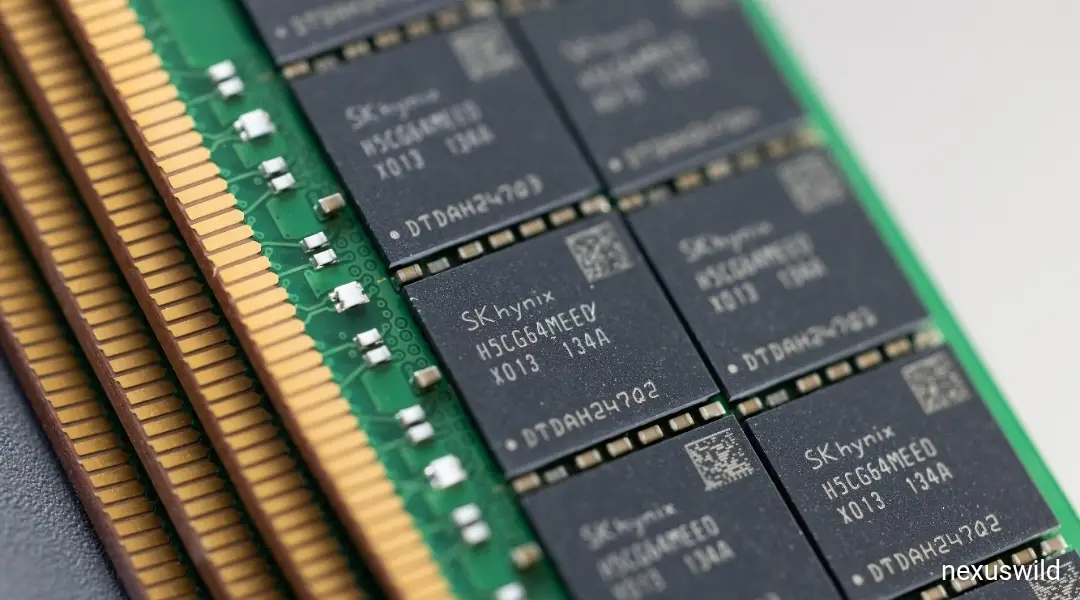
Korean chipmakers had some of the biggest drops because their stock market depends a lot on companies that make semiconductors. The shares of SK Hynix went down about 10.1%. Samsung Electronics shares dropped about 7.4%. These two companies are suppliers of memory for phones, computers, servers and AI systems. Their drops had an effect on the KOSPI.
The KOSPI went down than 7% during the day but recovered some by the end. This showed how fast investor feelings can change when a group of companies has uncertainty about profits.
The drop wasn’t because the companies had suddenly gotten worse at what they do. Instead investors were thinking about how future competition might affect how much the companies can charge for memory, how market share they can keep and how much profit they can make.
ChangXin Memory Technologies is the DRAM maker in China and part of China’s effort to make more of its own semiconductors. DRAM is used to hold data that a processor needs quickly. It is used in computers, phones, servers and AI systems. Reports said that ChangXin Memory Technologies had made progress on a 4F² DRAM cell design, which is meant to fit memory cells in the same space. More density can make memory from a single wafer but the business benefits depend on how hard it is to make how well it works and the cost.
ChangXin Memory Technologies is also trying to make server-grade DDR5 memory by the end of 2026. That is a goal for the future, not a sign that they have already made a product that's ready for sale.
This difference is important because having a design is only one part of making semiconductors. A company also needs to make sure that the product works well is reliable and can be made in quantities.
It is not clear how quickly the progress from ChangXin Memory Technologies could change the global memory market.
Investors are worried that memory prices could go down
The memory business has been doing well because more people are using AI and building data centers. These systems need a lot of memory which gives companies a chance to do well.
Investors have hopes for companies that are in a good position to benefit from the AI boom.
If a new company comes along that can make memory. Sell it for less the big companies could have trouble with their profits or lose some of their customers.
The impact would be different for different types of memory. Regular DRAM, server-grade DDR5 and high-bandwidth memory used in AI systems all have needs and ways of being made.
A better design for DRAM doesn’t mean that the company is good at making high-bandwidth memory. HBM needs engineering, advanced packaging and being part of complex computer systems.
So ChangXin Memory Technologies’ progress is a way to compete but not proof that the big companies are about to lose their place in every part of the memory market.
The drop spread to US semiconductor companies
The drop didn’t just happen in South Korea. A US company that makes memory, Micron Technology dropped about 4.5% on Tuesday. Other companies like SanDisk, Seagate Technology and Western Digital also had drops. The Philadelphia semiconductor index went down for the day in a row according to Reuters.
This shows that investors were thinking about than one problem. Along with the possibility of competition from China semiconductor stocks were also dealing with worries about high prices and the amount of money needed to keep building AI systems.
Technology companies are spending a lot on data centers, processors and other systems. These investments depend on the belief that future demand and money will make the investments worth it.
If people start to doubt that prices can drop even if companies still have sales. This can make semiconductor stocks very sensitive to competition.
AI demand is still strong. What people expect is changing
The drop doesn’t mean that demand for AI systems has gone away. Memory is still needed for systems that use a lot of data and the need for systems is still helping the industry have good future chances.
The question is whether that demand will bring in much profit as people think it will.
The industry is trying to find a balance. Strong demand can help keep prices high and encourage investment but more factories can mean more supply. If supply grows faster than demand prices can. Profits can go down.
Competition from China could add another factor to this balance. How it affects things will depend on how the technology works, how much it costs to make and how fast it is used in the market.
For investors the main challenge is to tell the long-term threat from the idea of how quickly that threat might come.
What happens next?
Investors will be looking for information from ChangXin Memory Technologies proof that they can make memory products for servers and signs of how fast they can make more.
What happens with Samsung Electronics, SK Hynix and Micron is also important how they are doing with making better memory making it more efficiently and making products for AI work.
The next part of the competition will depend not on if ChangXin Memory Technologies can make a better memory design but if they can make products that are good and cheap enough to make in big amounts.
For now the drop, on October 13 shows how sensitive the prices of semiconductor companies have become to any news that might change the balance of what people expect from AI-driven demand, future supply and the profits of the industry.
Nexuswild welcomes factual corrections. Email contact@nexuswild.com with evidence and the article URL.