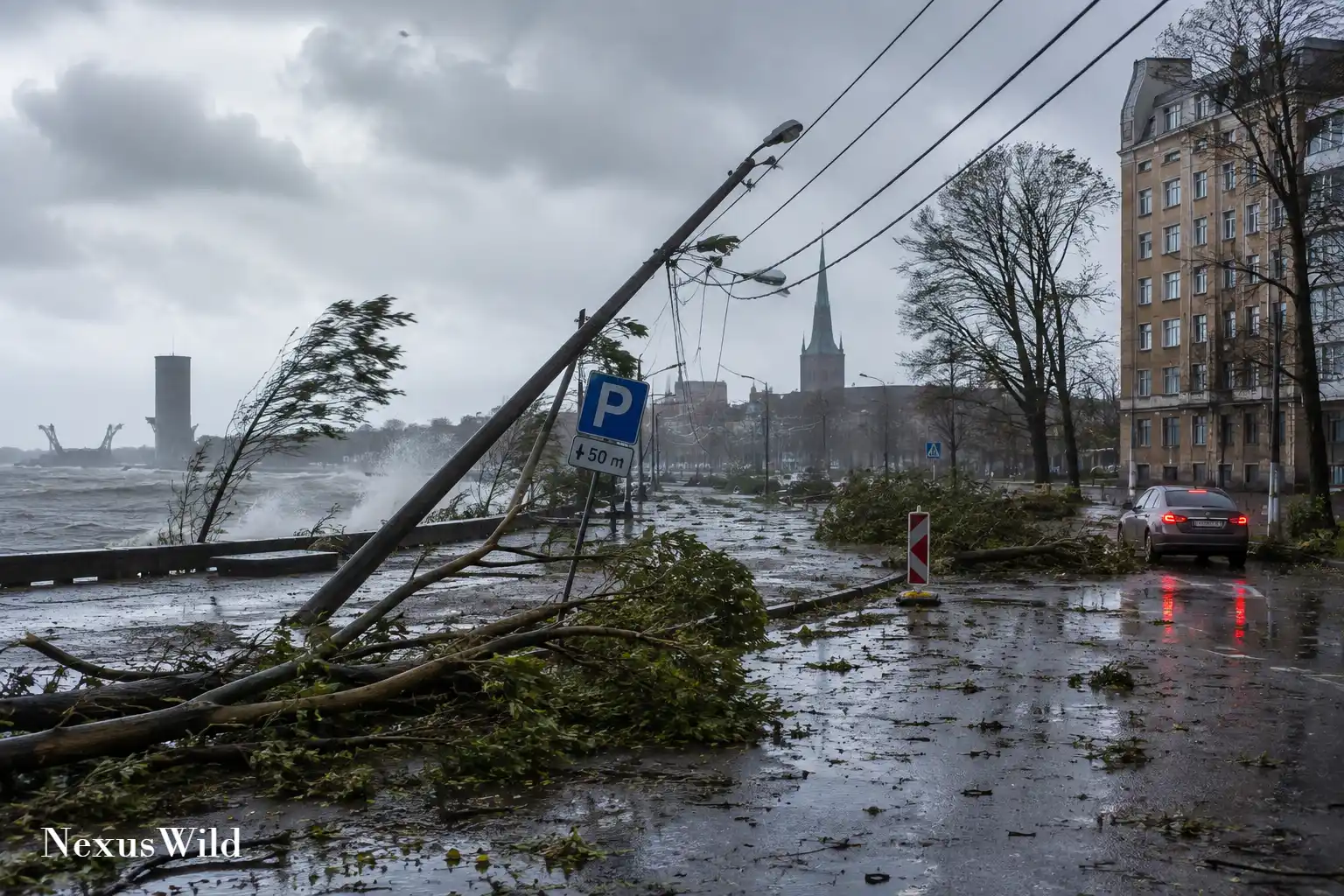

RIGA — Emergency crews were restoring electricity and clearing damaged roads across the Baltic states on Tuesday after a powerful cyclone brought destructive winds, torrential rain and widespread disruption to Latvia, Lithuania and Estonia.
Casualties and Extreme Weather
Two deaths have been verified. One person was killed when part of a building collapsed in Jelgava, Latvia, while a man died after being struck by a falling tree in Lithuania’s Anykščiai district. Authorities reported injuries in Latvia and Lithuania, but no consolidated regional injury total had been released. Estonia reported no serious injuries.
The storm moved north across the region on August 22 and into the following morning. Wind gusts exceeded 30 metres per second, or 108 kilometres per hour, in Riga and parts of Estonia. Several Latvian monitoring stations recorded about half their average monthly rainfall in one day, while flooding developed beneath Riga viaducts and on roads elsewhere.
Power and Infrastructure Disruptions
Approximately 277,000 electricity customers lost power in Latvia at the height of the storm, according to distribution operator Sadales tīkls. Lithuania’s ESO recorded a peak of about 268,000 affected customers. Together, the figures exceeded half a million.
Restoration work continued on August 25. Latvia had reduced its outage total to about 31,000 customers after restoring supplies to more than 250,000. More than 200 repair crews were working on damaged lines, supported by teams from Estonia. In Lithuania, ESO data reported by local media showed about 79,000 customers still awaiting reconnection, down from the peak of 268,000. Latvian Public Media said fallen trees, broken wires and damaged power-line supports were complicating repairs.
Mobile networks were also affected, particularly where backup power at base stations was exhausted.
Transport Delays and Cleanup Efforts
Fallen trees damaged buildings, vehicles, roads and rail infrastructure. Public transport was diverted in parts of Riga, while some Latvian rail services remained disrupted on Monday. Cross-border trains experienced delays, and Riga Airport warned that flights could be delayed or diverted during the worst conditions.
Estonian island ferry services were cancelled during the storm but had resumed by Sunday morning. Estonia’s electricity outages fell from 3,410 households on Saturday evening to 22 by Monday morning, according to Estonian Public Broadcasting.
Latvia’s Environment, Geology and Meteorology Centre described it as the country’s strongest summer storm since at least 1966. Cleanup operations are expected to continue, with Riga authorities warning that clearing damaged trees from parks and forests could take more than a month.
Further reading and useful links
Reader questions
Frequently asked questions
How many people died in the Baltic storm?
Two deaths have been verified. One person died in Latvia from a building collapse, and another died in Lithuania after being struck by a falling tree.
How widespread were the power outages during the storm?
At the height of the storm, over half a million customers lost power. Latvia saw approximately 277,000 outages, while Lithuania recorded a peak of about 268,000.
How severe was the storm compared to historical weather events in the region?
Latvia’s Environment, Geology and Meteorology Centre described the cyclone as the country’s strongest summer storm since at least 1966.
Nexuswild welcomes factual corrections. Email contact@nexuswild.com with evidence and the article URL.