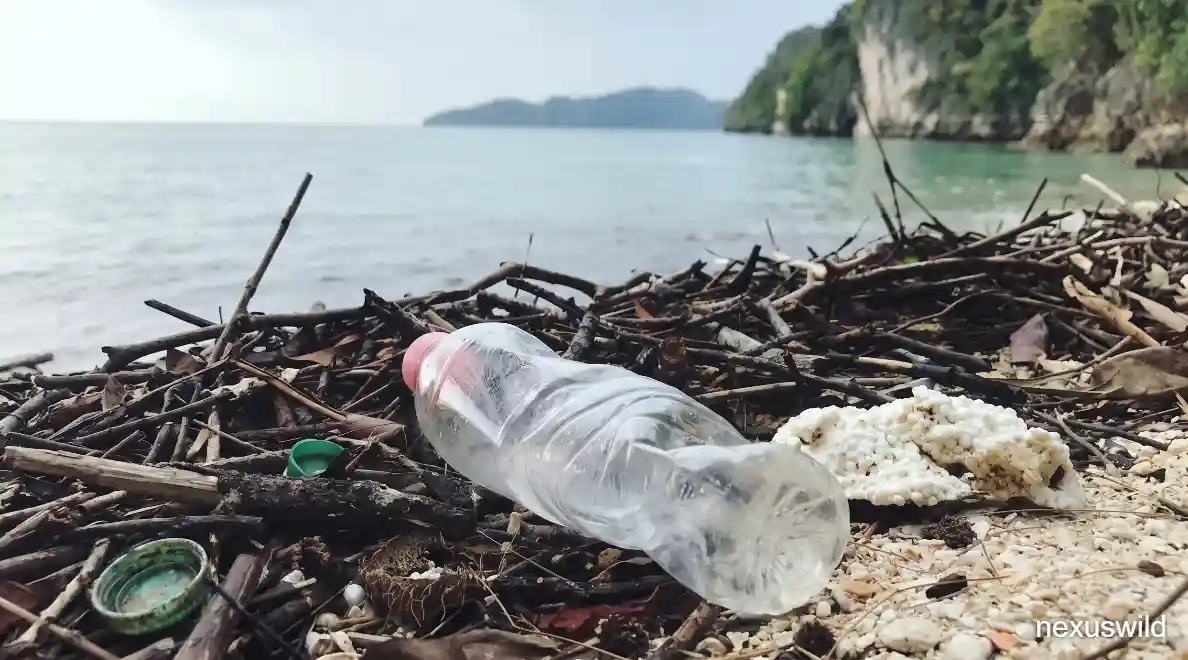

Plastic is built to last, which is exactly the problem once it becomes waste. Most of it is burned, buried or left to fragment into microplastics, because microbes have had little time to evolve ways to eat materials that did not exist a century ago. This month, researchers in Germany reported a new enzyme that suggests some bacteria are adapting faster than expected, though not in the way a headline might suggest.
What was found
A team at the University of Konstanz sequenced DNA from soil microbial communities growing on plastic and identified an enzyme they call LCPH1. Structural modelling with AlphaFold3 showed an unusually wide, open active site, the part of an enzyme that grips what it is breaking down. That shape earned it the nickname "Pac-Man enzyme". The work was published in The ISME Journal.
In laboratory tests, the purified enzyme broke the polyester PE-2,18 into its basic building blocks. The plastics involved are long-chain aliphatic polyesters, a plant-based family of bioplastics developed by chemist Stefan Mecking's group, which collaborated on the study. The enzyme also carries signals suggesting it sits on the outside of bacterial cells, which could let a microbe digest plastic right at its surface.
The penicillin twist
The enzyme has a second ability. It also broke down penicillin G and ampicillin in the lab, and it closely resembles a class of proteins bacteria use to defeat penicillin antibiotics. That led to headlines linking plastic digestion and antibiotic resistance.
The study does not show that. Breaking down penicillin in a test tube does not prove the enzyme protects living bacteria from antibiotics, and the work does not establish that exposure to biodegradable plastics increases antibiotic resistance in the environment. It is a lead for further research, not a finding.
Senior author David Schleheck said the finding is encouraging because bacteria "seem to be able to adapt to breaking down polyester plastics faster than we expected." He also described the "plastisphere," the community of microbes living on plastic waste, as a new habitat in the environment.
What it does and doesn't mean
The enzyme works on materials with chemical bonds that microbes can cut, such as the ester links in polyesters. According to a report of the study, biodegradable materials, including the bioplastics and others such as PHBV and PCL, broke down completely in roughly 250 to 330 days in laboratory tests, cellulose in about 80 days, while the high-density polyethylene tested showed almost no degradation. Those timescales come from secondary reporting, not the paper itself.
So this is not an enzyme that eats ordinary plastic bags or bottles. The researchers' practical conclusion is about design: if plastics are made with built-in breakpoints that microbes can attack, biological recycling becomes realistic.
Other enzyme work, and a caution
This is one of several recent efforts. In September, an Aarhus University group reported CCPUR1, an enzyme from compost that attacks polyurethane and nylon, two plastics that are very hard to recycle. It is still slow: in three days it broke down just under 1 percent of powdered mattress foam, and a redesigned version managed about 1.4 percent of polyurethane from a real shoe sole.
In early October, researchers writing in Nature urged caution about claims that bacteria or enzymes can degrade polyethylene or PVC, calling for stricter ways to verify such results. Another team described progress on enzymes that cut PET and polyurethane into reusable components under mild conditions, which could allow plastic to be reused as raw material. These are recommendations and lab results, not commercial processes.
What happens next
Nothing here is ready for a recycling plant. The open questions are speed, scale, cost and whether enzymes can work on real, mixed plastic waste instead of purified test materials. The Konstanz finding is most useful as evidence that natural enzymes can adapt to man-made polymers, and as a push toward designing plastics that are easier to break down in the first place.
Nexuswild welcomes factual corrections. Email contact@nexuswild.com with evidence and the article URL.