
China accounted for 94% of global production of sintered rare-earth permanent magnets in 2024, giving the country an unusually concentrated position in a component used across electric vehicles, wind turbines, industrial equipment, data centres and defence technologies.
The figure comes from the International Energy Agency's 2026 assessment of the rare-earth supply chain.
It requires an important qualification: China did not produce 94% of every rare-earth material worldwide. The figure specifically refers to sintered permanent magnets associated with magnet rare earths, particularly neodymium, praseodymium, dysprosium and terbium.
Further upstream, China's share was smaller but still substantial. The country produced about 60% of globally mined magnet rare earths in 2024 and approximately 91% of refined output, according to the IEA.
The concentration becomes greater at each major downstream step, illustrating why governments increasingly view magnet manufacturing, rather than mineral deposits alone, as a strategic supply-chain issue.
Why Rare-Earth Magnets Matter
Rare earths comprise 17 chemically related elements, but only a subset is central to today's highest-performance permanent magnets.
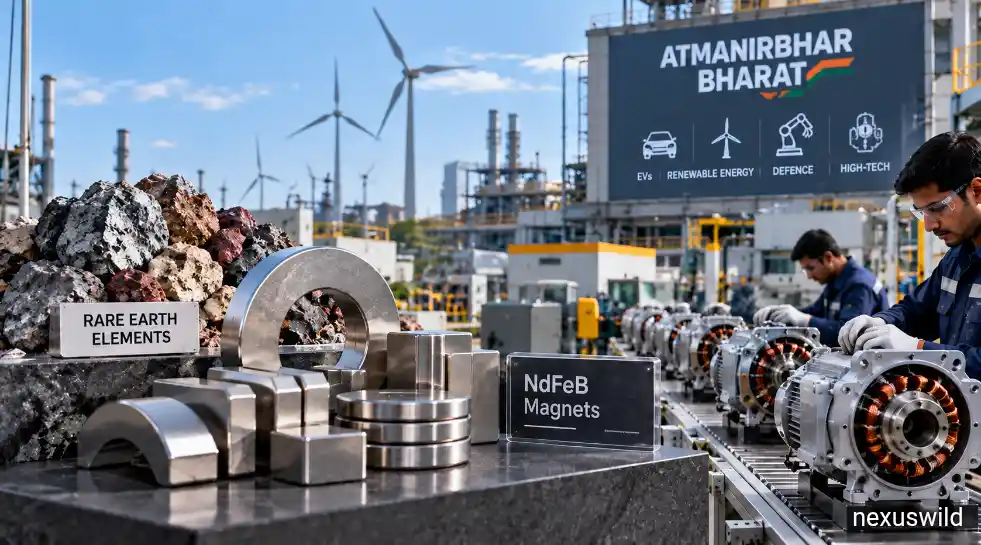
Neodymium and praseodymium form the core of many neodymium-iron-boron, or NdFeB, magnets. Dysprosium and terbium can be added to improve performance at higher temperatures.
The resulting magnets can produce strong magnetic fields relative to their size and weight, making them particularly useful where efficiency, compactness and precise motion control matter.
The IEA estimates permanent magnets account for roughly 95% of total rare-earth consumption by value, making them the industry's most strategically important application.
China’s Position Extends From Mines to Finished Magnets
China's strength does not begin or end with mining.
The rare-earth value chain starts with extraction and beneficiation before moving through chemical processing, separation into individual rare-earth oxides, metal production, alloying and finally magnet manufacturing.
China represented about 60% of mining for the four principal magnet rare earths in 2024.
Its share climbed to 91% at the refining stage, where chemically similar rare-earth elements must be separated into usable individual materials.
China then accounted for 94% of global sintered permanent-magnet production.
The change over time is significant. The IEA estimates that China's share of sintered permanent-magnet manufacturing was around 50% in 2005.
That means the country's dominant position was built not merely through geological resources but through two decades of investment in processing, metallurgy, manufacturing expertise, equipment and a large domestic industrial customer base.
Electric Vehicles Depend on High-Performance Magnets
Permanent-magnet motors are widely used in electric vehicles because they can deliver high efficiency and power density without requiring an external electrical supply to create the rotor's magnetic field.
Not every EV uses a rare-earth permanent-magnet motor. Alternative motor architectures exist and manufacturers can redesign systems to reduce or eliminate rare-earth content.
But NdFeB magnets remain important across a substantial part of the EV market.
The magnet supply chain therefore sits several stages removed from the battery supply chain but is still important to vehicle electrification.
Canada's critical-minerals programme estimates that an electric vehicle can use roughly 1 to 2 kilograms of permanent magnets in its motor, depending on design.
Wind Turbines Create Another Large Market
Rare-earth magnets are also used in some wind-turbine generators, particularly designs where high efficiency and compact machinery are valuable.
Direct-drive and other permanent-magnet configurations can reduce the need for some mechanical components while enabling efficient generation across changing operating conditions.
The quantities can be substantial because wind-turbine generators are much larger than automotive motors.
Canadian government data note that some modern turbine designs can use as much as 2 tonnes of NdFeB magnets, although actual material requirements vary significantly by turbine technology and configuration.
As with EVs, not all wind turbines require rare-earth permanent magnets. Different generator designs can reduce exposure to these materials.
Data Centres Add a Less Visible Source of Demand
Rare-earth magnets are not primarily used inside AI processors themselves, but they are important to some of the physical infrastructure surrounding modern computing.
High-performance permanent magnets appear in motors, cooling equipment, pumps, fans, storage systems and other precision electromechanical devices.
The IEA now explicitly includes AI data centres among the strategic applications supported by high-performance NdFeB magnets. Automation and robotics are expected to add further demand as digital infrastructure expands.
This makes rare-earth supply relevant not only to clean energy but increasingly to the physical infrastructure supporting artificial intelligence and advanced computing.
Defence and Aerospace Raise the Strategic Stakes
The same characteristics that make NdFeB magnets useful in efficient commercial motors also matter in aerospace and defence applications.
Permanent magnets can be found in specialised motors, actuators, sensors and other precision systems.
The IEA identifies defence, aerospace and medical equipment among the sectors dependent on rare-earth technologies.
That combination of civilian and defence demand is one reason governments increasingly treat rare-earth processing and magnet manufacturing as an economic-security issue rather than an ordinary commodity trade.
A disruption affecting a relatively small volume of magnet material can potentially interrupt production of much higher-value finished equipment.
Export Controls Demonstrated the Concentration Risk
The risks became more visible in April 2025, when China introduced export controls covering seven heavy rare-earth elements, related compounds and certain magnets.
The restrictions required export licences rather than imposing a universal ban.
The IEA says exports of affected materials and magnets fell sharply during April and May 2025. Manufacturers in several importing regions experienced difficulty obtaining magnets, and some automotive facilities reduced utilisation or temporarily interrupted production.
Exports later recovered as licences were granted.
China announced a wider set of controls in October 2025 covering additional elements, technology and products containing Chinese rare-earth inputs. Those expanded measures were subsequently suspended for one year in November 2025.
Chinese authorities have nevertheless continued to administer controls on specified rare-earth materials, including certain permanent-magnet products containing dysprosium or terbium.
The episode demonstrated that supply-chain exposure is about more than annual production totals. Licensing delays alone can create problems when alternative sources are limited.
Diversification Is Harder Than Opening a New Mine
Rare-earth deposits exist in many countries.
The harder challenge is developing the industrial chain required to turn ore into magnets that meet demanding technical specifications.
The IEA says mining capacity outside China has the strongest pipeline. Existing and announced projects could take diversified magnet-rare-earth mining capacity beyond 50,000 tonnes of rare-earth content by 2035, led by the United States and Australia, with additional projects in countries including Brazil, Tanzania and India.
Processing develops more slowly.
The corresponding diversified refining and separation pipeline totals less than 40,000 tonnes, while announced production of metals, alloys and finished magnets amounts to only about 18,000 tonnes on a rare-earth-content basis.
The result is a potential mismatch: countries may successfully mine more rare earths while remaining dependent on overseas refining or magnet factories.
The United States Is Building Domestic Magnet Capacity
The United States is attempting to rebuild several parts of the supply chain simultaneously.
MP Materials operates the Mountain Pass rare-earth mine in California and began manufacturing NdFeB magnets on commercial-scale equipment at its Independence facility in Fort Worth, Texas, in December 2025.
In February 2026, the company announced plans for a new magnet-manufacturing campus in Northlake, Texas, backed by more than $1.25 billion of planned company investment.
The project is intended to expand domestic production of rare-earth metals, alloys and finished magnets, although the new facility remains a development project rather than existing production capacity.
The US Department of Energy has also committed public funding to rare-earth processing, recycling and magnet technologies, including $72 million announced in June 2026 for research into domestic critical minerals and advanced magnet production.
Europe Is Building Magnet Manufacturing of Its Own
Europe is pursuing a similar strategy through the Critical Raw Materials Act and direct support for industrial projects.
In September 2025, a new rare-earth permanent-magnet factory opened in Narva, Estonia, with financial support from the European Union's Just Transition Fund.
The European Commission described it as Europe's largest rare-earth magnet factory at opening and said it was intended to supply industries including electric vehicles, wind turbines and microelectronics.
The EU has also selected strategic critical-material projects intended to increase domestic extraction, processing and recycling while diversifying imports.
The Critical Raw Materials Act sets 2030 benchmarks under which the bloc aims to develop extraction capacity equivalent to at least 10% of annual strategic-material consumption, processing capacity of 40% and recycling capacity of 25%.
Those are policy targets, not current production shares.
Australia Is Expanding Rare-Earth Refining
Australia is already an important rare-earth mining country but is trying to capture more of the downstream processing chain.
Iluka Resources is building the Eneabba Rare Earths Refinery in Western Australia with support from a A$1.65 billion Australian government loan.
The refinery is designed to produce separated neodymium, praseodymium, dysprosium and terbium oxides and is scheduled for commissioning in 2027.
Iluka's planned capacity includes approximately 5,500 tonnes a year of NdPr oxide and 750 tonnes of dysprosium and terbium oxide.
That project concerns refining rather than finished-magnet manufacturing, highlighting how diversification can occur at different stages of the value chain.
Lynas Rare Earths already operates an integrated Australian-Malaysian supply chain and describes itself as the only commercial producer outside China currently separating both light and heavy rare-earth oxides at scale.
Recycling Could Reduce Dependence on New Mining
Recycling is another potential source of diversification.
Permanent magnets contained in discarded motors, vehicles, wind turbines and electronic equipment can potentially be recovered and processed into new rare-earth material.
The IEA estimates that improved recycling could reduce the amount of new primary rare-earth supply required by as much as 35% by 2050.
At present, much secondary supply still comes from manufacturing scrap, and that scrap is itself concentrated in China because China manufactures most magnets.
The opportunity outside China should expand as larger volumes of EV motors, wind-turbine equipment and electronics reach the end of their useful lives.
Europe could become particularly important. The IEA projects that by 2030 the region could generate around half of global magnet scrap from wind turbines and approximately one-quarter of scrap from electric vehicles.
These are projections rather than current recycling volumes.
Demand Is Expected to Keep Growing
Demand for the four principal magnet rare earths has already roughly doubled since 2015, according to the IEA.
Under today's policy settings, the agency projects demand will rise by another one-third by 2030 as EVs, renewable energy, automation, robotics and digital technologies expand.
Outside China, magnet-rare-earth demand is projected to rise by approximately 50% by 2035.
The IEA estimates that existing and currently expected diversified capacity would still cover only around half of projected non-China mining requirements, one-quarter of refining needs and well below one-fifth of magnet demand in 2035 before additional projects are considered.
Those numbers are scenario-based projections.
They do not mean future shortages are inevitable.
Additional projects, recycling, redesigned motors, alternative magnet materials, lower demand or technological improvements could change the supply-demand balance considerably.
Why Magnet Manufacturing Is the Main Bottleneck
The 94% figure matters partly because finished magnets are technically difficult to manufacture consistently.
Producing high-performance NdFeB magnets requires control over alloy composition, powders, particle alignment, sintering, heat treatment, machining and, for some applications, specialised techniques involving heavy rare earths.
The IEA says diversified manufacturers also face shortages of specialised machinery and technical knowledge.
Equipment such as alloy strip casters, electrolysis systems, alignment presses and grain-boundary diffusion equipment can itself have limited suppliers outside China.
A country can therefore possess a rare-earth deposit without possessing a competitive magnet industry.
That is why government strategies increasingly cover the entire chain from mines and refining to metals, alloys, magnets and recycling.
Conclusion
China's 94% share of global sintered permanent-magnet production in 2024 represents one of the most concentrated manufacturing positions in the critical-minerals economy.
But the statistic needs to be described precisely.
It refers to high-performance permanent magnets built from magnet rare earths such as neodymium, praseodymium, dysprosium and terbium. It does not mean China produces 94% of all rare earths or controls every application of the 17 rare-earth elements.
Upstream, China accounted for about 60% of mining and 91% of refining for magnet rare earths in 2024. The increase to 94% at the magnet-manufacturing stage shows that the greatest concentration lies not merely underground but in the industrial capability that converts minerals into high-value components.
That matters because those magnets are embedded across EVs, wind turbines, industrial motors, data-centre equipment, robotics, aerospace and defence systems.
Export controls since 2025 have shown how quickly concentrated production can create supply difficulties when alternatives are limited.
The United States is expanding domestic magnet manufacturing. Europe has opened new production capacity and is supporting strategic projects. Australia is building additional refining capacity, while recycling programmes are being developed across several regions.
Those initiatives are beginning to diversify the chain, but they remain much smaller than China's existing industrial base.
The global challenge is therefore not simply finding more rare-earth deposits. It is developing the refining expertise, metallurgy, equipment, recycling systems and high-volume magnet factories required to turn those resources into components that modern energy and technology industries can actually use.
Nexuswild welcomes factual corrections. Email contact@nexuswild.com with evidence and the article URL.