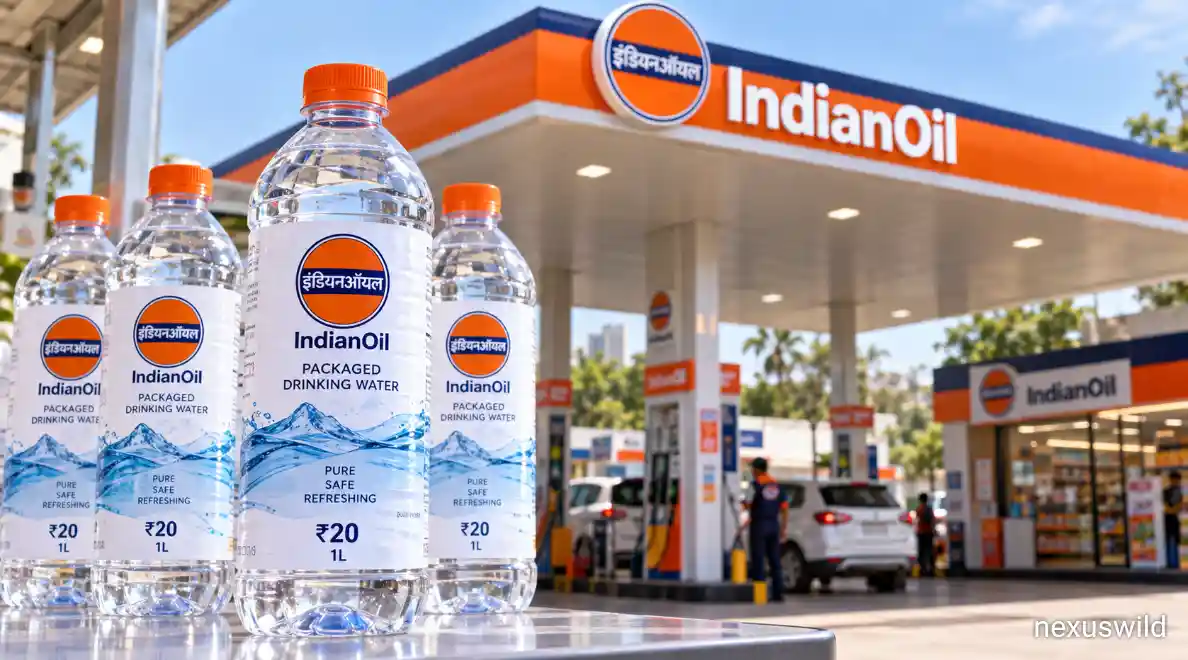

Indian Oil Corporation has explored launching its own packaged drinking water brand through its nationwide fuel-station network, signalling another attempt by India's largest state-owned oil marketing company to build business beyond petrol and diesel.
The proposal outlined a tentative price of ₹20 for a one-litre bottle, alongside smaller 500 ml and 250 ml formats. IndianOil planned to begin with highway fuel outlets before potentially extending distribution to urban, semi-urban and rural locations.
However, the plan remains at a preliminary stage. IndianOil's official supplier-notices page now lists the withdrawal of the Expression of Interest that had been issued to select aggregators for the packaged-water project. That means the previously reported rollout should not be treated as a confirmed commercial launch at this stage.
IndianOil Had Proposed Three Bottle Sizes
The original Expression of Interest, issued by IndianOil's Retail Sales division on September 18, 2026, sought companies capable of supporting the launch of IndianOil-branded packaged drinking water.
The initial range was expected to include:
- 250 ml bottles at a tentative price of ₹6
- 500 ml bottles at ₹10
- 1-litre bottles at ₹20
The prices were proposed as maximum retail prices inclusive of GST, with the one-litre bottle expected to serve as the main product.
IndianOil had also left open the possibility of later expanding into categories such as mineral water, alkaline water and other hydration products, subject to feasibility and regulatory requirements.
No final brand name for the proposed water product has been publicly confirmed.
Highway Fuel Stations Were Expected to Come First
A major advantage behind the proposal was IndianOil's existing retail footprint.
According to the Expression of Interest cited by *Business Standard*, the company had 43,603 retail outlets, including 21,435 locations on national and state highways.
The planned first phase focused on highway stations, where motorists and long-distance travellers represent a natural market for bottled water and other convenience products.
If the project were eventually implemented more widely, IndianOil would be able to use infrastructure it already has rather than building a completely new retail network.
That distribution advantage helps explain why fuel retailers increasingly view petrol stations as broader consumer-service locations rather than places used only for refuelling.
Manufacturing Would Have Been Outsourced
IndianOil was not proposing to manufacture the water directly at its own facilities.
Instead, the Expression of Interest outlined an aggregator-led model. Selected partners would arrange production through facilities approved by IndianOil and manage functions including quality assurance, packaging procurement, warehousing, logistics and supply to designated fuel outlets.
IndianOil would retain ownership of the brand, trademarks, packaging artwork and other intellectual property associated with the product.
The proposed structure also included revenue sharing.
According to the reported EOI terms, dealers were expected to receive a margin of around 25% to 35% of the maximum retail price excluding GST, while IndianOil proposed a revenue share of at least 12% of the dealer landed price, also excluding GST.
Those numbers described the proposal, not a finalized commercial agreement.
Part of a Wider Non-Fuel Revenue Strategy
IndianOil subsequently confirmed that the packaged-water proposal was intended as a non-fuel revenue initiative.
After media reports on the plan, the National Stock Exchange sought clarification from the company. IndianOil responded that it routinely examines customer-focused business opportunities using its retail network and that it had only floated an EOI to gauge aggregator interest.
The company also said that, even if implemented in phases, the proposal was not expected to have a material financial impact on IndianOil.
That clarification is significant because the water proposal represents diversification at the retail-outlet level rather than a major strategic shift away from IndianOil's core energy operations.
IndianOil already uses parts of its network for non-fuel retail products and services. Its own corporate material refers to initiatives involving food, beverages and other non-fuel offerings at retail outlets.
The EOI Has Since Been Withdrawn
The most important development since the original reports is that the packaged-water EOI is no longer active.
IndianOil's official supplier-notices page currently carries a notice titled “Withdrawal of Expression of Interest for selection of aggregator(s) for launch of IOCL branded packaged drinking water at IOCL retail outlets.”
The company has not, in the publicly available material reviewed for this article, announced that the broader idea has been permanently abandoned.
But withdrawal of the EOI means there is currently no basis to describe the ₹20 water product as having a confirmed launch schedule.
A future proposal could be revised or restarted, but that would require a fresh company announcement.
Conclusion
IndianOil's packaged drinking water proposal showed how the company could use its vast fuel-station network to pursue additional consumer businesses.
The original plan envisaged three bottle sizes, including a ₹20 one-litre bottle, with an initial focus on highway outlets and production handled by approved third-party partners.
But the project should now be described carefully.
IndianOil has officially withdrawn the Expression of Interest connected with the proposed launch, so the water brand remains an explored business concept rather than a confirmed nationwide product rollout.
The episode nevertheless highlights IndianOil's broader interest in generating more non-fuel revenue from a retail network that extends far beyond its traditional role as a place to buy petrol and diesel.
Nexuswild welcomes factual corrections. Email contact@nexuswild.com with evidence and the article URL.