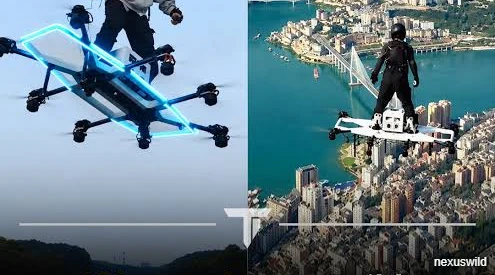

A flying machine inspired by one of Spider-Man's most recognisable fictional technologies has attracted global attention after a Chinese inventor demonstrated a homemade electric hoverboard capable of carrying a person above rivers, mountains and other outdoor locations.
Song Xingyu, a 26-year-old technology creator from Hubei province in central China, developed the experimental flying platform after becoming fascinated with the Green Goblin's glider from the Spider-Man films. Known online as Shenqi Ayu, Song spent approximately two months building the electric version, which uses 10 brushless motor units to lift and propel its rider.
Videos of the device show Song standing on the compact platform as it takes off, hovers and travels above the landscape. One widely circulated demonstration showed him flying across the Yangtze River, while other footage captured flights near mountain terrain and a river gorge.
The project has attracted attention not only because it resembles a fictional flying skateboard, but also because of the engineering process behind it. Song's development journey included a failed jet-powered prototype, an AI-assisted technical analysis and a switch to electric propulsion.
Although the invention demonstrates an unusual personal flight experiment, it remains an experimental aircraft rather than a certified consumer transportation product. Its long-term potential will depend on improvements in safety, flight duration, reliability, control systems and regulatory approval.
From Spider-Man's Green Goblin to a Real Flying Platform
The inspiration for Song's invention came from the flying glider used by the Green Goblin, a fictional character in the Spider-Man universe.
The movie device allows its rider to travel through the air while standing on a compact platform. Song wanted to recreate the central idea using available engineering components and his own understanding of mechanical systems and flight control.
Unlike conventional electric skateboards, which use wheels and ground-based movement, his platform generates lift through multiple propulsion units. The rider stands on the board while the motors produce enough thrust to raise the machine and maintain flight.
The design resembles a compact multicopter aircraft with a person positioned above its propulsion system. Its ability to lift a rider and move through the air makes it visually similar to the fictional glider, although its engineering is fundamentally different from the technology portrayed in the films.
Song is largely self-taught. Reports about his background describe him as someone who developed an interest in flight through independent learning and experimentation rather than formal engineering education.
His work has also included other unusual projects, such as a balloon-assisted high-altitude experiment and a homemade jet-powered wing. These earlier attempts demonstrate a continuing interest in personal flight technology, although they also underline the risks involved in building and testing experimental aircraft.
The First Prototype Failed During Testing
Song's first attempt at creating a flying platform relied on small turbojet engines.
The initial prototype reportedly contained five jet engines. According to accounts of the development process, the combined thrust was intended to provide enough lifting power for the rider and the platform.
However, the first major combined test ended in a serious technical failure. Although the engines reportedly operated individually, running them together caused a fire that damaged the fuel lines and electrical wiring.
The problem was linked to the arrangement of the engines. They were positioned too close together, while their exhaust outlets were relatively close to the ground. During operation, hot exhaust reportedly reflected from the ground and was drawn back towards the engines' air intakes.
This created an overheating and combustion problem that the original design could not safely manage.
The failure forced Song to reconsider the propulsion architecture. Instead of simply changing the spacing or adjusting individual components, he explored whether a different power system could reduce the risks associated with the first prototype.
The unsuccessful test became a turning point in the project. It demonstrated that generating enough thrust was only one part of the engineering challenge. The system also needed to manage heat, airflow, power delivery and stability during operation.
AI Helped Analyse the Engineering Problem
Artificial intelligence played a supporting role in the redesign process.
Song reportedly submitted the test information from the jet-powered prototype to an AI agent for analysis. The system helped identify the possible relationship between engine positioning, ground-reflected exhaust and the overheating problem.
The analysis led to a recommendation to move away from the turbojet arrangement and consider electric propulsion.
This illustrates a practical application of AI in experimental engineering. Rather than using AI only to generate text or images, a creator can use an AI-assisted system to examine test observations, organise technical information and explore possible explanations for equipment failures.
However, the role of AI should be understood carefully. The available reporting describes its involvement in analysing the prototype and providing guidance. It does not establish that the AI independently designed, manufactured or certified the flying board.
The engineering decisions, physical construction and flight testing remained part of Song's own experimental work.
The shift to electric propulsion also changed the nature of the project. Electric motors can avoid the hot exhaust and fuel-combustion problems associated with the original jet arrangement, although they introduce other engineering demands, particularly high electrical loads, battery management, heat dissipation and motor reliability.
Ten Electric Motor Units Power the New Version
The redesigned platform uses 10 brushless electric propulsion units.
Reports describe each unit as producing more than 30 kilograms of thrust. Taken together, the inventor's stated figures indicate a substantial lifting capability, although these specifications should be treated as reported experimental figures rather than independently certified performance data.
The system is designed to lift the board and its rider while providing enough control authority for low-altitude movement and hovering.
The use of multiple propulsion units is important because the aircraft must generate lift while maintaining balance. The rider's weight, the position of the motors, the distribution of electrical power and the response of the control system all influence flight behaviour.
Song has also reportedly cited a peak current of approximately 2,000 amperes. That figure illustrates the substantial electrical demand of the experimental platform, although detailed independent information about its battery configuration, operating voltage, usable energy capacity and flight endurance has not been publicly established in the reports reviewed.
These missing specifications matter because thrust alone does not determine whether a personal flying device can become practical transportation.
A machine may generate enough force to lift a person but still have limited endurance, poor efficiency or insufficient safety margins. Battery capacity, thermal management, motor redundancy and emergency landing capability are equally important.
For now, the 10-motor arrangement demonstrates that a compact electric platform can lift a rider under controlled experimental conditions. It does not establish that the design is ready for commercial use.
AI-Assisted Guidance Helps the Rider Maintain Balance
One of the most interesting elements of Song's invention is the system used to help him control his body position during flight.
Balancing on a small airborne platform is considerably more difficult than riding a conventional skateboard. A rider's movement can influence the position and attitude of the aircraft, making it important to maintain control while adjusting posture.
Song reportedly developed an assistance system using two smartphones. One device is installed within the platform to collect information about its orientation and movement. The other is carried by the rider.
The system uses this information to provide spoken instructions through Bluetooth earphones. The guidance can include prompts such as shifting the centre of gravity or adjusting the position of the knees.
This approach turns flight information into practical instructions that the rider can understand without looking at a screen.
The system is particularly relevant because the rider must focus on the environment and the platform's movement while airborne. Spoken feedback can help communicate corrections more directly.
Reports also describe the use of post-flight training feedback, with the system generating observations and recommendations after individual attempts.
However, there is an important technical distinction between AI-assisted guidance and automatic flight control. The available information describes an AI system that advises the rider on posture. It does not prove that a conversational AI model is directly controlling every motor or independently maintaining the aircraft's stability.
The underlying flight-control system must still respond to changes in balance and propulsion quickly enough to keep the platform airborne. Spoken instructions can support the rider, but they should not be confused with a fully autonomous aircraft-control system.
More Than Ten Days of Practice Before Longer Flights
After completing the electric version, Song faced another major challenge: learning to control it reliably.
The platform's movement depends on the interaction between the rider's posture and the propulsion system. Small changes in body position can affect balance, while incorrect movements can make the machine difficult to control.
Reports indicate that Song's early attempts included a failed flight that resulted in sprains and scraped knees. He subsequently spent more than 10 days practising and improving his control.
The AI-assisted feedback system became part of this training process, providing spoken suggestions during flights and observations afterwards.
During China's National Day holiday period in early October 2026, Song carried out demonstrations around his home region in Hubei province.
One notable flight took place in the Badong area, where he travelled across the Yangtze River. Local reporting described another demonstration in a river gorge that covered more than 300 metres and lasted just over two minutes.
These demonstrations attracted significant attention online. Videos of the device circulated widely on Chinese social media, and reporting described the project as one of the year's most unusual examples of independent technology experimentation.
The footage also generated questions about whether the flights were digitally created. Song publicly stated that the flying footage was genuine and that the board had been built by hand.
The demonstrations helped move the project beyond a workshop prototype, but they should still be understood as controlled experimental flights rather than evidence of a mature transportation system.
Why Electric Propulsion Matters for Personal Flight
The move from turbojet engines to electric motors highlights a wider development in experimental aviation.
Electric propulsion has attracted interest in drones, vertical take-off and landing aircraft, and other emerging aviation technologies. Electric motors can offer direct power delivery and avoid the fuel-combustion and exhaust-management requirements of traditional jet engines.
For small flying platforms, multiple electric motors can also be arranged around a structure to distribute thrust and support different control strategies.
However, electric propulsion is not automatically safer or more efficient in every application. High-power systems require careful battery design, thermal management, electrical protection and reliable control electronics.
A failure in one propulsion unit can become serious if the aircraft does not have enough redundancy or control capacity to compensate. Battery damage or overheating can also create significant hazards.
The energy required to lift a person is another major limitation. A personal aircraft must carry the rider, its own structure, motors, batteries and control equipment. The more energy it needs, the greater the challenge of providing useful flight time without making the device too heavy.
These constraints explain why a successful demonstration is only an early stage in the development of personal flying technology.
Could the Hoverboard Become a Commercial Product?
Song's project raises an obvious question: could a flying board eventually become a practical consumer product?
The concept is attractive because it promises a compact form of personal flight. A device that can lift a single rider without a conventional runway could have applications in recreational aviation, demonstrations and specialised activities.
However, everyday transportation would require much more than the ability to take off and cross a river.
A commercial product would need to demonstrate consistent flight performance, reliable emergency systems, predictable battery endurance and protection against mechanical or electrical failures. It would also need to operate safely in changing weather conditions and around buildings, roads, people and other aircraft.
Regulatory approval would be another major requirement. Authorities would need to determine how such a device should be classified, where it could operate, what training a pilot would require and what technical standards it must meet.
The current project has not demonstrated that it meets those requirements.
Its development should therefore be viewed as an experimental engineering achievement rather than the arrival of a new form of mass-market transport.
The Business Potential of Experimental Flight Technology
Although Song's flying board is not yet a commercial product, the project reflects several technology areas attracting investment and research interest.
The first is electric propulsion. Improvements in motors, batteries and power electronics are central to the development of drones and emerging electric aircraft.
The second is artificial intelligence-assisted control. Sensors and software can help pilots interpret movement data, identify unusual conditions and receive more understandable feedback during training.
The third is the growing role of independent creators in technology development. Affordable electronics, digital design tools, online technical communities and AI-assisted analysis have made it easier for individual inventors to experiment with complex engineering ideas.
Song's project also illustrates how social media can turn an experimental invention into a widely recognised technology story. Demonstration videos can attract public attention, encourage technical discussion and create opportunities for creators to work with technology companies.
However, public interest should not be mistaken for commercial readiness. A viral demonstration does not establish that a product can be manufactured safely, maintained reliably or sold under existing aviation regulations.
For businesses interested in emerging mobility technologies, the more important question is whether the underlying engineering ideas can eventually be developed into safe, repeatable and economically viable systems.
What Comes Next?
Song has indicated that he wants to continue experimenting and improve the flying platform, including attempts to fly at greater heights.
Any further development will need to address the limitations that currently separate a successful demonstration from a practical aircraft.
Flight endurance will be a major factor. Without detailed and independently verified information about battery capacity and operating time, it is difficult to assess how useful the platform could become beyond short demonstrations.
Safety will be equally important. A personal aircraft operating above rivers, roads or populated areas needs reliable emergency procedures and sufficient protection against propulsion or power-system failures.
Control systems will also require further development. AI-assisted guidance may help the rider learn, but it cannot replace the need for robust aircraft stability, predictable motor response and fail-safe engineering.
Independent testing and transparent performance data would help establish what the device can reliably achieve.
A Science-Fiction Idea Becomes an Engineering Experiment
Song Xingyu's 10-motor electric hoverboard demonstrates how a fictional concept can inspire a real engineering experiment. The project combines electric propulsion, independent mechanical development and AI-assisted feedback in a form that has captured public attention.
Its journey from a failed jet-powered prototype to an electric flying platform also highlights an important part of engineering: identifying why a design fails and changing the approach rather than simply repeating the same experiment.
For now, the device remains a specialised personal flight prototype, not a replacement for conventional transport. Its battery endurance, safety systems, reliability and regulatory status will determine whether the idea can develop further.
Nevertheless, the project offers a glimpse into how electric technology and AI-assisted engineering could influence future experiments in personal aviation. The Green Goblin's fictional glider may still be far from becoming an everyday vehicle, but Song's invention has brought the visual idea of a rideable flying board closer to reality.
Nexuswild welcomes factual corrections. Email contact@nexuswild.com with evidence and the article URL.