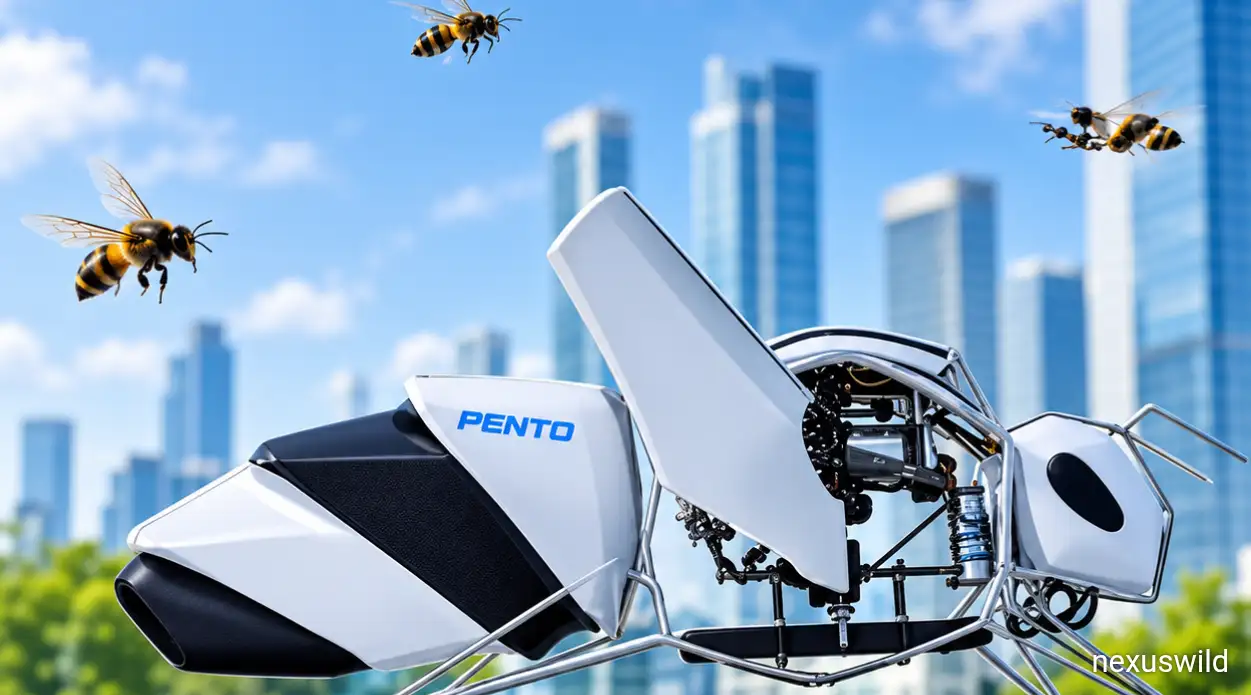

Festo's BionicBee is a 34-gram robot that beats its wings up to 20 times a second and flies in close formation with nine others. The German automation company unveiled it at Hannover Messe in April 2024, and it remains a research demonstration, not a commercial product.
Each bee is 220 mm long, with a 240 mm wingspan. It was developed by Festo's Bionic Learning Network, a research program that has studied flight for more than 15 years. Earlier flying creations from the program include butterflies, flying foxes, gulls and swifts. Festo says the BionicBee is the smallest of them and the first able to fly autonomously in large numbers. The bees performed their first flight show at Hannover Messe, which ran April 22 to 26, 2024.
At a glance
| Feature | Detail |
|---|---|
| Weight | About 34 grams |
| Size | 220 mm long, 240 mm wingspan |
| Wingbeat | 15 to 20 hertz, 180-degree stroke |
| Control | Four degrees of freedom |
| Swarm | Ten bees, tracked by eight ultra-wideband anchors |
| Built | By hand, with self-calibration after a test flight |
Source: Festo.
How a robot bee flies
A brushless motor drives the wings back and forth through a 180-degree stroke at 15 to 20 hertz. Three small servo motors at the wing roots change the shape of the wing, which changes how much lift it generates at different points in the stroke.
That is how the bee steers. More lift at the back of the stroke tilts it forward. More lift on one wing than the other rolls it sideways. Offsetting the lift between the two wings turns it. Festo says this gives the bee four degrees of freedom.
The body is also the housing. The motors, battery, gearbox and circuit boards sit inside the small frame. Festo used generative design software for the first time in the program. After a few parameters were entered, the software proposed a structure that uses as little material as possible while staying stable, which is essential for a robot this light.
How the swarm stays together
The bees do not see each other. Eight ultra-wideband radio anchors on two levels of the room send signals, and each bee measures its distance to them and calculates its position from the time stamps. A central computer sets the flight paths. Festo says it had to plan for air turbulence between neighbors, since the downdraft from one bee can disturb another.
Each bee is assembled by hand, and tiny differences affect how it flies. After a short test flight, each bee works out its own control settings. Festo says this lets the swarm be controlled from outside as if all the bees were identical.
Flying this close together demands high accuracy in both space and time, Festo says, which is why the positioning system and the central planning matter as much as the bees themselves. Festo shows a new bio-inspired project at Hannover Messe most years, New Atlas noted, and the BionicBee was the 2024 entry.
The design also has limits, which follow from Festo's own description. The bees rely on fixed anchors in the room and on a central computer for their flight paths. That makes this a controlled indoor demonstration, not a swarm that organizes itself in the open air. That reading is this article's analysis, not a Festo statement.
Building something this light
A VoxelMatters report published around August 2025 said the bee's structure was produced with EOS 3D-printing technology, and that algorithm-driven optimization cut one part from 20 grams to 3 grams, a reduction of 85%. That account comes from a supplier-linked source, and Festo's own pages do not give the figure.
A demonstrator, not a product
Festo describes the Bionic Learning Network as a research test bed. It develops principles drawn from nature that feed its automation business and technical education. It has not announced a commercial version of the BionicBee or a deployment for it.
For scale, academic insect-scale flapping robots are far smaller. A 2019 research paper described one weighing 95 milligrams, roughly 360 times lighter than the BionicBee by this article's calculation. The Festo bee is a larger demonstration of control and design, not a model for the smallest robots.
What is known and what is not
The specifications, the swarm of ten and the localization method are documented by Festo and confirmed by independent technology reporting. What is not known is whether Festo plans a commercial application, how the swarm would perform outside a prepared room with its positioning system, and whether a newer version exists. No update was found since 2024.
Nexuswild welcomes factual corrections. Email contact@nexuswild.com with evidence and the article URL.