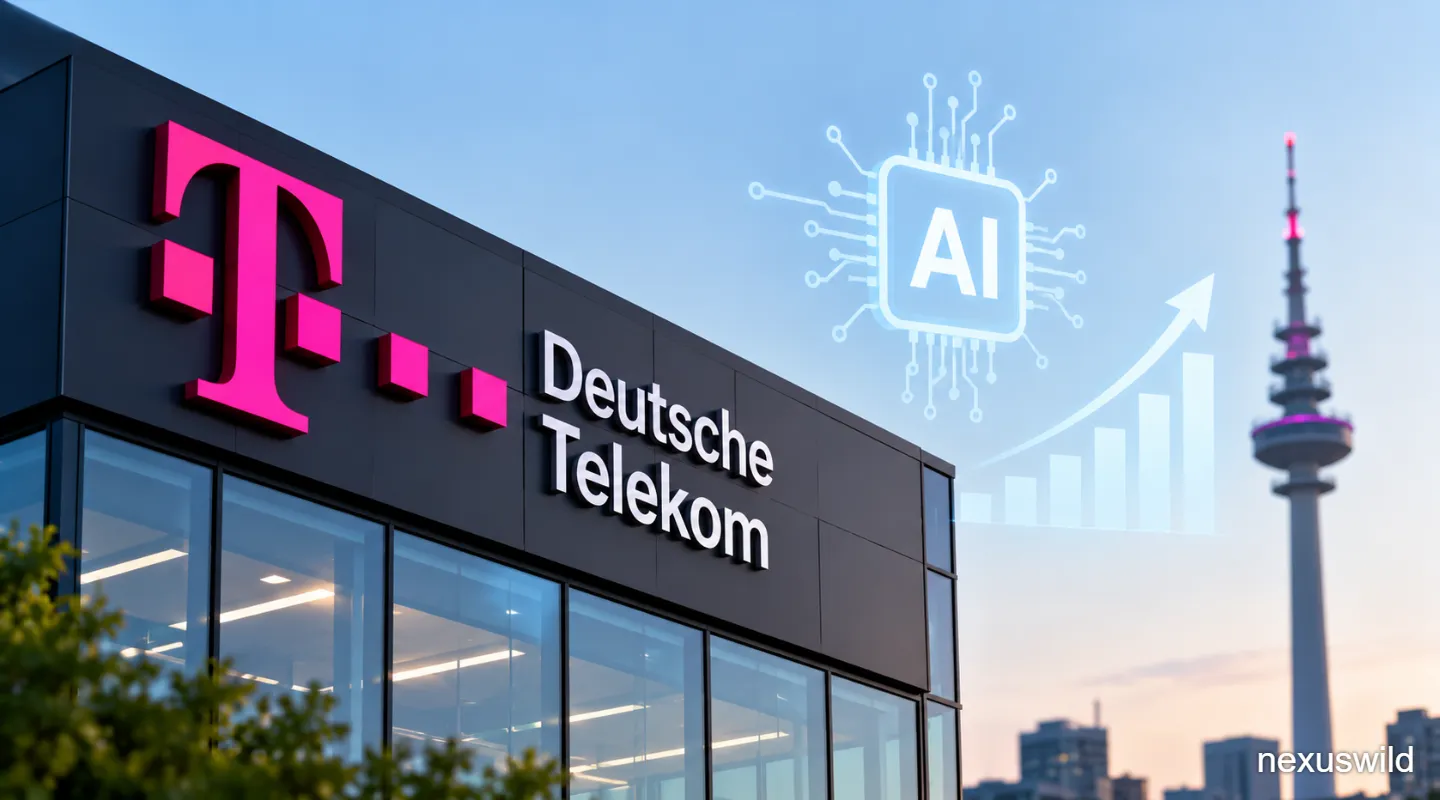

Deutsche Telekom is putting artificial intelligence and automation at the center of its efficiency strategy, targeting approximately €2.5 billion in indirect-cost savings by 2030 compared with 2023 as it expands the use of AI across network operations, customer service, software development and administrative work.
The German telecommunications group disclosed the targets at its AI Investor Day in Bonn on October 5, 2026, where executives outlined how the company plans to translate AI investment into lower operating costs, new revenue and faster service delivery.
For 2027, Deutsche Telekom expects AI and automation to generate about €1.1 billion in gross savings outside the United States, also measured against the 2023 baseline. The company said part of those savings would be reinvested in digital transformation and Germany’s fiber rollout.
Those figures are forward-looking management expectations. Deutsche Telekom has not reported €2.5 billion of realized AI savings, and the 2030 target remains dependent on the company successfully scaling the technologies across its operations.
Deutsche Telekom Sets a 2030 Efficiency Target
The €2.5 billion figure relates specifically to indirect costs, rather than total operating expenditure.
Deutsche Telekom said it plans to reach that level of savings by increasing automation in areas that involve large volumes of recurring work. The company identified network operations, customer interactions, software engineering and internal administrative processes as major areas where AI can reduce manual tasks or accelerate existing workflows.
Reuters reported that the savings target forms part of Deutsche Telekom’s broader effort to use AI not just as a product category but as an operating tool across the group.
Management has emphasized that the target is measured relative to 2023, which is important when interpreting the number. It does not mean the group expects its overall cost base to fall by €2.5 billion in absolute terms, since wages, investment, business growth and other costs can move independently.
€1.1 Billion Gross Savings Expected Outside the U.S. in 2027
Before reaching the longer-term target, Deutsche Telekom expects a significant intermediate contribution in 2027.
The group forecasts approximately €1.1 billion in gross savings from AI and automation outside the U.S. in 2027 compared with 2023.
“Gross savings” differs from the amount that would ultimately flow through to profit. Deutsche Telekom has said some of the efficiency gains will be reinvested, including in faster digital transformation and additional fiber deployment in Germany.
The company did not present the €1.1 billion figure as guaranteed earnings growth.
Instead, it represents the operating savings Deutsche Telekom expects its AI and automation initiatives to generate before considering reinvestment and other cost movements.
AI-Related Business Revenue Targeted at €800 Million
Deutsche Telekom is also trying to generate direct revenue from AI.
The company said it expects AI-related revenue from its business-customer operations outside the U.S. to reach approximately €250 million in 2026, rising to about €800 million by 2030.
That target includes services sold to corporate customers rather than the internal efficiency benefits that underpin the cost-saving projections.
Deutsche Telekom is developing AI products for business customers, including a platform aimed at small and medium-sized companies that would automate repetitive processes such as customer service and logistics tasks.
It also sees potential for AI-enabled consumer services, although the €800 million figure disclosed at Investor Day applies specifically to business revenue outside the United States.
As with the cost projections, the 2030 revenue figure is a company target rather than revenue that has already been booked.
AI Is Being Used to Detect Network Problems Earlier
Network management is one of the most developed areas of Deutsche Telekom’s AI strategy.
The company’s RAN Guardian Agent uses AI to monitor mobile-network behavior and identify rising traffic levels or other signs of strain before they create broader service problems.
Deutsche Telekom says the system has reduced the time required to manage major network events from several hours to around one minute.
The technology is designed to anticipate demand spikes around large gatherings and automatically support remedial actions.
According to Deutsche Telekom, RAN Guardian triggered more than 100 autonomous remediation actions during Christmas-market events in its first month of operation after launching in November 2025. The system was also used to identify hundreds of thousands of network events during 2026.
Those are company-reported operational results, unlike the 2030 financial targets, which remain projections.
MINDR Extends AI Across More of the Network
Deutsche Telekom is now extending the same approach beyond radio-access infrastructure.
Its MINDR, or Multi-Agentic Intelligent Network Diagnostics & Remediation platform, is designed to use multiple AI agents across radio, transport and core-network systems.
The platform, developed with Google Cloud technologies, is intended to detect anomalies, identify likely causes and coordinate corrective actions across different network layers.
The system builds on the RAN Guardian model but is meant to cover a broader share of network operations.
Deutsche Telekom has described the project as a step toward more autonomous and self-healing networks. That description reflects the company’s strategic objective rather than proof that its network currently operates without human oversight.
Customer Service Is Another Major Automation Target
Customer support is one of the largest areas where Deutsche Telekom is already applying AI at scale.
The company said its “Frag Magenta” chatbot handled about 2.6 million customer-service calls during the first half of 2026.
AI systems also assist human service representatives by retrieving relevant information during calls and handling documentation, allowing employees to focus more directly on resolving customer issues.
Deutsche Telekom says some early applications have reduced complaints by around 30% when AI is used to detect problems while customers are setting up new services.
Those figures represent specific company-reported use cases and should not be interpreted as a 30% reduction in complaints across Deutsche Telekom’s entire customer base.
U.S. Operations Provide a Larger-Scale Example
Deutsche Telekom also highlighted the use of AI at its U.S. subsidiary, T-Mobile US.
The company said the number of customer-service calls there has fallen by 55%, while AI agents now handle approximately 40% of customer contacts.
The 2027 €1.1 billion savings target, however, explicitly covers operations outside the U.S.
The U.S. figures were presented as examples of what wider automation can achieve rather than as part of the calculation behind that European and international savings target.
Software Development Is Being Accelerated With AI
Deutsche Telekom is also deploying AI inside its development teams.
The company said coding assistants and other AI tools are helping employees create software more quickly and replace older IT systems.
This use case is particularly relevant for a telecommunications group that operates a large number of legacy platforms across multiple countries.
AI-assisted development can help with coding, testing, documentation and migration work, although Deutsche Telekom has not disclosed a single groupwide productivity figure for the impact of those tools.
The financial value expected from software automation is included within its broader cost-saving ambitions rather than reported as a separate realized result.
Administrative Processes Are Also Being Automated
Internal corporate functions form another part of the strategy.
Deutsche Telekom said it is applying AI to administrative processes where large volumes of repetitive work can be standardized or automated.
The company is giving employees access to tools including AskT, ChatGPT Enterprise and Microsoft Copilot under an internal initiative called “AI for All.” More than 100,000 employees have already received AI training, according to Deutsche Telekom.
Management says the intended model is for employees to define objectives, review AI-generated results and retain responsibility for final decisions.
That approach suggests Deutsche Telekom is currently positioning AI primarily as a productivity and workflow tool rather than describing human decision-making as fully automated.
AI Is Also Becoming Part of Consumer Services
Beyond internal operations, Deutsche Telekom is building AI directly into customer-facing products.
One example is the Magenta AI Call Assistant, which is designed to provide services such as real-time translation, answering questions and summarizing phone conversations without requiring a separate application or specialized handset.
The company sees products such as these as potential sources of additional consumer revenue and new tariff structures.
Deutsche Telekom has not disclosed a standalone revenue forecast for the call assistant, however, so any future financial contribution remains uncertain.
AI Is Being Used in Marketing and Personalization
The company is also applying artificial intelligence to customer targeting.
Deutsche Telekom said AI is already being used within its Magenta Moments rewards program to provide more relevant offers and improve the way customers are segmented for marketing.
The goal is to improve customer engagement and reduce inefficient marketing expenditure.
The company has not disclosed a specific financial return generated by this use case, meaning its contribution should be treated as part of the broader efficiency and revenue strategy rather than a separately verified earnings figure.
Savings Are Intended to Support Further Investment
Deutsche Telekom is not planning to retain all of the projected efficiency gains.
Management said some of the savings generated in 2027 will be reinvested in digital transformation and in expanding fiber-optic infrastructure in Germany.
That approach illustrates why the company’s gross-savings targets should not be equated directly with higher net profit.
AI may lower the cost of running parts of the business while simultaneously allowing Deutsche Telekom to redirect spending into infrastructure or new technology.
The financial outcome will therefore depend both on how much efficiency the company achieves and how management chooses to deploy those savings.
Investor Day Focuses on Measurable Business Impact
The October 5 event was structured around specific AI applications rather than a general technology presentation.
The agenda included sessions on AI strategy, network operations, customer interactions, enterprise services, T-Mobile US and financial value creation. Chief Executive Tim Höttges and Chief Financial Officer Christian Illek were among the executives scheduled to address investors.
The event reflects an increasingly common challenge for large companies investing heavily in AI: demonstrating that the technology can generate measurable financial returns rather than simply adding new technology spending.
For Deutsche Telekom, management’s answer is a combination of lower costs, increased automation, improved service quality and new AI-linked revenue.
Whether all of those targets are reached will depend on execution through the end of the decade.
Conclusion
Deutsche Telekom is setting measurable financial goals around artificial intelligence as it moves from experimentation toward wider operational deployment.
The company expects AI and automation to generate approximately €1.1 billion in gross savings outside the United States in 2027 compared with 2023 and is targeting around €2.5 billion in indirect-cost savings by 2030 on the same baseline.
It also aims to increase AI-related revenue from business customers outside the U.S. to approximately €800 million by 2030, from an expected €250 million in 2026.
Deutsche Telekom is already using AI in network monitoring, customer service, software development and internal workflows. Its RAN Guardian technology has reduced response times for some high-traffic network events from hours to roughly a minute, while its customer-service systems are handling millions of interactions.
Those operational examples are current company-reported results. The €1.1 billion, €2.5 billion and €800 million figures, by contrast, remain forward-looking targets and should not be treated as guaranteed financial outcomes.
Nexuswild welcomes factual corrections. Email contact@nexuswild.com with evidence and the article URL.