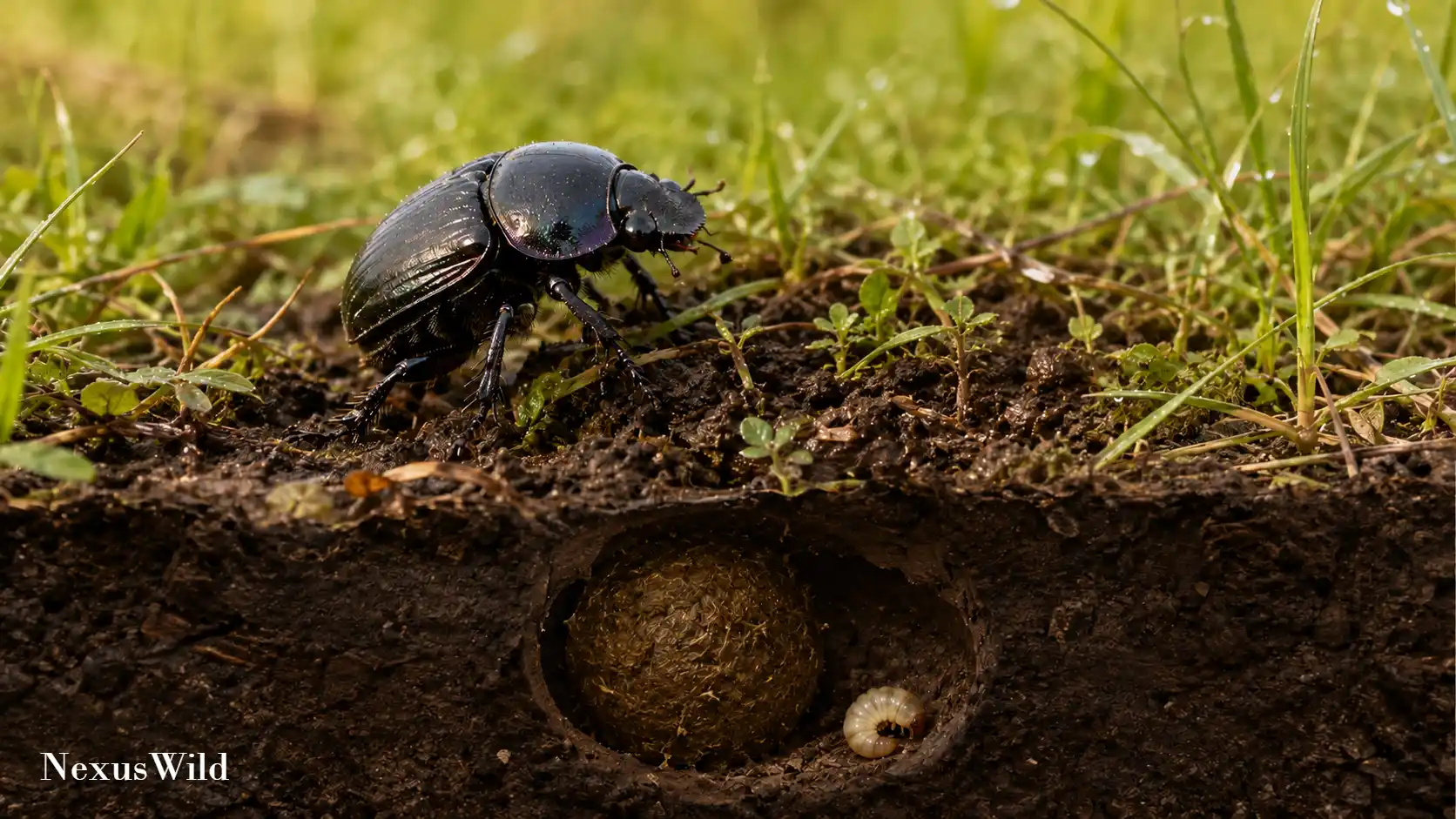
Dung beetles have a reputation for being unfussy eaters. Most species are considered generalists, willing to work with whatever dung happens to be lying around. But a study published in August 2026 in the journal Ecology and Evolution suggests that in cities, this flexibility may be leading beetles into a trap of their own making.
The Study
Researchers at Clark University in Worcester, Massachusetts, led by evolutionary biologist Erin L. McCullough along with colleagues Beatrice M. Altopp, Daniel F. Kellogg, Madelyn S. McInnis, and Luna J. Pagan, set out to understand how the urban dung beetle Onthophagus orpheus responds to a resource its ancestors never evolved with: dog waste. As cities have grown and wild mammal populations have thinned out, domestic dog dung has become one of the most abundant dung types in urban green spaces. Cow dung, by contrast, is the traditional standard used in dung beetle research and offers a useful point of comparison because it comes from a different trophic guild, a herbivore rather than an omnivore.
The team combined two approaches. First, they ran field surveys in two urban forests around Worcester, Hadwen Arboretum and Cascades Park, using pitfall traps baited with either cow or dog dung to see which one beetles preferred in the wild. Second, they brought beetles into the laboratory to test something field surveys alone cannot show: what actually happens to a beetle's offspring depending on which dung it is raised in. That combination, preference in the field and performance in the lab, is what let the researchers uncover a pattern that a survey of adult attraction alone would have missed entirely.
Dung Beetles Strongly Preferred Dog Waste
The field results were unambiguous. Across the 2024 field season, the researchers collected 452 beetles, and 67% of them turned up in traps baited with dog dung rather than cow dung. That preference held in four of the five months when adults were active, with statistically significant results in May, June, August, and September. Only in July, when beetle activity peaked for the season, did the preference disappear, with beetles showing no significant leaning toward either dung type. The researchers note this seasonal wobble might reflect temperature and moisture conditions, since cow dung holds more moisture and could become more useful to beetles during the hottest, driest part of summer, though the study did not test this directly.
Why might an omnivore's waste be so appealing? The researchers point out that dog dung, like other omnivore dung, tends to be identified as a higher quality resource in other dung beetle studies, though the exact reason (whether it is texture, nutrient content, scent, or something else) was not something this study was designed to pin down. What is clear is that the appeal was not selective by sex or body size: male and female beetles showed the same preference, and beetles drawn to dog dung were not systematically larger or smaller than those drawn to cow dung.
The Unexpected Cost to Offspring
To understand what dung type means for the next generation, the researchers moved into the lab. Female dung beetles do not just lay eggs and leave. They dig tunnels beneath a dung pad, gather dung, and mold it into a brood ball, a compact ball of food that will nourish a single larva through its entire development, from hatching to pupation to adult emergence. The quality of that one ball is essentially the only resource a beetle offspring will ever get.
The researchers gave female beetles either cow or dog dung to provision their brood balls, then tracked each ball until the larva inside either emerged as an adult or died. The results were stark: 59.3% of brood balls provisioned with dog dung failed, compared to 25.0% of those provisioned with cow dung. Mortality on dog dung was therefore more than twice as high.
It is worth being precise about what this figure means. The 59.3% mortality rate applies to brood balls in this controlled laboratory experiment, not to a measured death rate of every dung beetle that happens to encounter dog waste in a park or backyard. Wild conditions involve many variables the lab setup did not include, so this number should be read as evidence of a real and substantial cost associated with dog dung under experimental conditions, not as a global mortality statistic for the species.
A Strange Biological Trade-Off
Here is where the study gets genuinely strange. The offspring that did survive on dog dung were not worse off than those raised on cow dung. They were better off, at least by the usual measures biologists use. Beetles reared on dog dung developed faster, taking about 62.0 days to reach adulthood compared with 64.6 days on cow dung, and they emerged as larger adults, a trait that typically correlates with better reproductive prospects in dung beetles.
So dog dung produced faster, bigger beetles, but far fewer of them made it that far. The researchers call this a preference-performance mismatch: a situation in which the resource adults most want to use is also the one that most often kills their offspring before they can grow up. It is not simply that dog dung is bad. For the beetles that survive it, dog dung appears to be the better food source. The mismatch lies in the fact that adult beetles cannot detect, or at least do not act on, the much higher risk of their brood dying altogether.
Could Dog Waste Become an Evolutionary Trap?
Biologists use the term evolutionary or ecological trap to describe a situation where an animal's instincts, which evolved to guide it toward good resources, end up steering it toward something that looks appealing but actually reduces its chances of successfully reproducing. Traps like this usually arise when an environment changes faster than an animal's behavior can adapt to it. A classic example is an insect laying eggs on a shiny car hood because it resembles the surface of water.
The Clark University researchers frame their findings as consistent with this kind of trap. Dog waste is an increasingly abundant feature of urban green spaces, precisely the kind of habitat where O. orpheus thrives, and the beetles' strong attraction to it, combined with the high failure rate of the resulting brood, fits the pattern of a preference that no longer serves reproductive success. It is important to be careful here: the researchers present this as an interpretation and a concern raised by their data, not as a settled conclusion that dog waste has become a confirmed evolutionary trap for dung beetles everywhere. Further work would be needed to show that this dynamic is actually reducing beetle populations over time, rather than simply revealing a cost in a laboratory setting.
Why Is Mortality Higher?
The study is candid about what it cannot yet explain. The exact reason brood balls made from dog dung fail so much more often remains unresolved. The researchers lay out several possibilities worth investigating further, without claiming any one of them caused the mortality they observed. These include:
- Differences in moisture content, nutritional composition, and microbial communities between dog and cow dung.
- The potential presence of parasites in dog waste.
- Pharmaceutical residues, since many pet dogs are regularly treated with antiparasitic medications containing compounds already known to harm dung-dwelling insects in livestock contexts.
- Microplastics, which have separately been shown to reduce survival in dung beetle larvae and are commonly detected in animals living in urban environments.
The researchers are explicit that these remain hypotheses. None of them was tested directly in this study, and disentangling their relative contributions is a task for future research.
Why Dung Beetles Matter
It is easy to overlook dung beetles, but they perform outsized ecological work. By burying and breaking down dung, they recycle nutrients back into soil, improve soil aeration and structure, and in some ecosystems help disperse the seeds that pass through mammal digestive systems. They also do a quieter but valuable service simply by clearing away accumulated animal waste, which is one reason ecologists use dung beetle communities as indicators of overall ecosystem health.
This study fits into a broader story about how urbanization reshapes the resources available to insects. As cities grow, native mammal populations and their dung often decline, while human-associated food sources, including pet waste, become more common. That shift does not necessarily eliminate species like *O. orpheus*, which appears to be thriving in Worcester's urban forests, but it can quietly change the terms on which they survive and reproduce.
What This Means for Dog Owners and Cities
None of this is a reason to leave dog waste on trails or in parks. The study is not evidence that beetles benefit from more dog dung being left on the ground, and its authors do not frame it that way. If anything, the findings suggest the opposite kind of caution: an abundant, human-generated resource is drawing in a native insect species and, in laboratory conditions at least, undermining a large share of its reproductive attempts. Proper pet waste disposal remains important for public health, water quality, and the wellbeing of urban wildlife more broadly, regardless of what dung beetles make of it.
What the study does offer is a reminder that urban ecosystems are shaped by choices and byproducts that seem mundane, including where a dog relieves itself on a morning walk. Whether this preference-performance mismatch is affecting dung beetle populations broadly, in other cities or other species, is a question this single study cannot answer on its own. The researchers frame their result as a first look at a previously unrecognized risk, one that invites further study rather than settling the matter.
Further reading and useful links
Reader questions
Frequently asked questions
Why are urban dung beetles attracted to dog waste?
Omnivore waste, including dog dung, is generally identified as a higher-quality resource in other dung beetle studies, though the exact reason—whether due to texture, scent, or nutrient content—remains unconfirmed.
How does dog waste affect dung beetle offspring?
In laboratory tests, 59.3% of brood balls provisioned with dog dung failed, resulting in a mortality rate more than twice as high as offspring raised on cow dung.
Is dog waste considered an evolutionary trap for dung beetles?
The Clark University study suggests it could be an 'ecological trap.' Adult beetles show a strong preference for dog waste, yet that same resource significantly reduces their offspring's chances of survival, creating a preference-performance mismatch.
NexusWild welcomes factual corrections. Email [email protected] with evidence and the article URL.


