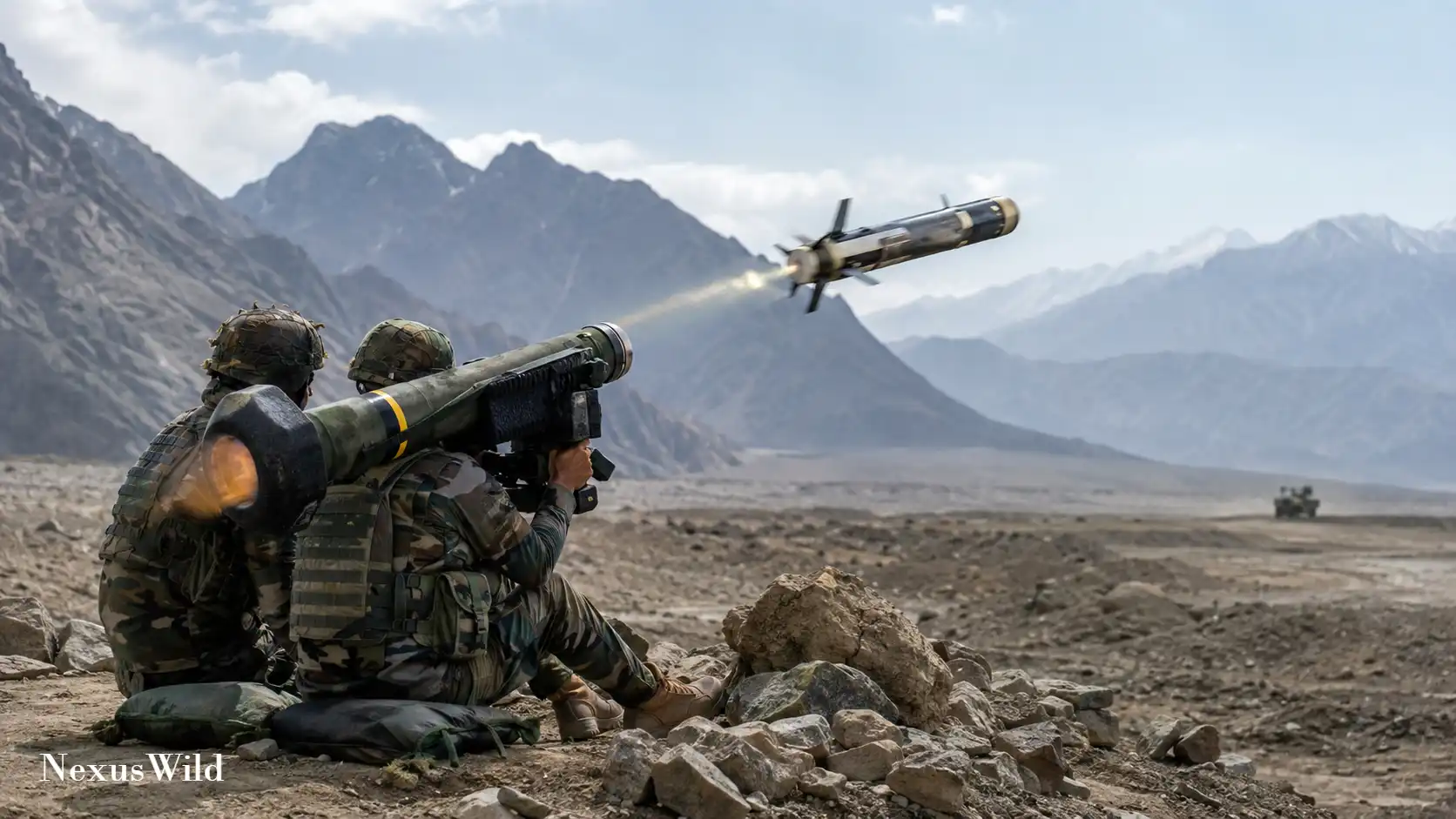

NEW DELHI — The Indian Army has signed a Letter of Offer and Acceptance with the United States for the acquisition of the Javelin anti-tank guided missile system, moving a proposed American arms sale into a formal government-to-government procurement process.
The U.S. Embassy in India announced the signing on August 28, 2026. Reuters reported that neither the value nor the quantities covered by the signed agreement were publicly disclosed. The announcement described Javelin as a medium-range guided missile system used against armoured vehicles and other targets and said the agreement could create opportunities for cooperation between the defence industries of India and the United States.
The announcement is important, but it does not confirm every detail previously associated with the procurement. In particular, it should not be treated as confirmation that India has contracted for the maximum quantities or the maximum estimated value listed in the November 2025 U.S. congressional notification.
What India Has Signed
A Letter of Offer and Acceptance, commonly called an LOA, is the central agreement used in the U.S. Foreign Military Sales (FMS) process. Under FMS, the U.S. government procures defence articles and services on behalf of an eligible partner rather than leaving the foreign government to negotiate a direct commercial purchase with the manufacturer.
Signing the LOA means India has accepted the U.S. offer for the FMS case. Under U.S. Defense Security Cooperation Agency (DSCA) procedures, a case normally becomes implemented after the purchaser signs the LOA, any required initial deposit is received and the necessary transactions are entered into U.S. government systems. Acquisition, production, training, logistics and delivery activities then take place during case execution.
The August 28 announcement confirms that the Indian Army signed the LOA. It does not publicly establish whether every implementation requirement, including any required deposit, had already been completed when the announcement was issued. It also does not provide a delivery date. That distinction matters because a congressional arms-sale notification and an accepted LOA represent different stages.
On November 19, 2025, the U.S. State Department approved a possible Foreign Military Sale of the Javelin system and associated support to India. The DSCA notification placed the estimated cost at $45.7 million and listed:
- 100 FGM-148 Javelin rounds
- One additional FGM-148 missile identified as a fly-to-buy missile
- 25 Lightweight Command Launch Units, or alternatively Javelin Block 1 Command Launch Units
- Trainers, simulation rounds, spare parts, tools, manuals, technical assistance, system integration, training and lifecycle support
The Federal Register subsequently recorded $37.1 million in major defence equipment and $8.6 million in other equipment and support.
Those were the highest estimated quantity and value based on India’s initial requirements. DSCA explicitly stated that the actual value could be lower depending on final requirements, available budget authority and the signed sales agreement. As of August 28, 2026, neither India nor the United States had publicly released the signed LOA’s detailed quantities or price. The earlier figures therefore remain the authorized ceiling for the proposed package, not confirmed final contract terms.
What Remains Before Delivery
The LOA gives the procurement a formal government-to-government basis, but weapons do not become deliverable immediately after signature. Depending on the terms of the case, the remaining work may include financial implementation, placement or execution of acquisition arrangements, production scheduling, inspections, training, preparation of technical documentation and logistical coordination.
The public announcement provides no confirmed delivery timetable. It also does not say whether India will receive the newer Lightweight Command Launch Unit, refurbished Block 1 launch units or a combination. The 2025 notification had allowed either configuration.
The U.S. announcement said the agreement creates opportunities for future industrial cooperation. That language does not establish a co-production programme, technology-transfer package, licensed-production arrangement or Indian manufacturing share.
The 2025 DSCA notification said the U.S. government was not aware at that time of any proposed offset agreement. It added that offsets, if pursued, would be defined through negotiations between India and the contractors. No subsequently published official document reviewed for this article confirms that Javelin co-production or technology transfer in India has been finalized.
What is the FGM-148 Javelin?
Javelin is a man-portable anti-tank guided missile system originally developed for dismounted forces. Its two main tactical components are a reusable sighting and fire-control unit and a missile sealed inside a disposable launch-tube assembly.
The reusable component is called the Command Launch Unit (CLU). The newer model is the Lightweight Command Launch Unit, or LwCLU. It contains day and thermal-imaging sights, controls, processing equipment and the interface used to prepare the missile for launch. It can also function independently as an observation device without a missile attached.
The round contains the missile and its launch tube. Once fired, that tube is not reused.
Javelin uses an imaging infrared seeker in the missile’s nose. Unlike a simple heat detector that merely follows the strongest hot object, an imaging seeker forms a thermal image of the scene. Before launch, the operator identifies a target and commands the seeker to lock onto its thermal image. The system is therefore described as lock-on before launch and fire-and-forget. It can operate during the day or at night because the thermal sight and seeker detect infrared energy rather than relying only on visible light.
How Fire-and-Forget Guidance Works
Older anti-tank guided missiles commonly required the operator to continue tracking the target after launch. Depending on the system, steering commands could be transmitted through wires, radio signals or other command links. The operator and launcher might have to remain exposed or maintain an uninterrupted line of sight until impact.
Javelin changes that relationship between operator and missile. Before firing, the operator uses the Command Launch Unit to locate and identify the target. The missile seeker is then given the selected target image and establishes a lock. After launch, an onboard computer and imaging infrared seeker compare the observed thermal scene with the target signature and guide the missile autonomously.
The operator does not have to steer the missile throughout its flight. This allows the firing team to seek cover, relocate or prepare for another engagement after launch.
Fire-and-forget does not mean that every launch will succeed or that the missile is immune to weather, obscuration, countermeasures or identification errors. It describes the guidance architecture, specifically the missile’s ability to continue tracking after launch without continuous commands from the operator.
Why Top-Attack Capability Matters
Armoured vehicles cannot carry the same level of protection over every surface. The frontal area of a tank is generally built to withstand the most severe direct threats because it is most likely to face an enemy. The roof must accommodate hatches, sensors and other equipment while remaining within strict weight and mobility limits. Its protection can therefore differ from that of the frontal structure.
In top-attack mode, Javelin follows an arched flight path and approaches the target from above. The purpose is to engage the vehicle from an angle different from a conventional flat-trajectory shot.
Javelin also has a direct-attack mode. This gives the missile a less elevated approach for targets or circumstances in which the top-attack profile is unsuitable. Official U.S. descriptions identify direct attack as one of the system’s standard operating modes but do not claim that either profile guarantees destruction of every target.
The missile carries a tandem shaped-charge warhead. The forward charge is designed to interact with external protection such as explosive reactive armour, while the main charge follows to act against the underlying armour. The effectiveness of any engagement still depends on factors such as the missile variant, target design, impact conditions and defensive countermeasures.
Soft Launch and Infantry Portability
Javelin uses a soft-launch sequence. An initial motor ejects the missile from the tube before its main flight motor operates. This reduces the immediate launch signature and permits firing from a broader range of protected positions than weapons whose main motor ignites fully inside the launcher.
The system is man-portable, but that does not mean it is light enough to be carried without logistical consequences. Missiles, launch units, batteries and supporting equipment still impose a substantial load on dismounted troops.
The 2025 U.S. notification for India described the system as weighing approximately 43.5 pounds, or about 19.7 kilograms, and having a maximum range exceeding 4,500 metres. It also specified imaging infrared guidance, fire-and-forget operation, top and direct attack, lock-on before launch, a tandem warhead and soft launch.
These figures should be understood as the specification used in the U.S. notification, not as universal measurements for every Javelin configuration. Legacy Block 1 launch units are heavier and use older optics than the LwCLU, while missile generations have received seeker, electronics, warhead and range improvements.
Why India Wants Javelin
The acquisition gives Indian infantry access to another portable, day-and-night anti-armour system with autonomous post-launch guidance. Its reusable observation unit, top-attack option and ability to operate without continuous missile steering are relevant to the Army’s wider modernization of infantry anti-tank capabilities.
Portability can be particularly valuable where vehicle movement is constrained, including broken ground, built-up areas and difficult terrain. However, India has not publicly identified the formations, deployment locations or geographical sectors that will receive the systems.
The relatively limited ceiling in the 2025 notification also suggests that this is not, on the currently available evidence, a wholesale replacement programme for India’s other anti-tank weapons. The package includes launch units, missiles, trainers and support equipment sufficient to establish and sustain an initial capability, but the final scale remains undisclosed.
The purchase also adds another operational link to India-U.S. defence cooperation. The two countries already cooperate across aircraft, helicopters, artillery, maritime surveillance, logistics and military exercises.
Javelin Alongside MPATGM, Nag and Spike
Javelin will enter an Indian anti-tank environment that already includes imported, licensed and domestically developed weapons with different roles.
- MPATGM: India’s indigenous Man Portable Anti-Tank Guided Missile is the closest broad-role comparison. DRDO describes it as a third-generation fire-and-forget weapon with an imaging infrared seeker, tandem warhead and top-attack capability.
- Nag: Also an imaging-infrared, lock-on-before-launch and fire-and-forget missile, the Nag's established ground configuration is carried on the tracked NAMICA vehicle, making it a vehicle-mounted system rather than a direct substitute for a dismounted team.
- Spike LR: The Israeli Spike LR associated with Indian service is man-portable and uses an electro-optical seeker, capable of both fire-and-forget and fire, observe and update operation.
These systems overlap in anti-armour purpose but differ in portability, launch platform, guidance choices and programme maturity. No Indian government announcement says Javelin will replace MPATGM, Nag or Spike.
Javelin’s Combat Record and Manufacturing
Javelin entered U.S. service in the 1990s and has been used in multiple conflicts. Its most prominent recent employment has been in Ukraine, where the U.S. Defense Department committed more than 10,000 systems by January 2025.
Javelin is produced through the Javelin Joint Venture between Raytheon, an RTX business, and Lockheed Martin. The manufacturers said in 2024 that they were expanding annual production capacity to 3,960 all-up rounds by late 2026, reporting production of more than 50,000 missiles and 12,000 reusable Command Launch Units overall.
For India, the confirmed development is the signing of the FMS Letter of Offer and Acceptance. Future co-production may remain an objective or opportunity, but no publicly released agreement as of August 28 confirms Indian manufacture, technology transfer or an industrial workshare.
Further reading and useful links
Reader questions
Frequently asked questions
What is the Javelin missile system?
Javelin is a man-portable anti-tank guided missile system featuring a reusable Command Launch Unit and fire-and-forget, imaging-infrared guidance with top-attack capabilities.
Did the India-US agreement confirm the final price and quantity of the Javelin missiles?
No. While the initial 2025 US congressional notification estimated $45.7 million for up to 100 missiles and 25 launch units, the final quantities and price of the signed Letter of Offer and Acceptance have not been publicly disclosed.
Does the Javelin agreement include domestic manufacturing in India?
As of August 28, 2026, no official document confirms that co-production or technology transfer in India has been finalized, though the US Embassy noted it creates opportunities for future industrial cooperation.
Nexuswild welcomes factual corrections. Email contact@nexuswild.com with evidence and the article URL.