
Global fast-moving consumer goods (FMCG) boardrooms are grappling with a multi-speed world in late 2026. Following years defined by severe inflationary shocks and supply-chain bottlenecks, the industry has transitioned into a phase of cautious volume recovery. However, the dynamics driving this recovery differ vastly depending on the geography.
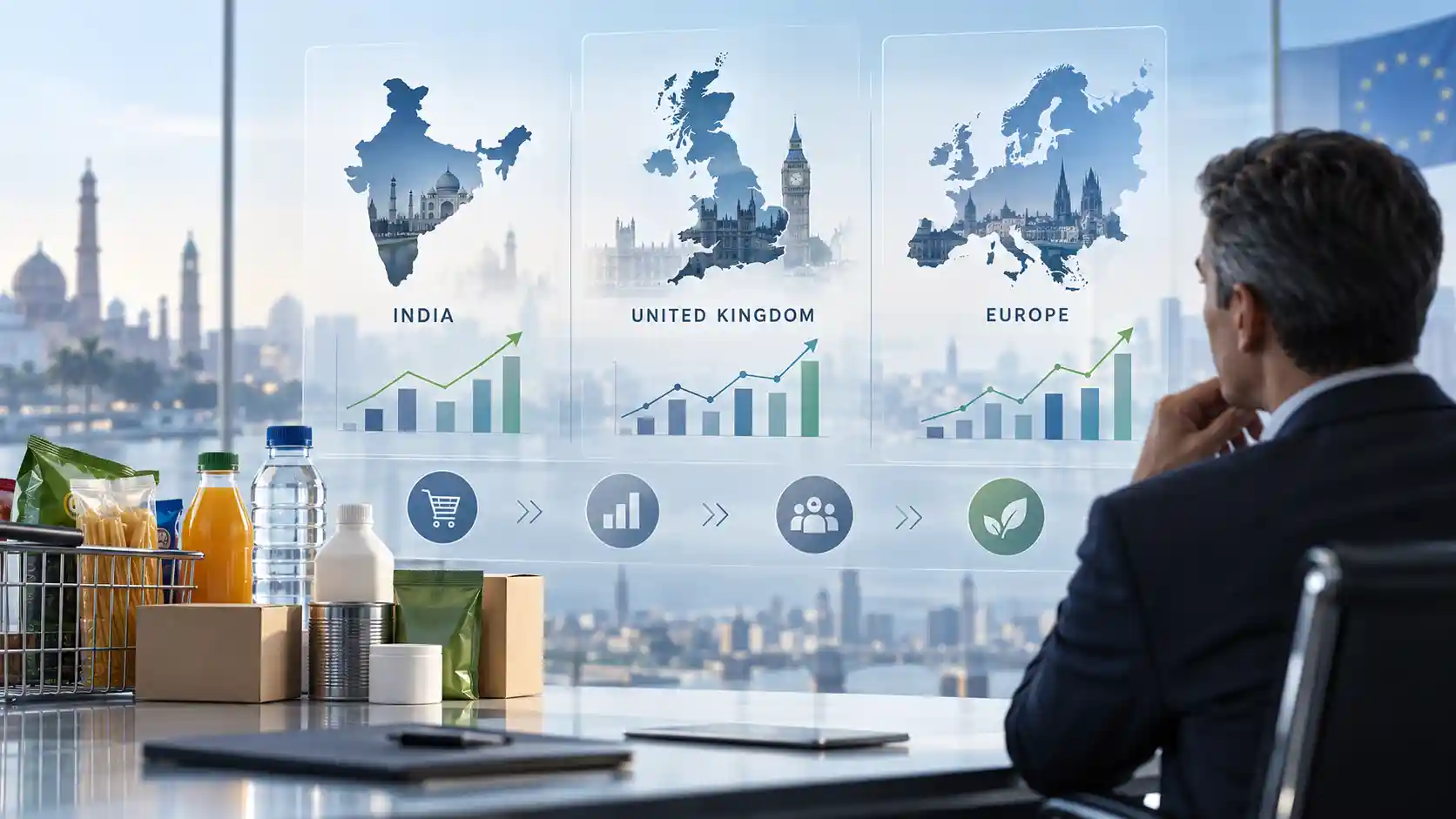
A deep dive into the consumer goods market India, the UK consumer goods market, and the broader European consumer market reveals three distinct retail ecosystems. While India is being reshaped by a rapid quick-commerce boom and rural demand recovery, the UK and Europe are locked in fierce supermarket price wars characterized by the undeniable rise of private-label brands. Understanding these regional nuances is critical for investors and brands navigating the FMCG market trends 2026.
India FMCG Market: Latest Trends
The FMCG market India continues to be a high-growth engine for global multinationals, valued at approximately $120 billion. According to NielsenIQ estimates spanning late 2025 and early 2026, the sector is seeing volume growth stabilize in the 6% to 6.5% range.
This growth is driven by two diverging trends. In urban centres, premiumisation is rampant. Consumers are actively trading up in personal care, packaged foods, and cosmetics. Conversely, rural India - which accounts for a significant portion of volume - is witnessing a gradual recovery after prolonged inflation squeezed agricultural incomes. Easing food inflation and better monsoon distributions have helped rural volume growth outpace urban markets in recent quarters, breathing life back into mass-market categories.
UK FMCG Market: Latest Trends
The FMCG market UK operates in a radically different environment. Following a historic cost-of-living crisis, British consumers have fundamentally rewired their shopping habits. According to Kantar data from mid-2026, while grocery inflation has eased back to manageable low-single digits, shopper loyalty to legacy brands remains fractured.
The UK market is highly consolidated, dominated by major grocers like Tesco and Sainsbury's, and heavily disrupted by discounters Aldi and Lidl. To protect market share, supermarkets have expanded their own-label (private label) ranges. Today, private labels account for over half of all FMCG sales by volume in the UK, forcing traditional branded manufacturers to heavily justify their price premiums through aggressive promotions or superior innovation.
European FMCG Market: Latest Trends
When analyzing the Europe FMCG industry, it is crucial to separate the European Union (alongside EFTA nations like Switzerland and Norway) from the UK. The continental European market - valued at over $650 billion - is highly fragmented across varying languages, regulations, and retail structures.
According to retail analytics firm Circana, FMCG volume growth across major EU markets like Germany, France, and Italy has remained largely stagnant or flat through early 2026. Value growth is primarily driven by residual price increases rather than consumers buying more goods. Furthermore, the European market is heavily influenced by stringent regulatory frameworks, such as the EU Deforestation Regulation (EUDR) and new packaging waste directives, which add compliance costs to supply chains that manufacturers must absorb or pass on.
India vs UK vs Europe: Key Market Differences
A comparative India vs UK FMCG market analysis highlights the contrast between an emerging, fragmented retail landscape and a mature, consolidated one. India’s retail sector is still overwhelmingly dominated by millions of traditional kirana (mom-and-pop) stores, though organized retail and digital commerce are aggressively taking share.
In contrast, the UK and Europe are defined by powerful supermarket conglomerates. While European discounters focus on immense scale and limited assortments to drive down prices, India’s disruption is entirely digital, led by the promise of 10-minute deliveries.
Consumer Behaviour and Spending Trends
Across all three regions, FMCG consumer trends show a polarization of spending.
In Europe and the UK, the "squeezed middle" is disappearing. Consumers are aggressively buying private-label household products and basic pantry staples to save money, while selectively splurging on premium health and wellness items or small indulgences - a phenomenon economists term the "lipstick effect."
In India, rising disposable incomes among the urban middle class are driving a massive shift away from unbranded, loose commodities toward branded, packaged consumer goods with health-focused or organic positioning.
Pricing, Inflation and Margin Pressure
For FMCG companies, 2026 has been a year of margin protection. During the peak inflation of 2022-2024, companies pushed through aggressive price hikes to offset skyrocketing raw material costs. Now, as commodities like wheat and palm oil stabilize - despite volatility in cocoa and coffee - pricing power is waning. Retailers in the UK and Europe are actively pushing back against further price increases, leading to tense negotiations and occasional product delistings. As a result, FMCG industry growth must now come from selling more units (volume) rather than simply charging more.
E-Commerce, Quick Commerce and Retail Transformation
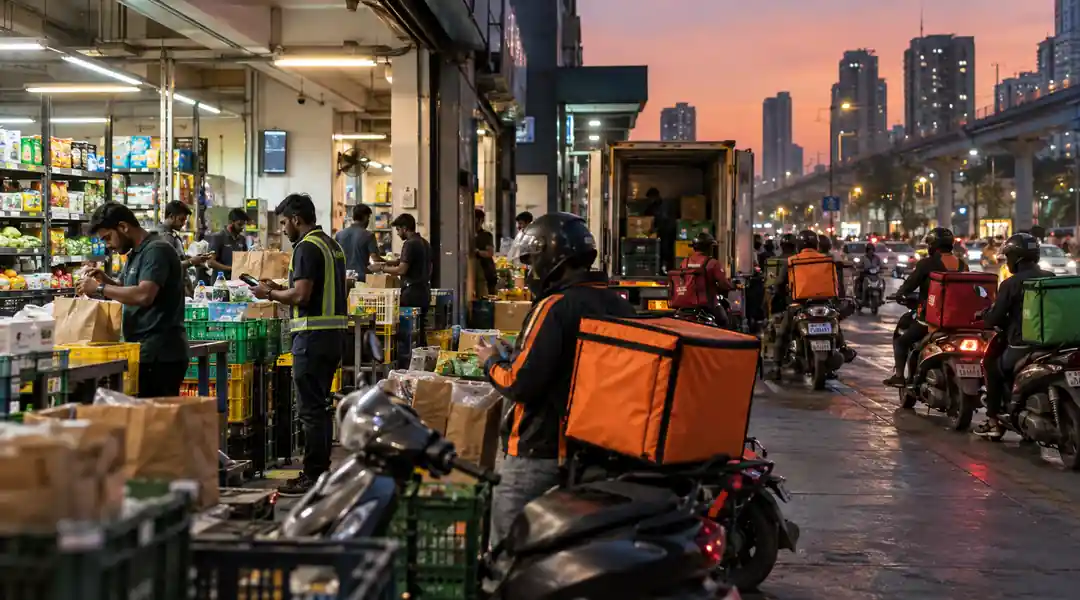
Nowhere is the retail transformation more striking than in India's quick commerce sector. Platforms like Blinkit, Zepto, and Swiggy Instamart have evolved far beyond emergency grocery runs; they now move significant volumes of beauty products, electronics, and premium packaged foods, effectively leapfrogging traditional e-commerce models.
In the UK and Europe, quick commerce has seen massive consolidation and scaling back due to high labour costs and strict city regulations. Instead, digital commerce in these regions relies on mature supermarket click-and-collect services and scheduled home deliveries.
What FMCG CEOs Are Saying
The FMCG CEO outlook for late 2026 reflects a cautious pivot from pricing to volume.
During Unilever’s early 2026 earnings updates, CEO Hein Schumacher reiterated the company’s strategic shift to focus ruthlessly on its top 30 "power brands," investing heavily in marketing to win back volume share lost to private labels in Europe.
Similarly, at Hindustan Unilever (HUL), CEO Rohit Jawa has repeatedly highlighted the steady, albeit gradual, recovery of rural demand in India, noting that targeted pricing interventions and localized marketing are essential for driving penetration in the subcontinent's hinterlands.
In Europe, executives across Nestlé and Danone have echoed the need for "real innovation." With European consumers refusing to pay more for the same product in a smaller box (shrinkflation), CEOs note that margin growth now requires genuinely superior formulations or sustainable packaging that justifies a premium.
Technology, AI and Supply-Chain Changes
Artificial intelligence is moving out of the IT department and onto the supermarket shelf. In India, FMCG companies are heavily leveraging AI to optimize micro-fulfillment centers, predicting exactly which SKUs a specific neighbourhood will order on a Tuesday evening to minimize quick-commerce stockouts.
In Europe and the UK, AI is being deployed primarily in R&D and supply-chain logistics. By utilizing digital twin technology and predictive data analytics, European manufacturers are simulating supply-chain disruptions - such as the ongoing freight rerouting around the Red Sea - to optimize inventory levels and reduce warehousing costs.
Key Risks and Growth Opportunities
Despite the stabilizing inflation, risks remain. Geopolitical tensions continue to threaten global shipping lanes, potentially raising freight costs for UK and European imports. Climate change poses a severe risk to agricultural yields, creating sudden price spikes in soft commodities.
However, growth opportunities are equally present. India remains the ultimate volume prize for global multinationals, provided they can master the fast-evolving digital distribution networks. For Europe and the UK, the opportunity lies in the "silver economy" - reformulating products with active health benefits tailored to an aging, yet wealthy, demographic.
Conclusion
The global FMCG market analysis for 2026 reveals an industry successfully moving past crisis management and returning to fundamentals. However, the playbook for success is entirely localized. Winning in India requires mastering ultra-fast digital distribution and riding the wave of urban premiumisation. Succeeding in the UK and Europe requires fierce operational efficiency, relentless brand innovation, and the ability to prove value to consumers who have learned to love private labels.
Comparison Table: India vs UK vs Europe FMCG Markets
| Market | Latest Market Size (Est. 2025/26) | Volume Growth Rate | Consumer Trend | Retail Trend | Key Challenge |
|---|---|---|---|---|---|
| India | ~$110B – $120B | 6.0% – 6.5% | Trading up (Premiumisation) | Quick-commerce explosion | Rural income volatility |
| UK | ~$130B | Flat to +1.0% | Private-label loyalty | Discounter (Aldi/Lidl) expansion | Supermarket price wars |
| Europe (EU+EFTA) | ~$650B – $700B | Flat | Polarized spending (Value vs Premium) | Regulatory compliance focus | High operating & labour costs |
(Data reflects general industry consensus and market intelligence firm estimates spanning H2 2025 through H1 2026).
Further reading and useful links
Reader questions
Frequently asked questions
What is the primary difference in FMCG growth between India and Europe in 2026?
India is experiencing strong volume growth in the 6.0% to 6.5% range driven by quick-commerce adoption and rural recovery, whereas Europe and the UK are seeing largely flat volume growth with value increases driven primarily by residual pricing.
How has quick commerce transformed the Indian FMCG landscape?
Quick-commerce platforms like Blinkit, Zepto, and Swiggy Instamart have expanded beyond basic groceries into beauty, packaged foods, and electronics, becoming major volume drivers for consumer brands.
What role do private labels play in the UK FMCG market?
Private-label (supermarket own-brand) products now account for over 50% of FMCG sales volume in the UK, driven by the expansion of discounters like Aldi and Lidl and lingering cost-of-living caution.
What strategic priorities are FMCG CEOs emphasizing in 2026?
CEOs across major multinationals like Unilever, Nestlé, and Danone are shifting focus from price increases to driving volume growth through power brands, genuine product innovation, and localized distribution.
Nexuswild welcomes factual corrections. Email [email protected] with evidence and the article URL.