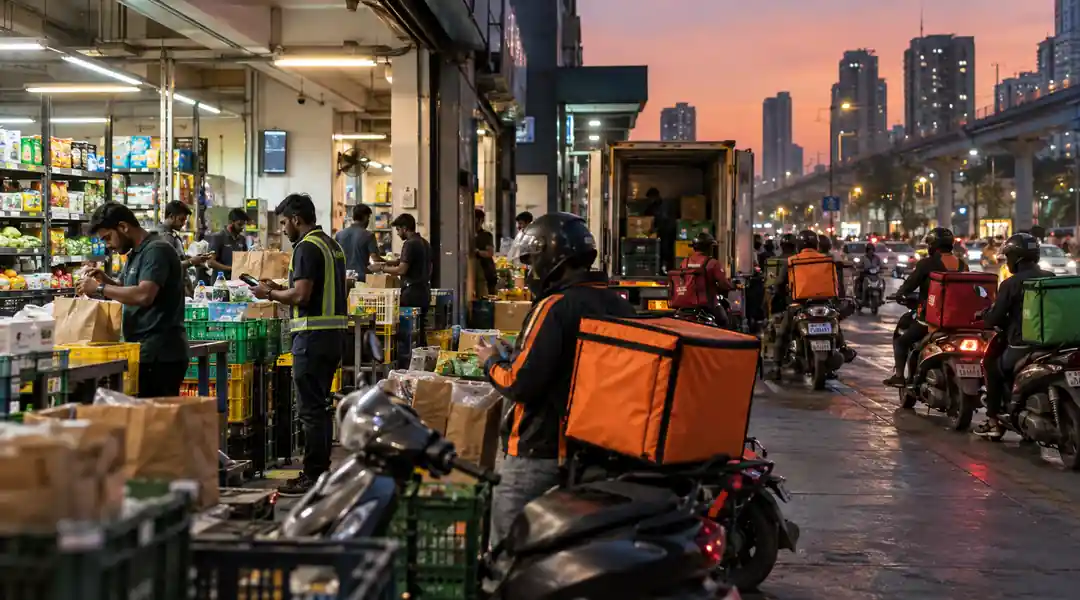

Amazon is preparing a multibillion-dollar expansion of rapid delivery in India, entering a market where local companies established consumer expectations around minutes rather than days. The immediate headline is important, but the larger story is how the event changes the operating assumptions around Amazon India quick commerce.
What happened
Reuters reported, citing sources, that Amazon plans to invest about $3 billion through 2030 in expanding its India quick-commerce operations, its largest bet on the country’s rapid-delivery market.
Why the development matters
Quick commerce is operationally different from traditional ecommerce. It relies on dense urban fulfillment networks, highly localized inventory, rapid picking and short delivery radiuses, which can make unit economics sensitive to order frequency and basket size.
The business-model test
The strategic announcement is only the first layer. The harder test is whether distribution, unit economics, customer acquisition, supply-chain execution and capital intensity improve together. Scale can strengthen a business model, but it can also expose weak economics faster when every incremental customer requires expensive infrastructure.
The deeper signal
Amazon’s challenge is not simply adding faster shipping. It has to adapt a global logistics system to an Indian model that was shaped by local competitors and consumer behavior. The outcome could influence how the company approaches other dense emerging markets.
Why markets and operators will care
A single announcement rarely changes an industry by itself. What matters is whether it alters cost, capacity, risk allocation or the speed at which competitors must respond. That is why this story is best tracked through measurable follow-through rather than headline momentum. Capital spending, utilization, financing terms, regulatory filings and counterparties' behavior can confirm whether the change is becoming structural.
What to watch next
Expansion of dark stores, delivery coverage, membership integration, grocery assortment and profitability metrics will reveal whether scale improves economics.
Bottom line
The core NexusWild takeaway is not a prediction. It is that Amazon India quick commerce now has a clearer set of measurable constraints and catalysts. The next update should be judged against those indicators, with new claims separated from confirmed data.
Reader questions
Frequently asked questions
What happened in the Amazon India quick commerce story?
Reuters reported, citing sources, that Amazon plans to invest about $3 billion through 2030 in expanding its India quick-commerce operations, its largest bet on the country’s rapid-delivery market.
Why does this development matter?
Quick commerce is operationally different from traditional ecommerce. It relies on dense urban fulfillment networks, highly localized inventory, rapid picking and short delivery radiuses, which can make unit economics sensitive to order frequency and basket size.
What is the key technical or financial issue?
Amazon’s challenge is not simply adding faster shipping. It has to adapt a global logistics system to an Indian model that was shaped by local competitors and consumer behavior. The outcome could influence how the company approaches other dense emerging markets.
What should readers monitor next?
Expansion of dark stores, delivery coverage, membership integration, grocery assortment and profitability metrics will reveal whether scale improves economics.
Nexuswild welcomes factual corrections. Email [email protected] with evidence and the article URL.