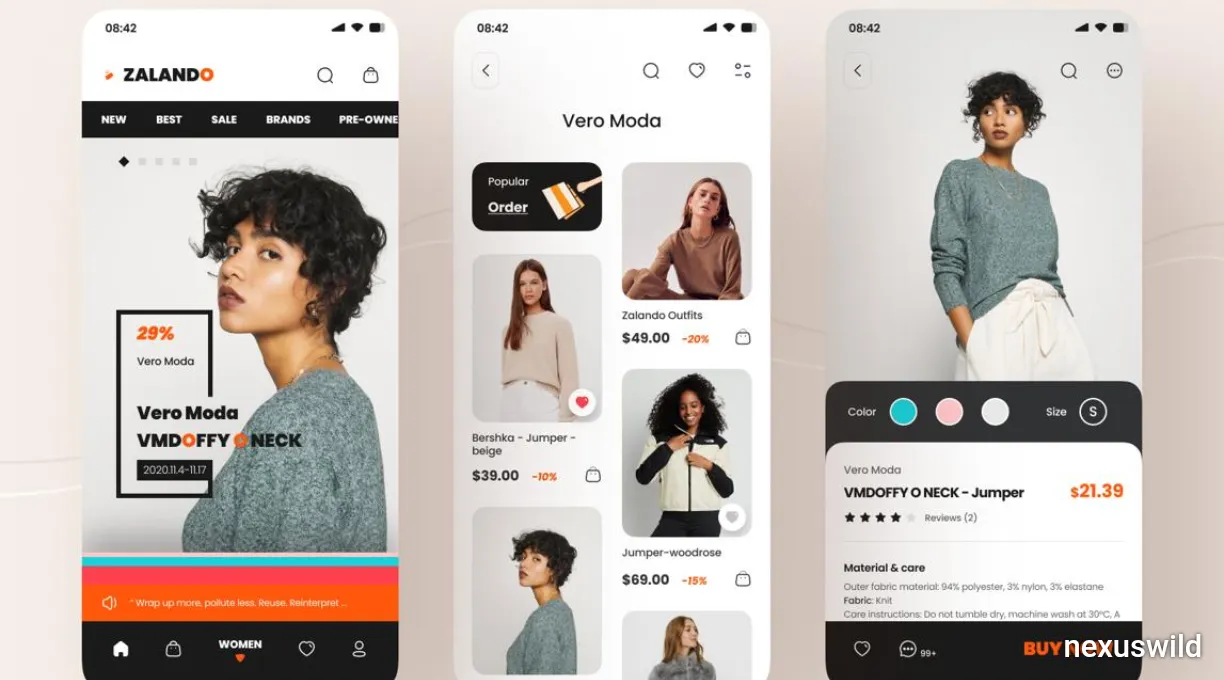

German online fashion and lifestyle retailer Zalando reported higher revenue and adjusted operating earnings for the third quarter of 2026, supported by strong growth in its business-to-business (B2B) operations and continued expansion of its platform model.
The company recorded group revenue of €3.17 billion for the quarter ended September 30, an increase of 5.1% compared with the same period last year. Gross merchandise volume (GMV), which measures the total value of goods sold through the platform, rose 7.5% to approximately €4.54 billion.
Adjusted earnings before interest and taxes (EBIT) increased 10.6% to €106.5 million, while the adjusted EBIT margin expanded from 3.2% to 3.4%.
Alongside its financial results, Zalando introduced Zalando Extended, a new initiative that aims to bring products from external online retailers into its shopping platform. The company plans to use artificial intelligence to help customers discover and purchase those products without leaving the Zalando app.
Revenue and adjusted earnings increase
Zalando's third-quarter performance showed continued growth in its marketplace and technology-enabled business operations.
Group revenue reached €3,174.7 million, compared with €3,020.6 million in the corresponding quarter of 2025. GMV increased from €4,218.6 million to €4,536.7 million.
The adjusted EBIT improvement was supported by lower fulfilment costs, benefits from the integration of ABOUT YOU and stronger B2B performance, according to the company.
However, the increase in adjusted EBIT did not translate into positive net income for the quarter. Zalando reported a net loss of €18 million, compared with net income of €12.5 million in the third quarter of 2025.
The distinction is important for investors because adjusted EBIT excludes certain items and is not the same as the company's final net profit. The results therefore show stronger adjusted operating earnings alongside a negative bottom-line result.
Zalando also reported that its gross margin declined by 0.9 percentage points to 38.7%. Reuters attributed the pressure partly to targeted discounts, particularly in the sneaker category. The company described the margin pressure as temporary and indicated that it expected a broadly stable gross margin for 2026.
B2B business delivers strong growth
The B2B division was a major contributor to Zalando's quarterly performance.
B2B revenue reached €354.4 million, increasing almost 28% from €277.1 million a year earlier. Adjusted EBIT in the segment more than doubled to €42.2 million from €19.6 million, lifting its adjusted operating margin to 11.9%, compared with 7.1% in the previous-year quarter.
The business serves brands and retailers through several technology and operational services.
ZEOS provides logistics and fulfilment services, allowing retailers to use Zalando's logistics infrastructure. Tradebyte helps brands connect with online marketplaces and sales channels, while SCAYLE provides software for businesses operating their own online stores.
Zalando said SCAYLE secured enterprise customers in the United States, including Rue Gilt Groupe and Neighborhood Intelligence, whose portfolio includes Bed Bath & Beyond. In the United Kingdom, it added N Brown Group.
Its ZEOS fulfilment business also secured customers including Lascana, LC Waikiki and Champion.
The expansion highlights how Zalando is developing beyond its consumer-facing retail platform. By providing logistics, marketplace connectivity and e-commerce software to other businesses, it can generate revenue from services that are not limited to products sold directly to consumers.
Zalando Extended introduces a new approach to online shopping
One of the most significant announcements alongside the earnings results was Zalando Extended.
The initiative is designed to expand the range of products available through Zalando by including products from external online retailers that the company does not sell itself.
The first pilot partner is Westwing, a European home and living retailer. The collaboration began in 2026, with the AI-assisted checkout capability expected to become available from 2027.
Under the planned model, Zalando's AI agent will be able to purchase selected external retailer products on behalf of customers. Shoppers will be able to discover and buy those products within the Zalando app rather than navigating to a separate retailer's website to complete the transaction.
Zalando says the approach is intended to reduce technical integration requirements for participating merchants. The external retailer can make products available to Zalando customers without needing to build a complex new technical connection or change its logistics operations.
The company also expects participating retailers to have opportunities to advertise through Zalando's retail media business.
This could allow Zalando to extend its commercial reach beyond its existing fashion and lifestyle catalogue. It could also create new advertising and commerce-related revenue opportunities, although the company has not provided a detailed financial forecast for Zalando Extended.
AI assistant adoption provides a foundation
Zalando is also expanding its existing AI-powered shopping assistant.
The company said more than 22 million unique users had visited the Zalando Assistant during 2026. The tool allows customers to describe what they are looking for through natural-language conversations, helping them discover products beyond traditional keyword searches.
The assistant is part of Zalando's broader investment in fashion-specific data, product discovery and personalised shopping experiences.
Zalando Extended represents a different stage in that development. While a conversational assistant helps customers find products, the planned agentic commerce system is designed to take additional actions during the purchasing process.
The distinction matters because agentic AI in commerce involves more than answering questions or recommending products. It can include carrying out tasks such as product discovery, purchase coordination and checkout, subject to the permissions and safeguards built into the system.
However, Zalando Extended's planned checkout functionality is not yet a fully deployed service. Its first Westwing implementation is expected from 2027.
Customer base and platform development
Zalando reported that its active customer base reached 63.2 million, up from 61.4 million in the previous-year quarter.
The company also said its partner business and retail media operations grew at double-digit rates. The share of partner business in B2C GMV increased to 33.6%, moving closer to Zalando's stated medium-term target of 40% to 50% by 2028.
Retail media revenue increased nearly 18% year-on-year and represented approximately 2% of B2C GMV.
These developments reflect the company's effort to operate as a broader technology and commerce platform rather than relying exclusively on traditional retail sales.
A larger partner ecosystem can expand product selection, while advertising and B2B services offer additional commercial opportunities. The challenge will be maintaining customer experience, delivery reliability and profitability as the platform becomes more complex.
Full-year 2026 guidance remains unchanged
Zalando confirmed its full-year guidance, which it had previously communicated in August.
The company expects GMV and revenue growth in the lower half of its 12% to 17% guidance range. Adjusted EBIT is expected to reach between €680 million and €720 million.
The company also maintained its capital expenditure outlook of €240 million to €300 million.
The guidance suggests that Zalando expects to continue investing in its platform, logistics capabilities and technology while pursuing profitable growth.
The next major financial update is scheduled for March 11, 2027, when the company plans to report its full-year 2026 results.
What the results mean for e-commerce and AI
Zalando's latest results highlight two developments in European e-commerce: the growing importance of B2B technology services and the emergence of AI systems that can participate more directly in shopping transactions.
Its B2B division is expanding through logistics, software and marketplace services, while Zalando Extended could broaden the range of products available through its consumer platform.
The planned AI checkout system is particularly significant because it moves beyond product recommendations toward transaction execution. If the rollout works as intended, it could provide external retailers with access to Zalando's customer base while allowing the platform to participate in purchases outside its own inventory.
The commercial impact remains to be demonstrated. The scale of merchant participation, customer adoption, transaction economics and the reliability of AI-assisted checkout will help determine whether the initiative becomes a meaningful source of growth.
For now, Zalando's third-quarter figures show higher adjusted operating earnings and strong B2B expansion, while its AI commerce strategy points toward a broader role for technology in the future of online retail.
Nexuswild welcomes factual corrections. Email contact@nexuswild.com with evidence and the article URL.