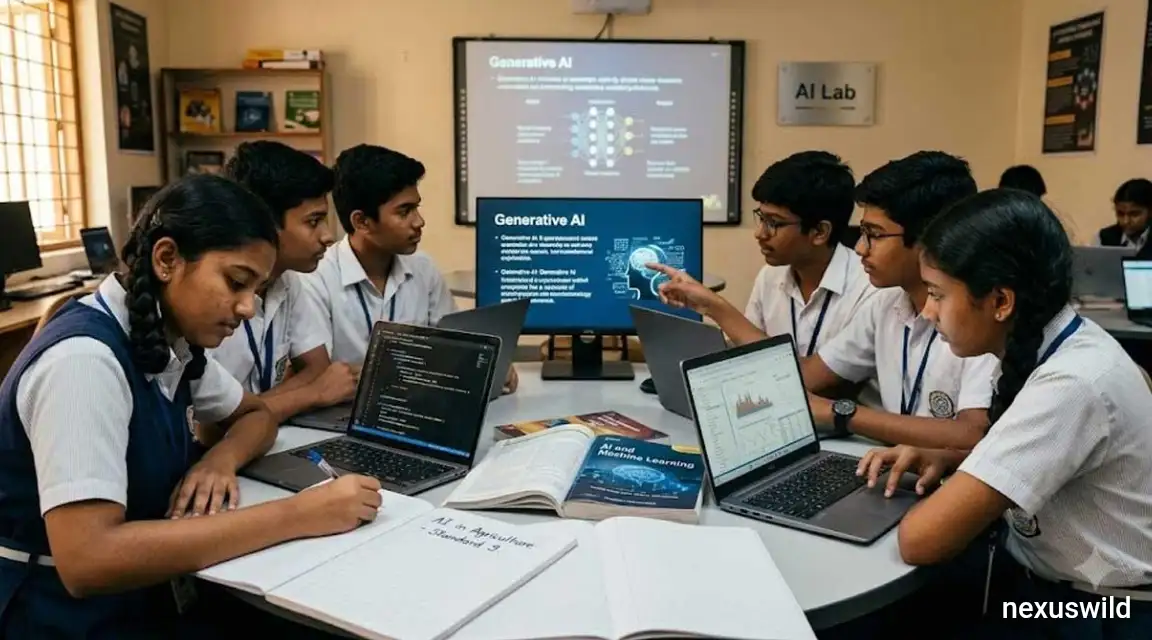

Accenture LearnVantage and Google Cloud have announced a strategic collaboration aimed at expanding artificial intelligence education across more than 1,000 public and private schools and higher education institutions in India. The initiative is designed to introduce structured AI learning, practical technology access and assessed training programmes into educational institutions, connecting academic learning with the skills increasingly sought by employers.
Announced on November 17, 2026, the partnership combines Accenture LearnVantage's learning and workforce-development capabilities with Google Cloud's Digital Campus offering and AI technology stack. Its proposed infrastructure includes Gemini-powered AI Labs for schools, Centres of Excellence and specialised academies for higher education institutions, alongside learning pathways ranging from foundational AI literacy to AI engineering.
The announcement represents a substantial proposed expansion of private-sector involvement in India's AI education ecosystem. However, the 1,000-plus institutional figure is a target rather than a confirmed count of operational facilities. The companies have not yet published a detailed institution list, implementation schedule or state-wise deployment breakdown.
A partnership designed to connect education with industry
The central objective is to make AI education more practical and closely aligned with changing workplace requirements.
Artificial intelligence is increasingly being incorporated into software development, business operations, financial services, manufacturing, customer support and research. As organisations adopt generative AI and agent-based systems, educational institutions face growing pressure to prepare students for work that involves more than conventional programming and computer literacy.
The Accenture-Google Cloud initiative seeks to address this gap through a combination of structured curricula, access to AI technology and practical learning environments.
Under the announced division of responsibilities, Accenture LearnVantage will design and deliver the educational programmes. Google Cloud will supply the underlying technology through its Digital Campus offering and unified AI stack.
The companies intend to work with both school networks and higher education institutions. This allows the proposed programme to cover two different stages of the education pipeline: introducing younger learners to foundational AI concepts and providing university-level students with more advanced development and engineering skills.
The partnership also reflects the broader commercial relationship between Accenture and Google Cloud. Both companies have existing enterprise AI activities, making education and workforce development a potential extension of their collaboration.
More than 1,000 institutions targeted across India
The most prominent commitment is the proposed reach of more than 1,000 schools and colleges.
The target includes public and private educational institutions. It is intended to extend access to AI learning beyond a limited number of specialist universities and technology-focused campuses.
However, the announcement does not provide a breakdown of how many schools, colleges or universities will participate. It also does not identify the first institutions scheduled to receive the programme.
This distinction matters because reaching 1,000 institutions can involve several different forms of participation. Some institutions may establish dedicated AI facilities, while others may primarily deliver structured learning programmes or use digital resources.
The companies have not yet disclosed the precise implementation model for every participating institution. Consequently, the announced reach should not be interpreted as a commitment to install an identical physical AI laboratory in every campus.
The first implementation details will help determine whether the partnership develops into a broad infrastructure programme or primarily operates as a curriculum and digital-learning initiative.
AI Labs planned for school students
One of the programme's major components is the proposed introduction of AI Labs powered by Google Gemini in school networks.
These facilities are intended to help younger learners understand artificial intelligence through practical experimentation rather than relying entirely on theoretical instruction.
Students are expected to gain access to AI tools in a controlled learning environment, where they can explore basic concepts, interact with AI systems and develop an understanding of how these technologies can be used.
The learning experience is expected to include guided pathways, personalised coaching through Gemini, multilingual voice capabilities and AI-driven educational content.
These features could make AI learning more accessible to students with different levels of technical experience and language preferences.
For schools, the programme could create opportunities to introduce AI literacy before students enter higher education. Early exposure may help learners understand the capabilities and limitations of AI systems while developing an interest in technology-related subjects.
However, providing access to an AI chatbot is not equivalent to delivering a complete AI education. Meaningful learning will require structured lessons, appropriate supervision, age-appropriate content, practical assignments and clear rules around responsible AI usage.
Schools will also need to consider student privacy, data protection, account management and the possibility of inaccurate or misleading AI-generated responses.
The effectiveness of the proposed labs will therefore depend not only on the technology but also on the quality of teaching and institutional safeguards.
Centres of Excellence for colleges and universities
The higher education component is designed to move beyond foundational AI awareness.
Participating colleges and universities are expected to establish Centres of Excellence, specialised centres and academies that can support applied learning, innovation and collaboration with industry.
These facilities are intended to provide students with access to modern AI tools, mentorship opportunities and practical exposure to emerging technologies.
The proposed model could allow students to work on projects that involve AI-assisted software development, application building, automated workflows and engineering-oriented problem-solving.
For universities and technical institutions, such centres may also create opportunities to connect academic programmes with practical industry requirements.
The announcement says institutions can explore customised offerings, including degree programmes aligned with emerging technology needs.
That provision should be interpreted carefully. It means institutions may explore customised academic offerings; it does not establish that new degree programmes have already received regulatory approval or begun accepting students.
The success of the Centres of Excellence will depend on their ability to provide sustained practical learning rather than functioning only as demonstration spaces for technology products.
Five learning pathways from AI literacy to engineering
The partnership outlines a curriculum structure that covers multiple levels of AI capability.
The proposed learning pathways include:
1. Generative AI literacy
This pathway is intended to introduce learners to generative AI systems and their practical applications. Students can develop an understanding of how AI tools generate content, assist with research and support productivity.
It should also help learners understand limitations such as hallucinations, inaccurate outputs, bias and the need to verify AI-generated information.
2. Agentic AI literacy
Agentic AI systems can perform multi-step tasks, interact with tools and coordinate workflows with varying levels of autonomy.
The literacy pathway is expected to introduce students to the principles of agent-based systems, including task planning, tool usage, workflow execution and human oversight.
Understanding these systems is becoming increasingly relevant as businesses explore AI agents for software engineering, customer operations and internal business processes.
3. Applied generative and agentic AI
This pathway moves from understanding AI systems to applying them in practical scenarios.
Students may develop experience using generative and agentic AI tools to solve problems, create applications and explore automated processes.
The value of this stage will depend on the complexity of the assignments and whether students are required to demonstrate their own reasoning and technical understanding.
4. AI developer programmes
The developer pathway is intended to introduce more technical work involving AI-powered application development.
This may include building software that integrates AI capabilities, working with model interfaces and creating applications that use AI tools to support specific tasks.
For students pursuing software development careers, such experience can provide a bridge between traditional programming and AI-assisted application engineering.
5. AI engineering
The most advanced pathway is designed around deeper technical capabilities in AI engineering.
It represents a progression beyond simply using AI applications towards understanding how AI-powered systems are developed and integrated into broader technology environments.
The precise course duration, technical prerequisites, assessment formats and individual certification specifications have not been fully disclosed in the public announcement.
Certifications and assessed learning
A notable part of the collaboration is the inclusion of programme certifications.
Students who successfully complete the relevant learning programmes and pass the associated assessments are expected to receive programme certificates.
This is important because access to AI tools alone does not demonstrate technical competence. Assessment can provide a more structured way to evaluate whether learners understand the concepts and can apply them.
However, the value of these certifications will depend on their design.
A meaningful assessment should test practical capability, problem-solving, responsible AI use and the ability to explain or reproduce work—not merely whether a student can generate an acceptable answer through an AI tool.
The public announcement does not provide detailed information about examination formats, certification levels, assessment standards or whether the credentials will carry formal academic credit.
It would therefore be premature to describe the certificates as equivalent to university qualifications or professional licences.
Their long-term value will depend on how employers, educational institutions and other training providers recognise them.
The importance of multilingual and personalised learning
The programme also incorporates Gemini-powered personalised coaching, guided learning pathways and multilingual voice capabilities.
These features could be particularly relevant in India's education environment, where students and teachers operate across multiple languages and different levels of access to technical resources.
Multilingual interfaces may help reduce the language barrier that sometimes limits access to advanced digital learning materials.
Personalised coaching could also allow learners to receive explanations and guided support at different levels of difficulty.
But AI-based personalisation is not a replacement for qualified teachers. Students still need human guidance, structured instruction and opportunities to discuss difficult concepts.
Teachers will remain essential for evaluating whether students understand a subject, identifying misconceptions and ensuring that AI-generated explanations are accurate.
The public announcement does not specify the number of teachers expected to receive training, the training schedule or the exact faculty-development model. Those details will be important in determining how effectively the programme can be integrated into classroom teaching.
Supporting the National AI Olympiad and AI Infinity
The collaboration will also support Accenture LearnVantage's existing student engagement initiatives, including the National AI Olympiad and AI Infinity programmes.
These initiatives are intended to encourage AI literacy, generate interest in emerging technologies and introduce students to potential technology careers.
Their inclusion creates a connection between the new institutional partnership and Accenture's broader student-focused engagement activities.
Competitions and project-based learning can help students apply concepts beyond conventional classroom exercises. They can also provide opportunities for learners to demonstrate creativity, technical problem-solving and collaboration.
Nevertheless, the announcement does not disclose the number of students expected to participate through these initiatives as part of the new partnership.
The scale of their contribution will become clearer as participation figures and programme schedules are released.
Why the partnership matters for India's AI workforce
India has a large education system and a substantial technology services industry. The country also hosts global capability centres, software engineering operations, research teams and technology-focused businesses that increasingly need workers familiar with AI systems.
The expansion of AI capabilities is changing the skills expected from entry-level professionals.
Software developers may need to understand AI-assisted coding and testing. Business analysts may increasingly work with AI-supported research and workflow automation. Technology teams may require engineers who can integrate models, build AI applications and manage agentic workflows.
This creates pressure on educational institutions to update curricula more frequently.
A partnership between an established learning provider and a major cloud technology company could help institutions access structured content and tools that would otherwise require significant independent development.
For students, the potential benefit is earlier exposure to practical technology and a more structured route from foundational literacy to specialised technical learning.
For employers, the initiative could eventually contribute to a larger pool of graduates familiar with enterprise AI tools and development practices.
However, the companies have not disclosed projected graduate employment numbers, hiring commitments, salary outcomes or reductions in corporate training costs.
Any claim that the programme will directly solve India's AI talent shortage would therefore be premature.
Google Cloud's ecosystem opportunity
The collaboration also has a commercial dimension for Google Cloud.
Introducing students and educators to Gemini-powered learning environments and Google Cloud technology can create familiarity with Google's AI ecosystem during the early stages of technical education.
As students progress into professional roles, that familiarity may influence which tools, development environments and cloud platforms they choose to use.
For Google Cloud, education partnerships can support long-term ecosystem development by expanding awareness of its products and services among future developers and technology professionals.
For Accenture, the initiative strengthens its position in learning services and workforce transformation while extending its engagement with educational institutions.
This is a potential ecosystem benefit rather than proof of guaranteed platform adoption. Students and institutions may use multiple AI providers and cloud environments throughout their education and careers.
The long-term commercial impact will depend on the actual usage of the tools, institutional purchasing decisions and whether students continue using the platforms after completing their programmes.
Implementation challenges: access alone will not be enough
The announced target is ambitious, but delivering consistent AI education across more than 1,000 institutions will involve operational challenges.
Infrastructure and connectivity: Institutions may have different levels of computer availability, network reliability and access to suitable devices. These differences can affect how much practical learning students receive.
Teacher readiness: Teachers will need sufficient preparation to incorporate AI tools into lessons, evaluate student work and address incorrect AI-generated responses.
Curriculum consistency: The programme will need clear learning objectives and assessment standards to maintain quality across different institutions and education levels.
Student safety and privacy: AI use in schools requires safeguards around student accounts, personal information, age-appropriate access and data handling.
Long-term maintenance: AI tools and models evolve rapidly. Educational content, assessments and practical assignments will need regular updates to remain relevant.
Measuring outcomes: The number of participating institutions is only one measure of scale. Student completion rates, practical project quality, demonstrated skills and further education or employment outcomes will provide a more meaningful picture.
These factors will determine whether the partnership becomes a sustained education programme or remains primarily an institutional technology-access initiative.
What remains undisclosed
Despite the announcement, several important implementation questions remain unanswered.
The companies have not published a complete list of participating schools and colleges. The state-wise distribution of institutions and the division between K–12 and higher education are also not available.
A detailed rollout calendar has not been announced, and there is no public breakdown of the number of AI Labs or Centres of Excellence expected to become operational in each phase.
The companies have also not disclosed the total number of students expected to participate, the programme's overall investment, the cost to institutions or the detailed faculty-training arrangements.
Information about certification standards, independent assessment, data governance and long-term programme evaluation will also be important.
These details will allow students, parents, educators and policymakers to assess the initiative beyond its headline institutional target.
What to watch next
Several developments will determine the programme's practical impact:
- First participating institutions: The names and locations of the initial schools, colleges and universities will show where implementation begins.
- Deployment timetable: A phased schedule will clarify how quickly the companies intend to reach the 1,000-plus institutional target.
- AI Lab and CoE implementation: The number of facilities actually established will distinguish planned infrastructure from operational deployment.
- Teacher preparation: Details of educator training will indicate whether the initiative can be integrated into regular classroom instruction.
- Student participation: Enrolment, completion and assessment figures will help measure actual reach.
- Certification recognition: Employer and academic recognition will help determine the long-term value of programme certificates.
- Learning outcomes: Practical projects, demonstrated technical skills and employment outcomes will provide stronger evidence of impact than institution counts alone.
Conclusion: a major AI education ambition whose execution remains to be tested
The Accenture LearnVantage and Google Cloud partnership
Nexuswild welcomes factual corrections. Email contact@nexuswild.com with evidence and the article URL.