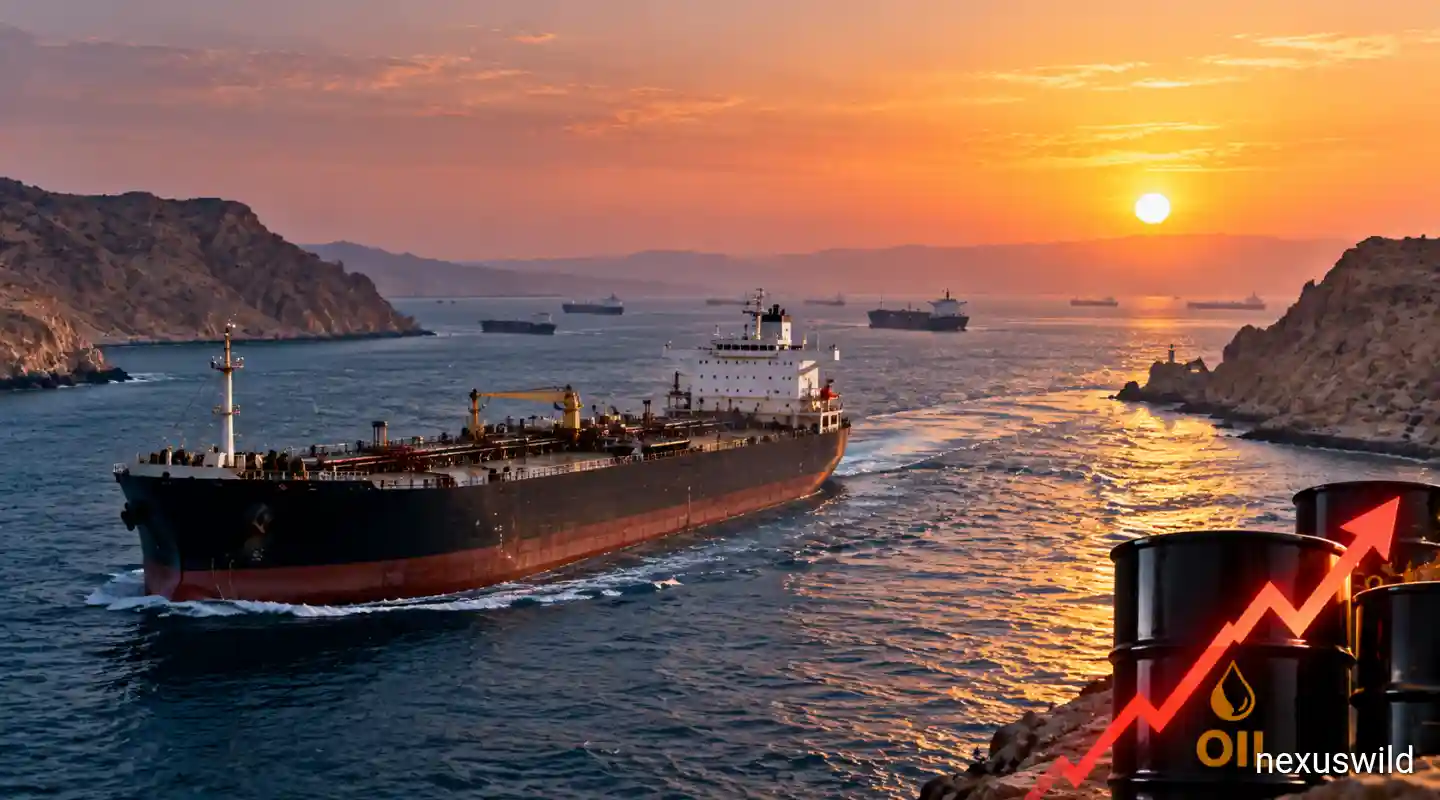

Commercial shipping through the Strait of Hormuz has fallen to its lowest level in more than two months, renewing concerns over Middle East energy supplies and helping push global oil prices sharply higher.
Only seven commodity vessels passed through the strait on October 6, the lowest daily total since July 23, according to vessel-tracking data cited in current market reporting.
Traffic recovered slightly to 10 vessels the following day, but remained well below the more than 20 daily crossings recorded earlier in the week.
The decline comes after a renewed wave of attacks on tankers operating around the Persian Gulf and Strait of Hormuz, increasing risks for shipowners, crews and energy traders.
Crude Flows Through Hormuz Drop 27%
Crude-oil movements through the strategic waterway fell approximately 27% to 10.1 million barrels per day.
That represents about 74% of pre-war crude volumes moving through the strait.
The decline reversed part of the strong recovery recorded in September, when regional exporters had succeeded in restoring a large proportion of their crude shipments despite persistent security threats.
The latest downturn demonstrates how quickly shipping conditions can deteriorate when attacks intensify.
Strait of Hormuz Is Critical to Global Energy Supply
The Strait of Hormuz connects the Persian Gulf with the Gulf of Oman and the Arabian Sea.
Before the conflict, approximately one-fifth of the world's oil and petroleum-product consumption moved through the route.
Large volumes of liquefied natural gas also pass through the strait, particularly from Qatar.
Its narrow geography makes it one of the most strategically important energy chokepoints in the world.
Any prolonged disruption can therefore affect crude prices, refined fuels, shipping rates and energy costs far beyond the Middle East.
Vessel Traffic Has Fallen Sharply From Pre-War Levels
Before the war began on February 28, approximately 125 large commercial vessels crossed the Strait of Hormuz each day.
Current traffic is only a fraction of that level.
The difference includes not only oil tankers but also LNG carriers, LPG vessels, bulk ships and other commercial traffic.
Shipowners have increasingly adjusted routes, delayed voyages or relied on alternative logistics as security risks have increased.
Tanker Attacks Intensify
The latest decline in traffic follows one of the most intense periods of attacks on shipping since the conflict began.
Tankers operating around the Gulf and Hormuz have faced missile, drone and projectile attacks, forcing operators to reconsider whether individual voyages are commercially and operationally viable.
A tanker operating near the northern coast of Qatar was hit by multiple projectiles on October 8, adding to concerns about the safety of regional shipping.
The growing number of incidents has increased uncertainty even when major oil-export infrastructure remains operational.
Oil Jumps Above $105
Energy markets reacted strongly to the renewed shipping disruption.
Brent crude rose about 5% on October 8 to above $105 a barrel, while U.S. West Texas Intermediate climbed to around $92.75 a barrel during trading.
The move marked another sharp increase after Brent had already returned above the psychologically important $100 threshold in September.
Prices remain highly sensitive to developments around Hormuz because traders must assess both actual supply losses and the possibility of a larger disruption.
Oil Had Already Been Holding Near $100
Brent settled at $100.32 a barrel on October 5 after stronger Middle Eastern exports and planned emergency stock releases had temporarily eased supply concerns.
Prices remained close to that level during the following sessions before the latest tanker attacks triggered another surge.
The market therefore remains volatile.
Improved physical exports can push prices lower, while renewed attacks can quickly reverse those gains.
Alternative Routes Are Cushioning the Impact
The fall in Hormuz traffic has not translated into an equivalent decline in total Middle Eastern crude exports.
Gulf producers have increasingly relied on alternative routes and export points.
Crude exports through the Gulf of Oman and Red Sea rose to about 6.7 million barrels per day, more than twice their pre-war levels.
Those flows have helped compensate for reduced movements directly through Hormuz.
As a result, total Middle Eastern crude exports have remained much stronger than the collapse in Hormuz vessel traffic alone would suggest.
Ship-to-Ship Transfers Have Become Important
Ship-to-ship transfers have become a significant part of the region's adapted oil-export system.
In these operations, crude is transferred between vessels away from traditional loading and transit patterns.
Such arrangements can help exporters reduce exposure to high-risk areas and keep cargo moving toward Asian and European markets.
The latest data indicate that much of the decline in Hormuz crude flows came from reduced ship-to-ship transfer activity in the Gulf of Oman.
This shows that oil logistics now depend on a complicated network of pipelines, alternate terminals and offshore transfers.
Saudi Arabia Has More Export Options
Saudi Arabia is better positioned than some Gulf producers to reduce its dependence on Hormuz.
Its East-West pipeline can transport crude from eastern oil fields to the Red Sea coast, where cargoes can be loaded without passing through the strait.
The country has increased use of Red Sea export infrastructure during the conflict.
That does not eliminate all risks, particularly because Red Sea shipping has faced separate security threats, but it provides Saudi Arabia with greater flexibility than countries whose export terminals are concentrated inside the Gulf.
UAE Also Has an Alternative Route
The United Arab Emirates can bypass Hormuz through infrastructure connecting Abu Dhabi's oil fields with the port of Fujairah.
Fujairah lies outside the Strait of Hormuz on the Gulf of Oman.
That allows some UAE crude to reach international markets without navigating the narrow waterway.
Alternative pipelines have become increasingly valuable as the security environment has deteriorated.
Qatar Is More Exposed on LNG
Qatar faces a different problem.
The country is one of the world's largest exporters of liquefied natural gas, and most of those shipments traditionally leave through Hormuz.
Unlike crude oil, large LNG volumes cannot easily be redirected through alternative pipelines.
That makes prolonged shipping disruption particularly important for global gas markets.
European and Asian buyers both depend on Qatari LNG supplies.
Shipping Costs Remain Extremely High
Security concerns have dramatically increased the cost of moving energy through the Gulf.
Tanker owners must account for:
- war-risk insurance;
- higher crew compensation;
- vessel availability;
- longer routes;
- security measures; and
- the possibility of physical damage.
Some tanker routes have seen daily freight costs rise to extraordinary levels.
These logistical expenses eventually increase the delivered price of crude even when the underlying oil itself remains available.
Crew Safety Has Become a Major Issue
The shipping crisis is also a human-safety problem.
Crew members face risks from missiles, drones and other attacks while transiting the region.
Shipowners have increasingly offered higher compensation to captains and sailors willing to operate on dangerous routes.
Some tanker captains have reportedly been offered monthly compensation approaching $100,000, along with large bonuses for individual Hormuz crossings.
The extraordinary pay reflects how difficult it has become for operators to secure experienced crews for high-risk voyages.
War-Risk Insurance Has Surged
Insurance costs have risen alongside the physical danger.
War-risk premiums for vessels operating in the Gulf can now add millions of dollars to the cost of a single voyage.
For some ships, total additional insurance costs can reach tens of millions of dollars depending on vessel value, cargo and route.
That makes voyages economically unattractive even when companies are technically willing to accept the security risk.
Higher insurance costs are one reason freight rates remain elevated.
Oil Supply Is Increasingly a Logistics Problem
The current market differs from a conventional oil shortage.
Middle Eastern producers still have substantial crude available.
The larger challenge is transporting that crude safely and economically to customers.
That distinction helps explain why oil prices can remain above $100 even as regional producers restore production and maintain relatively strong overall exports.
The physical barrels exist, but the cost and risk of moving them have increased significantly.
Refined-Fuel Markets Are Even Tighter
The situation is more difficult for refined products.
Diesel, gasoline and jet-fuel exports from the Gulf remain well below pre-war levels.
Refining disruptions, shipping constraints and reduced exports from other major suppliers have tightened global product markets.
This has created a gap between crude availability and finished-fuel availability.
More crude exports do not immediately solve diesel shortages if refineries and shipping networks cannot process and transport enough fuel.
Diesel Prices Remain Under Pressure
Diesel is particularly sensitive to the regional disruption because it is essential for trucking, agriculture, construction and industrial activity.
European diesel prices have risen substantially since the conflict began.
Higher diesel costs can spread through the economy by increasing transportation and production expenses.
That creates broader inflation risks for governments and central banks already dealing with elevated energy prices.
Hurricane Adds Pressure to U.S. Supply
The October 8 oil rally was not caused only by Hormuz.
A hurricane threatening the U.S. Gulf of Mexico forced producers to shut down offshore production.
Approximately 511,000 barrels per day of U.S. output was temporarily halted as companies evacuated personnel and secured offshore platforms.
The simultaneous pressure from Middle Eastern shipping attacks and U.S. production shutdowns intensified the market reaction.
Inventories Provide Limited Protection
Global oil inventories have already been reduced during months of supply disruption.
Lower stocks mean the market has less protection against a sudden loss of production or shipping capacity.
When inventories are high, buyers can temporarily compensate for disrupted flows by drawing from storage.
When inventories are low, even relatively small disruptions can have a larger impact on prices.
This helps explain why oil markets remain highly sensitive to new attacks.
Emergency Reserves Are Being Used
Major economies have responded by preparing releases from strategic oil reserves.
The Group of Seven has agreed on a coordinated release of around 100 million barrels of crude and fuel inventories to reduce immediate pressure on energy markets.
Such releases can provide short-term supply.
They cannot permanently replace commercial production, refinery capacity or safe shipping routes.
Strategic reserves also eventually need to be replenished.
Gulf Export Recovery Is Proving Fragile
September had provided evidence that Gulf producers were successfully adapting to the conflict.
Overall crude exports recovered strongly, with regional producers using pipelines, alternative ports and offshore transfers.
The sharp decline in Hormuz traffic in early October shows that the recovery remains fragile.
A few days of intensified attacks can quickly disrupt established shipping patterns.
That makes current export levels less predictable than before the conflict.
Shipping Could Recover Without Full Normalization
The fall to seven commodity vessels in one day does not necessarily mean traffic will remain at that level.
Shipping volumes can fluctuate sharply as operators delay departures, wait for security assessments or group voyages differently.
Traffic had already recovered slightly to 10 vessels the following day.
A sustained trend will require observing movements over a longer period.
The current data nevertheless show a significant deterioration from late September.
Oil Above $100 Reflects Risk as Well as Lost Supply
The current oil price includes more than the direct impact of missing barrels.
Markets also price the possibility of future disruption.
That geopolitical risk premium rises when:
- tanker attacks increase;
- shipping traffic declines;
- insurance costs surge;
- military tensions intensify; or
- alternative export routes become threatened.
Oil can therefore rise even when current global supply remains sufficient.
Further Escalation Would Have Global Effects
A prolonged closure or severe restriction of Hormuz would have consequences well beyond oil markets.
Higher energy prices could increase inflation and transportation costs worldwide.
Countries heavily dependent on imported Gulf energy would be particularly exposed.
Asian economies are among the largest buyers of crude and LNG transported through the region.
Europe could also face higher fuel and gas costs.
The scale of the impact would depend on how much traffic was disrupted and for how long.
Conclusion
Shipping through the Strait of Hormuz fell to its lowest level in more than two months on October 6, when only seven commodity vessels passed through the critical waterway.
Crude flows through the strait dropped approximately 27% to 10.1 million barrels per day, equivalent to roughly 74% of pre-war levels.
Traffic recovered slightly the following day, but remained far below recent levels.
Alternative routes through the Gulf of Oman and Red Sea have helped Gulf producers maintain stronger overall crude exports, preventing the decline in Hormuz traffic from becoming an equivalent loss of global oil supply.
The renewed disruption has nevertheless increased shipping costs and fears of further supply interruptions.
Brent crude surged above $105 a barrel on October 8, while U.S. oil also climbed sharply as Middle East shipping attacks coincided with hurricane-related production shutdowns in the Gulf of Mexico.
The latest decline shows that Middle Eastern oil supply is increasingly dependent not just on how much crude producers can pump, but on whether tankers can move it safely through one of the world's most important energy corridors.
Nexuswild welcomes factual corrections. Email contact@nexuswild.com with evidence and the article URL.