
At TSMC's first Arizona fab, engineers say the plant uses about 4.75 million gallons of water a day and recycles about 65% of it on site, AZFamily reported on August 24. TSMC has broken ground on a reclamation plant meant to lift reuse to 85% at first and 90% later, with operation expected in 2028, according to Data Center Dynamics.
For a chipmaker in the desert, reuse is not an extra. It is a condition for running the plant.
The same logic is spreading to refineries, food plants and data centers. A 2025 white paper from the WateReuse Association, Black & Veatch and Grundfos cited Black & Veatch's 2025 Water Report: about 40% of municipalities reported more interest from industries seeking water services, and two-thirds of that interest came from technology companies. The share of municipalities confident they could meet new demand fell from about 75% in 2023 and 2024 to 65% in 2025.
What "reuse" means
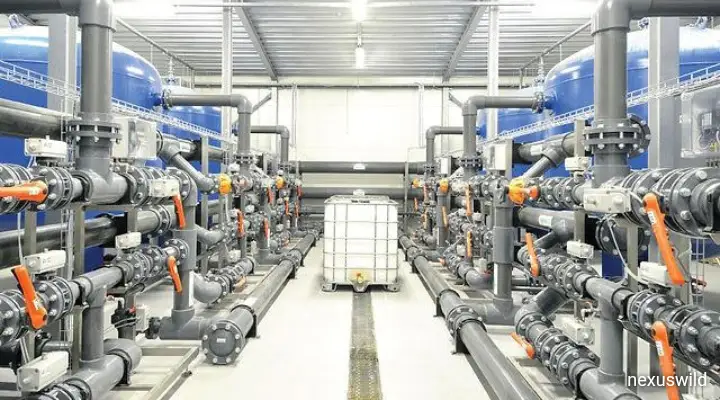
The white paper describes three steps. Reduce means using less water. Reuse means using water again for other tasks after limited treatment. Reclaim means treating wastewater to the standard a process needs, which is often below drinking quality, so a cooling tower does not get water treated for a hospital.
Combining the three could save up to 75% to 90% of intake, the paper said, citing research by J. Rasmussen and colleagues. Simple operational changes alone can cut use by 10% to 25%. Reclaiming is usually the most expensive step.
Where the money comes from
The savings come from four places: the freshwater a company no longer buys, the discharge fees it no longer pays, supply security for existing operations, and the ability to expand without waiting for new water allocations.
The economics are site-specific. The white paper noted that water in the US is inexpensive, which weakens the cost case without supportive policy. Vendor guides report paybacks of under two years in water-stressed regions and up to eight years for complex zero-liquid-discharge systems. Those are vendors' estimates, not independent audits, so treat them as a range to test.
There are costs too. Reclaiming 80% of industrial wastewater would raise industrial energy use by about 4.1%, according to a European study cited in the white paper. Disposing of the leftover brine can also decide whether a project pays.
How leaders are doing it
TSMC reported a process water recycling rate of 88.1% in 2024, down from 90.3% in 2023, according to its sustainability report as summarized by BigGo Finance. SK Hynix reported 47% in 2024, up from 44%. Samsung does not disclose a rate, and industry estimates put it near 40%. The Phoenix figure of 65% is a single-site number and not directly comparable.
Intel's Chandler, Arizona operation shows a utility partnership model. Its brine reduction facility returns 96% of brine to manufacturing. Its water treatment and recovery plant, with about 9 million gallons a day of capacity, recovers 98% of influent wastewater. Intel's Ocotillo site conserved 3.3 billion gallons in 2024, according to the white paper. In 2024, Intel and the City of Chandler opened a jointly funded $44.6 million reclaimed water interconnect facility, according to an industry data portal.
In California, Chevron's Richmond refinery uses recycled municipal water for boiler feed. The 3.5 million gallon-a-day expansion cost $55 million in 2010 and conserves potable water equal to what 39,000 homes use. Chevron pays the capital and operating costs, so there is little effect on the utility's rates, the white paper said. In Oklahoma, a Koch fertilizer plant treats municipal effluent to save about 1.5 billion gallons of freshwater a year.
Potential by sector
The white paper used Bluefield Research estimates to size the opportunity in the US. For semiconductors, savings could reach 55% to 76%, for food and beverage 47% to 64%, and for data centers 29% to 49%. Data center water use is expected to rise about 30% over five years, driven by cooling.
Risks and limits
Recycling is slow to build. A TSMC spokesperson told Manufacturing Dive that developing wastewater recycling technology is a long journey because industrial wastewater is complex. Even TSMC's Phoenix fab still draws roughly a third of its water from outside.
Quality is another risk. A mistake in reused water can damage products or equipment, so plants usually pilot first. Regulations also differ by state and country, and reuse reduces withdrawals but does not remove a plant's environmental footprint. The white paper comes from groups that sell or promote reuse, so its estimates should be read with that in mind.
What decision makers should weigh
- The full price of water: supply plus discharge fees, today and as rates rise.
- Supply risk: whether the local utility can serve future growth.
- Energy and brine: treatment power and disposal costs.
- Fit for purpose: treating water only as far as each process needs.
- Partners: municipal agreements, like Intel's and Chevron's, can share costs.
Reuse pays most clearly where water is costly or constrained. Often the stronger argument is risk, since a plant that cannot get water cannot run, and reuse is one way to protect production and growth.
Nexuswild welcomes factual corrections. Email contact@nexuswild.com with evidence and the article URL.