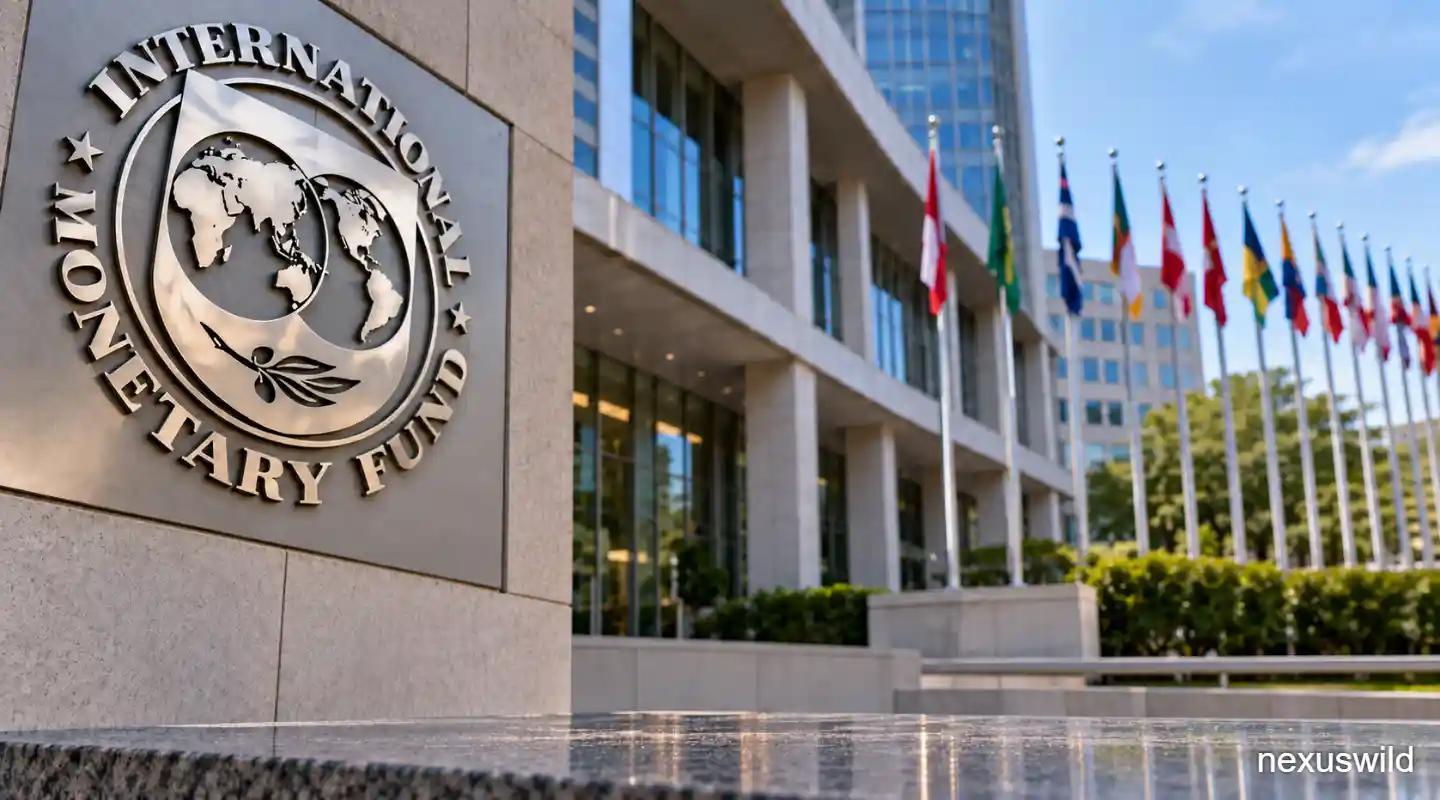

The International Monetary Fund has warned that the global economy is entering a difficult period shaped by three powerful forces: elevated energy prices, historically high public debt and a rapid expansion in artificial-intelligence investment.
Speaking ahead of the IMF and World Bank Annual Meetings in Bangkok, IMF Managing Director Kristalina Georgieva said the world economy has remained more resilient than initially feared but continues to face significant risks from geopolitical shocks, strained public finances and the increasingly large economic role of AI.
The IMF currently expects global growth of about 3% in 2026, but it has repeatedly emphasized that the headline figure hides major differences between countries. Energy importers and highly indebted economies face greater pressure, while countries closely connected to the AI investment cycle are benefiting from stronger capital spending and technology demand.
Energy Shock Has Not Fully Passed
The first major challenge is energy.
The global economy has adapted better than initially expected to disruptions caused by conflict in the Middle East, helped by strategic reserves, alternative energy supplies and changes in demand.
But the IMF says the energy shock is not over.
Oil, natural gas and refined-fuel markets remain vulnerable to disruptions, while strategic reserves used during the crisis will eventually need to be replenished.
Brent crude was trading above $100 a barrel in early October, while diesel, gasoline and jet-fuel prices remained substantially above their pre-conflict levels because refinery capacity and shipping networks were still constrained.
Higher energy prices can affect the economy through several channels.
They increase transportation and production costs, raise household expenses and can slow the process of bringing inflation back toward central-bank targets.
Refined Fuels Remain Particularly Tight
The IMF has stressed that crude-oil prices alone do not capture the full scale of the energy problem.
Households and companies consume refined fuels such as diesel, gasoline and jet fuel rather than crude oil directly.
The Fund said prices for several refined products were still 60% to 97% above pre-conflict levels at the beginning of October, partly because alternative refining hubs were operating close to capacity.
That matters for inflation because diesel and other fuels are deeply embedded in transportation, agriculture, construction and global supply chains.
Persistent fuel-price pressure can therefore spread beyond the energy sector into the broader economy.
Inflation Could Stay Higher for Longer
The IMF says the latest energy shock has interrupted the decline in inflation in several countries.
Some central banks have already tightened monetary policy or delayed expected rate cuts as higher energy costs pushed inflation expectations upward.
The Fund has warned governments against assuming that inflation will automatically return to previous levels once the immediate energy shock fades.
Recent research also suggests that repeated cost-of-living crises can influence inflation expectations for years, particularly when households experience large increases in food and energy prices.
That creates a difficult policy environment.
Central banks must control inflation without unnecessarily weakening growth, while governments face pressure to support households already dealing with higher living costs.
Public Debt Is Approaching Historic Levels
The second major challenge is government debt.
The IMF estimates that global public debt is now close to 100% of world GDP, exceeding the levels reached after World War II and continuing to rise in many economies.
Georgieva has described the pattern of global debt as resembling a staircase.
Debt rises sharply during crises, but governments often make little progress reducing it before the next shock arrives.
The pandemic, energy crises, military conflicts and emergency economic programs have all added to public borrowing.
Higher Interest Rates Make Debt More Expensive
Debt becomes more difficult to manage when interest rates rise.
Government borrowing costs have increased sharply across several major economies during 2026.
The yield on the benchmark 10-year U.S. Treasury recently reached about 5.34%, its highest level since 2002, while government bond yields also increased in France, Britain, Japan and other economies.
Higher yields increase the amount governments must spend on interest payments.
That can leave less money available for infrastructure, healthcare, education, climate investment and other public priorities.
Fiscal Credibility Is Becoming More Important
The IMF has urged governments with high debt levels to develop credible medium-term plans for stabilizing their finances.
That does not necessarily mean immediate large-scale spending cuts.
Instead, the Fund has emphasized gradual fiscal adjustment, better tax systems and policies that protect productive public investment while reducing unsustainable deficits.
The IMF is also warning against political pressure on central banks to keep borrowing costs artificially low.
If investors begin to doubt a government's ability to manage debt, bond yields can rise further, making the problem more difficult to solve.
AI Is Both a Growth Opportunity and a New Risk
The third challenge is very different from the first two.
Artificial intelligence is currently supporting economic growth rather than directly weakening it.
Massive spending on data centers, semiconductors, electricity infrastructure and software is boosting investment in the United States and in economies linked to the global AI supply chain.
The IMF says AI could eventually raise global productivity significantly.
Georgieva has suggested that effective adoption could add around 0.5 percentage point to annual global growth under favorable conditions.
But the same investment boom creates new risks.
AI Investment Is Increasing Energy Demand
AI is connecting directly to the energy problem.
Large data centers require enormous amounts of electricity.
The IMF has noted that rapidly expanding AI infrastructure is increasing power demand at the same time that global energy markets are already experiencing supply constraints.
That creates an unusual economic interaction.
AI investment supports growth, but the electricity and infrastructure required to power it can contribute to higher energy prices and stronger inflationary pressure.
The challenge for governments is therefore to expand power generation and grid capacity quickly enough to support technological investment without worsening energy shortages.
AI Could Also Affect Interest Rates
The AI boom is influencing financial markets as well.
Heavy investment in data centers, power projects and semiconductor manufacturing increases demand for capital.
When that investment occurs alongside large government borrowing requirements, competition for financing can help keep long-term interest rates elevated.
This creates another link between the IMF's three major concerns.
AI can boost demand and productivity, but it can also contribute to higher borrowing costs in economies already struggling with large public debt burdens.
Financial Markets May Be Pricing AI Too Optimistically
The IMF is also monitoring financial-market valuations.
Technology companies connected to the AI boom have attracted enormous amounts of capital, pushing some equity valuations to historically high levels.
Georgieva warned that markets could face significant volatility if future AI profits fail to justify current expectations.
That does not mean the IMF is predicting an AI-market crash.
The concern is that unusually optimistic assumptions create greater sensitivity to disappointing earnings, higher interest rates or slower technological adoption.
A rapid repricing of major AI companies could spill into broader stock and credit markets.
AI Could Disrupt Labor Markets
Employment is another area of concern.
AI systems can automate tasks in sectors ranging from software development and customer service to finance, law and administration.
The IMF has repeatedly argued that governments need to invest in workforce training so workers can adapt as technology changes the type of skills companies require.
The distribution of benefits is also important.
Countries with strong digital infrastructure, skilled workforces and access to computing capacity could gain significantly from AI.
Countries lacking those resources risk falling further behind.
Cybersecurity and Systemic Risks Are Growing
AI also introduces new financial and technological vulnerabilities.
The IMF's 2026 agenda includes increasing attention to cybersecurity, autonomous financial systems and AI-powered trading.
As AI becomes embedded in financial markets and payment systems, failures or malicious use could potentially spread more rapidly across institutions.
Regulators therefore face a difficult balance.
They want to encourage innovation while ensuring that financial institutions remain resilient against cyberattacks, model failures and unexpected automated behavior.
Global Economy Is Experiencing Two Opposing Shocks
The IMF has described the current situation as a combination of two very different economic forces.
The energy shock is largely negative, reducing purchasing power and raising inflation.
The AI investment boom is largely positive for demand and investment, but it can also add inflationary and financial-market pressures.
Those forces help explain why the global economy has remained more resilient than expected despite major geopolitical disruption.
Growth has not collapsed, but inflation and financial risks remain unusually difficult to manage.
Some Countries Benefit More Than Others
The impact differs substantially across regions.
Energy-importing countries are generally more vulnerable to high oil and gas prices.
Countries integrated into semiconductor manufacturing, data-center construction and AI supply chains can benefit from higher technology investment.
Meanwhile, highly indebted governments face greater pressure from rising interest rates regardless of whether their economies benefit directly from the AI boom.
The IMF has therefore emphasized that global averages can hide significant economic divergence.
Low-Income Countries Face the Greatest Constraints
Poorer economies often face all three challenges with fewer resources.
Many import fuel, carry large debt burdens and have limited access to advanced computing infrastructure.
Higher energy prices weaken their trade balances and increase inflation.
Higher global interest rates make debt refinancing more expensive.
At the same time, weak electricity systems and limited digital infrastructure can prevent them from benefiting fully from AI-driven investment.
The IMF has identified low-income and fragile countries as among the economies most exposed to the current combination of shocks.
Governments Need to Rebuild Fiscal Buffers
One of the IMF's main policy recommendations is to rebuild the financial capacity needed to respond to future crises.
Governments used substantial fiscal resources during the pandemic and subsequent energy shocks.
Many entered the latest period of geopolitical instability with significantly less room to borrow.
The IMF argues that reducing debt during stronger economic periods is important because new shocks are increasingly frequent.
Without fiscal buffers, governments have fewer options when recessions, wars, climate disasters or financial crises occur.
Central Banks Must Preserve Price Stability
The Fund has also emphasized central-bank independence.
Persistent energy inflation and high debt can create political pressure to keep interest rates lower than economic conditions justify.
The IMF argues that allowing inflation expectations to become unanchored would ultimately make the economic adjustment more costly.
Price stability therefore remains a central priority even when governments face rising debt-service costs.
AI Policy Should Focus on Productivity, Not Only Investment
The IMF's position on AI is not simply that governments should spend more money.
The Fund argues that countries need policies that allow technology to translate into broader productivity gains.
That includes:
- education and workforce training;
- electricity and digital infrastructure;
- competitive markets;
- cybersecurity;
- responsible regulation; and
- policies that help workers move between jobs.
Without those foundations, large AI investments may generate less economic benefit than investors currently expect.
Annual Meetings Will Focus on These Risks
The warnings come ahead of the 2026 IMF and World Bank Annual Meetings in Bangkok, Thailand, from October 12 to October 18.
Finance ministers, central bankers and policymakers from around the world are expected to discuss global growth, debt sustainability, financial stability, energy security and the economic impact of AI.
The IMF's full October World Economic Outlook is scheduled for release during the meetings.
That report will provide updated projections for growth and inflation across major economies.
Conclusion
The IMF says the global economy has proved more resilient than expected, but that resilience is being tested by an unusual combination of pressures.
High energy prices continue to push up inflation and production costs.
Global public debt is approaching 100% of GDP, leaving governments increasingly exposed to higher borrowing costs.
At the same time, the AI investment boom is supporting economic growth while raising new questions about energy demand, financial valuations, employment and systemic risk.
The IMF's message is not that these forces will necessarily cause a global downturn.
Instead, it is that governments need to manage them simultaneously.
Energy security, credible fiscal policy, independent central banks, resilient financial systems and policies that spread the productivity benefits of AI will determine whether the current combination of shocks becomes a source of stronger long-term growth or greater instability.
Nexuswild welcomes factual corrections. Email contact@nexuswild.com with evidence and the article URL.