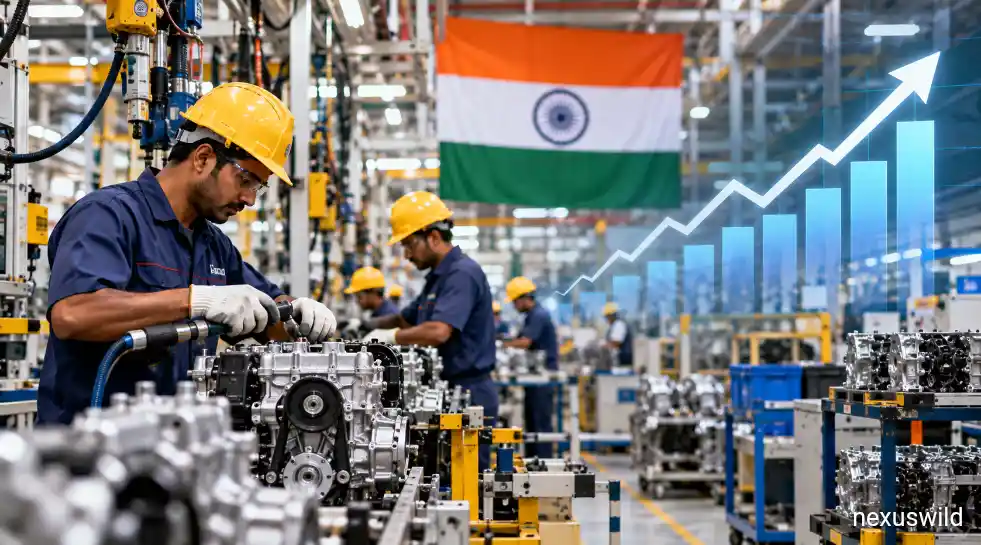

India’s manufacturing sector regained momentum in September, with factory activity expanding at its fastest pace in seven months as stronger domestic and overseas demand boosted new orders, production and hiring.
The HSBC India Manufacturing Purchasing Managers’ Index, compiled by S&P Global, rose to 55.1 in September from 52.8 in August, according to survey data released on October 1. The reading was the highest since February and marked a sharp recovery from the previous month.
A PMI reading above 50 indicates expansion in manufacturing activity, while a figure below 50 signals contraction.
September also ended a three-month period of slowing manufacturing growth, suggesting that factory activity strengthened toward the end of the second quarter of India’s 2026-27 financial year.
Stronger Demand Drives New Orders
The improvement was largely supported by stronger demand for manufactured goods.
New orders increased at the fastest pace since February, according to the survey, with companies reporting better demand for products including electronics, food, pharmaceuticals and textiles.
Higher order volumes encouraged manufacturers to increase production.
Factory output recorded its strongest expansion in four months, indicating that companies were responding to the improvement in sales by raising production levels.
Demand was not limited to the domestic market.
New export orders also increased more quickly during September, with manufacturers reporting stronger demand from customers in markets including Brazil, Europe, the United Arab Emirates and the United States.
The improvement in exports is significant because external demand had faced pressure earlier in the year from global economic uncertainty and disruptions linked to geopolitical tensions.
Hiring Returns to Growth
Improving order books also supported employment.
Manufacturing companies increased staffing levels during September after employment had declined in August. The pace of job creation was the strongest since May, according to the PMI survey.
The rise suggests some manufacturers were adding workers to manage higher production requirements.
However, PMI employment data reflects the companies participating in the survey and should not be treated as a substitute for official national employment statistics.
Manufacturers also increased purchasing activity and accumulated inputs as they prepared for expected demand.
Business Confidence Improves
Sentiment among manufacturers strengthened alongside the improvement in orders.
Business confidence rose to a four-month high, supported by new enquiries and expectations that demand conditions would remain favourable in the coming months.
HSBC Chief India Economist Pranjul Bhandari said the factory sector ended the quarter on a stronger footing, pointing to improving domestic and overseas demand, higher sales and production, and renewed hiring.
The rebound comes after the manufacturing PMI fell to 52.8 in August, its lowest level in about five years, although the index still remained above the 50-point threshold separating expansion from contraction.
Cost Pressures Increase but Remain Moderate
The September survey also showed some increase in manufacturers’ costs.
Input price inflation accelerated as companies reported higher costs for items including electronic components, pharmaceutical products and steel. Even so, the pace of cost increases remained below the survey’s historical average.
Manufacturers responded by increasing selling prices at a somewhat faster rate.
However, output-price inflation also remained below its long-term trend, suggesting that businesses were not fully passing higher input costs on to customers.
Cost conditions remain an important risk for manufacturers, particularly as global energy and commodity markets continue to face volatility.
Quarterly Average Still Shows Earlier Weakness
Despite September’s strong rebound, the broader quarterly picture remained more subdued.
The manufacturing PMI averaged 53.8 during the second quarter of FY27, its weakest quarterly average since the corresponding period in 2021.
That reflects slower momentum during July and August before the September recovery.
The final September reading of 55.1 was also below the preliminary flash estimate of 55.7 released earlier in the month.
Even so, the final reading confirms that operating conditions improved substantially compared with August.
Conclusion
India’s manufacturing sector entered the final month of the September quarter with stronger momentum.
The rise in the HSBC Manufacturing PMI to 55.1, its highest level in seven months, was supported by faster growth in new orders, production, exports and employment.
Stronger demand from both Indian and overseas customers helped manufacturers recover from several months of slowing activity, while business confidence also improved.
The September rebound does not erase the weaker performance earlier in the quarter, and higher input costs remain a concern. But the latest PMI data indicate that India’s factory sector ended the quarter in a significantly stronger position than it began it.
Nexuswild welcomes factual corrections. Email contact@nexuswild.com with evidence and the article URL.