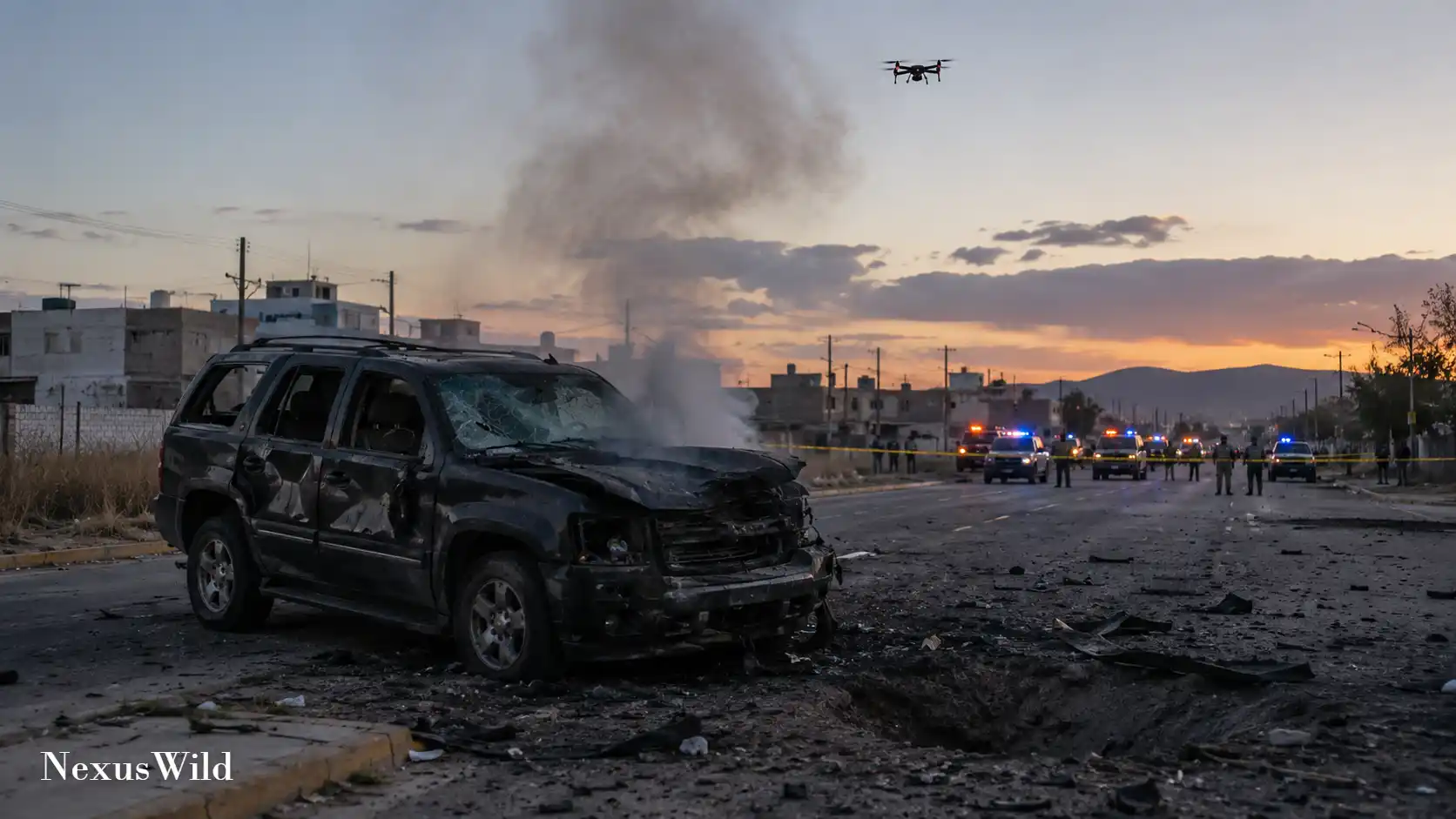

OJOCALIENTE — A suspected car bomb tore through the area outside a municipal police station in Ojocaliente, Zacatecas, on the night of August 30, injuring at least 11 people, including two police officers. The blast is the latest and most severe in a string of explosive attacks that Mexican authorities say reflects a broader shift in how organized criminal groups are operating across parts of the country.
Zacatecas Governor David Monreal said the explosion damaged roughly 40 buildings in the town, which was holding festivities for its patron saint at the time. State officials said a vehicle loaded with explosives had been left running near the police headquarters, and that an officer approached to inspect it moments before the device detonated. Videos shared on social media showed flames near the station and residents, including children, fleeing the scene.
It was the third attack involving explosives recorded in Zacatecas within about a week, according to a tally by the news agency AFP. State Attorney General Cristian Camacho said investigators were examining whether the bombing was retaliation for the arrest, a day earlier, of an 18-year-old man who told authorities he worked as a hitman for the Jalisco New Generation Cartel, known as CJNG. Camacho said the vehicle used in the attack had been stolen in an area of Jalisco where the cartel operates and that, while the investigation is ongoing, "everything indicates" CJNG was responsible. Mexico's federal Security Cabinet said army and National Guard units had reinforced security in the municipality following the attack.
An Evolving Threat Landscape
The bombing added to a trend that state officials describe as accelerating. Zacatecas security chief Arturo Medina said the state recorded a single explosives-related incident in 2024, six in 2025, and 10 so far in 2026. Monreal said the pattern points to an evolution in the tactics used by organized crime in a state that sits along a corridor used to move drugs between central and northern Mexico.
Explosive attacks tied to criminal groups have also surfaced elsewhere in the country, though the tactic remains concentrated among certain groups rather than widespread across all of Mexico's cartels. Research from the National Counterterrorism Innovation, Technology and Education Center has tracked 221 weaponized drone incidents attributed to criminal groups nationwide between 2021 and 2025, 27 of which caused fatalities, killing 77 people in total. CJNG was linked to the largest share of attributed attacks, while La Nueva Familia Michoacana accounted for a smaller but notable portion; many incidents in the dataset remain attributed to unidentified groups. Most attacks have been concentrated in Michoacán and Guerrero. In Guerrero this year, attacks blamed on a group known as Los Ardillos forced an estimated 800 to 1,000 families to flee rural communities, according to local human rights organizations, while residents of another Guerrero community described drone bombings and gunfire during clashes attributed to La Nueva Familia Michoacana.
In Sinaloa, where a conflict between rival factions of the Sinaloa Cartel has continued since 2024, Mexican Navy personnel discovered more than 300 improvised explosive devices and roughly 300 kilograms of explosive material at a rural property in El Rosario in August. The find came about two months after authorities located more than 550 devices at another site in the same municipality.
Weaponized Drones and Countermeasures
Drones used by criminal groups in Mexico were originally deployed mainly for surveillance and smuggling. Authorities say that began changing around 2021, when CJNG started fitting improvised explosives to commercial drones for use against rivals and security forces in Michoacán, a tactic other groups have since adopted in other parts of the country.
Mexican security forces have expanded specialized response capabilities in affected areas. The Navy's explosive ordnance unit, known by the Spanish acronym BLONAE, has been deployed to secure and defuse devices found in Sinaloa and elsewhere. The army has also introduced portable and fixed counter-drone systems, including signal-jamming equipment, ahead of large public events. In August, Mexico and the United States signed a non-binding agreement giving Mexico's defense ministry access to American suppliers of drone and counter-drone technology.
The rising use of car bombs, explosive-equipped drones and IEDs marks a departure from the shootings, kidnappings and armed clashes traditionally associated with cartel violence in Mexico. By targeting police stations, security convoys and rival encampments directly, these attacks bring the conflict into contact with civilians and public infrastructure in ways that are harder for authorities to contain, officials say, forcing a rethink of how security forces respond to organized crime.
Further reading and useful links
Reader questions
Frequently asked questions
What happened in Ojocaliente, Zacatecas?
On the night of August 30, a vehicle loaded with explosives detonated outside a municipal police station in Ojocaliente, Zacatecas. The blast injured at least 11 people, including two police officers, and damaged roughly 40 nearby buildings.
Who is suspected to be behind the Zacatecas car bomb?
State Attorney General Cristian Camacho indicated that the Jalisco New Generation Cartel (CJNG) was likely responsible. Investigators believe the attack may have been in retaliation for the arrest of an 18-year-old CJNG hitman the previous day.
Are explosive attacks by cartels becoming more common in Mexico?
Yes. Security officials note an accelerating trend of Mexican criminal groups using car bombs, weaponized drones, and improvised explosive devices (IEDs), moving beyond traditional firearms to target rivals and security forces directly.
Nexuswild welcomes factual corrections. Email contact@nexuswild.com with evidence and the article URL.