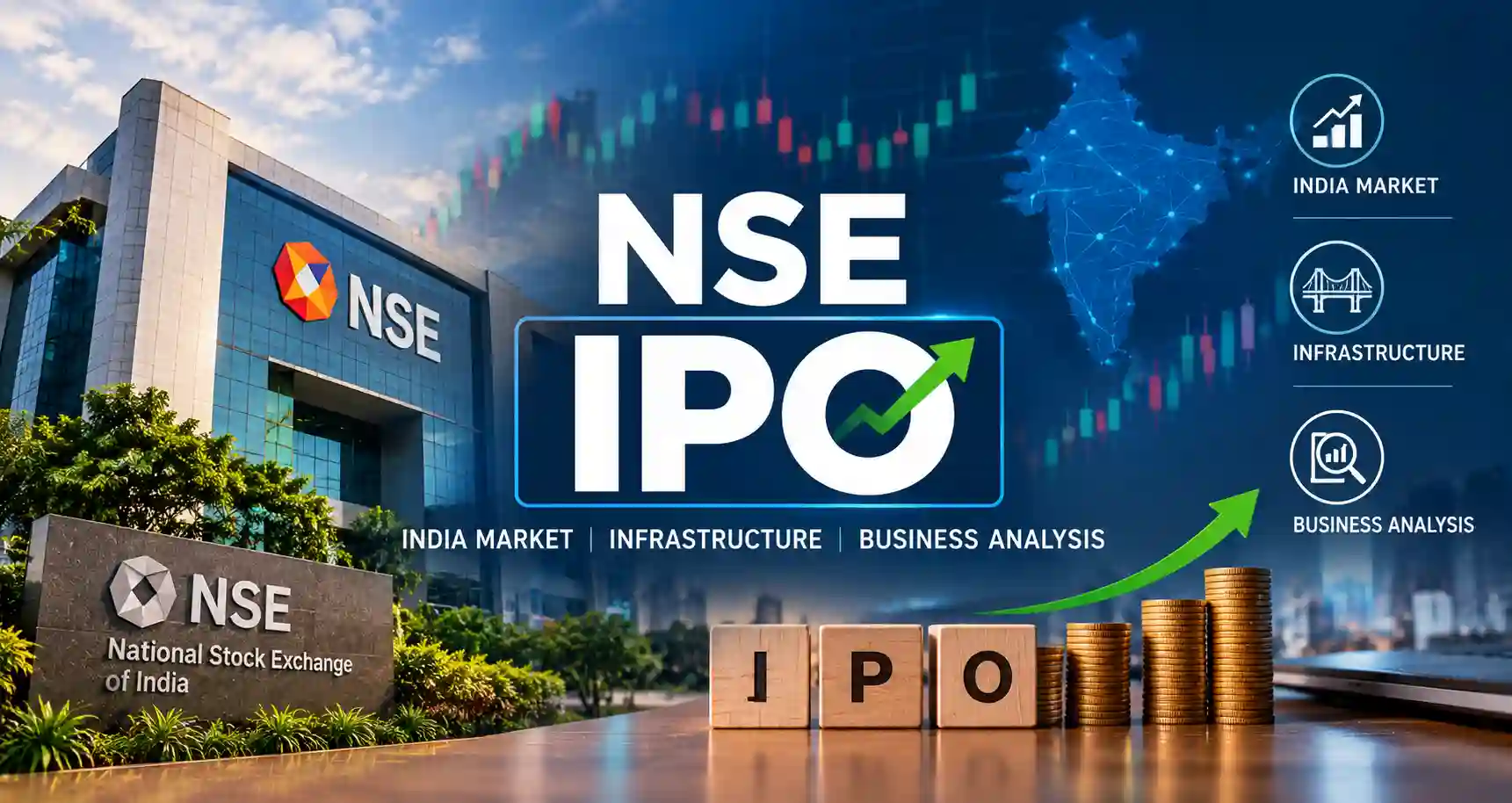

MUMBAI, Sept. 17, 2026 - After years of regulatory delays, legal scrutiny and private-market trading, the National Stock Exchange of India has finally opened its initial public offering to investors.
NSE's IPO is an offer for sale of up to 126,436,650 existing equity shares at a price band of ₹1,700 to ₹1,785 per share. At the upper end of that band, the offer is worth about ₹22,569 crore and implies an equity valuation of roughly ₹4.42 lakh crore.
The minimum bid is eight shares, meaning a retail investor applying at the upper band needs ₹14,280 for one lot.
But the most important fact is not the issue size.
This is a 100% offer-for-sale transaction. NSE itself is not raising fresh growth capital through the IPO. Existing shareholders are selling part of their holdings to public investors.
That makes the central question different from a typical growth-company IPO. Investors are not funding a new factory, branch network or technology buildout. They are buying a small ownership interest in an existing market-infrastructure business that already sits at the centre of India's equity, derivatives, clearing, index and market-data ecosystem.
What exactly are investors buying?
NSE is best known as the venue where millions of investors buy and sell shares. But the listed company investors are buying is much broader than a trading screen.
The group earns revenue from multiple parts of the market infrastructure stack. Its businesses include transaction charges from trading activity, listing services, clearing and settlement, index licensing, market data, colocation and technology services, international-market infrastructure and other capital-market services.
Its subsidiaries extend that ecosystem.
NSE Clearing handles clearing and settlement. NSE Indices develops and licenses benchmark indices. NSE Data & Analytics distributes market information and analytical products. NSE International Exchange operates from GIFT City and provides access to foreign-currency-denominated products.
So the investment case is not simply that more Indians may trade stocks. It is that NSE operates several layers of the infrastructure required for those markets to function.
132.37 million unique investors explain the scale
As of June 30, 2026, NSE reported 132.37 million unique registered investors. That compares with 30.87 million as of March 31, 2020, implying a compound annual growth rate of about 26.23%.
The difference between unique investors and accounts matters. One person can hold more than one trading account.
As of June 30, NSE reported 261.36 million registered investor accounts, almost twice the number of unique investors. The exchange also reported 1,328 trading members and 3,005 listed entities. Those listed entities had an aggregate market capitalisation of ₹474.08 trillion.
This is the basic network effect behind the business.
More listed companies attract investors. More investors create liquidity. Liquidity attracts traders and institutions. Higher participation makes the exchange more useful to issuers.
That cycle can reinforce itself.
NSE's investor reach is now national
NSE says its investors span more than 99% of Indian postal codes.
The exchange's April 2026 investor update showed the unique registered base crossing 130 million. It took 14 years from the start of operations for NSE to reach its first 10 million registered investors. Growth accelerated materially later.
Between FY2021 and FY2026, NSE said its overall investor base grew at a 26.4% compound annual rate.
That expansion matters because market infrastructure businesses can benefit from rising participation even when individual investors are not trading every day. A deeper investor base can support more listings, more mutual-fund activity, more derivatives use, more data consumption and more market-linked products.
The IPO does not give NSE ₹22,569 crore to spend
This point deserves emphasis.
The IPO is not a primary capital raise. It is an offer for sale. The shares already exist and selling shareholders are transferring part of their ownership to public investors.
NSE does not receive the issue proceeds as fresh cash for expansion.
The economic benefit to NSE is primarily the listing itself, broader public ownership, liquidity for existing shareholders and the governance requirements associated with becoming publicly traded.
A ₹22,000-crore-plus IPO can sound like a major infusion of capital. It is not.
The price band implies a demanding valuation
NSE has approximately 247.5 crore shares outstanding after the capital structure reflected in the offer documents.
At ₹1,785 per share, that gives an equity value of about ₹4.42 lakh crore. At ₹1,700, the implied value is about ₹4.21 lakh crore.
NSE reported consolidated profit after tax of ₹10,302 crore for FY2026.
Using the upper-end IPO valuation against that reported FY2026 profit produces a simple trailing price-to-earnings multiple of roughly 42.9 times.
This is not a forecast multiple. It is a basic valuation calculation using the upper-end IPO equity value and reported FY2026 profit.
A multiple above 40 times means investors are paying not only for current earnings but also for expectations that the franchise can continue growing, defend its market position and generate high returns over time.
That creates less room for operational or regulatory disappointment than a much lower valuation would.
FY2026 showed that even a dominant exchange is cyclical
NSE's scale does not make its earnings immune to market cycles.
For FY2026, consolidated revenue from operations was ₹16,601 crore, down about 3% from ₹17,141 crore in FY2025. Consolidated profit after tax was ₹10,302 crore, down about 15% from ₹12,188 crore in the previous year.
Those declines matter because they show that an exchange can have enormous structural advantages while still experiencing weaker annual financial results.
Trading activity changes. Product rules change. Regulatory fees change. Market volatility changes. Derivative volumes can rise or fall.
The business is infrastructure-like, but parts of its revenue remain tied to market activity.
The market-share numbers show why NSE is so valuable
The RHP describes NSE as India's largest exchange across several important trading segments.
For FY2026, NSE reported a 92.99% share of India's cash equity market based on turnover. Its share in equity futures was 99.79%. In equity options, measured using premium turnover, its market share was 74.71%.
Those are exceptionally high figures.
They reveal the strongest part of the investment thesis: liquidity is difficult to displace.
Traders generally prefer venues where other traders already are because deeper liquidity can produce better execution and tighter spreads. That creates a strong network effect.
But market dominance also attracts regulatory scrutiny.
A market infrastructure institution is not a normal private company that can maximize revenue without constraints. It performs a public-market function and operates within detailed rules set by the securities regulator.
NSE is part business and part market utility
This dual role is crucial to understanding the IPO.
NSE is a profit-making company. It is also a frontline market institution.
It supervises trading members, operates market systems, enforces exchange rules, coordinates clearing and settlement infrastructure and plays an important role in market integrity.
Its commercial interests therefore exist inside a regulatory framework that prioritizes orderly markets and investor protection.
This creates a structural tension. A higher-volume product may be commercially attractive. A regulator may still change its rules if it believes market stability or investor protection requires it.
That is one of the biggest differences between investing in an exchange and investing in a conventional technology platform.
Derivatives are both a strength and a concentration risk
NSE's derivatives franchise is one of its most powerful assets.
High liquidity attracts institutional hedgers, proprietary traders, market makers and retail participants.
But derivative activity is also highly sensitive to regulation.
Contract expiries can be redesigned. Lot sizes can change. Transaction taxes can increase. Investor-protection rules can become stricter. The number of permitted weekly contracts can be reduced.
These changes can affect volumes without changing the quality of NSE's technology.
That makes regulatory policy a direct earnings variable.
Investors therefore need to separate two ideas: NSE's market position can remain extremely strong while the economics of a particular product category weaken.
Dominance does not eliminate policy risk.
The technology layer is a major asset
Running a national exchange is ultimately a computing problem.
Orders have to be accepted, validated, matched, confirmed and distributed with extremely high reliability. The system must continue functioning during intense volatility when order traffic can rise dramatically.
According to the IPO material, NSE processed an average of 12.46 billion messages per day between April 2024 and June 2026. Its platform processed a peak of 21.89 billion order messages on March 24, 2026.
That scale is part of what investors are buying.
The exchange is not simply a financial brand. It operates a mission-critical, high-throughput technology platform.
Failures can have systemic consequences. Continued spending on capacity, cybersecurity, resilience, disaster recovery and monitoring is not optional.
Market data is another valuable layer
Every functioning market generates data.
Prices, order books, trades, corporate disclosures, index values and historical datasets all have commercial value.
NSE distributes market data through its data and analytics operations. Professional trading firms need high-quality real-time feeds. Asset managers need index and pricing information. Banks and research firms consume historical and analytical datasets.
Companies and financial products can also pay for index licensing.
These businesses can diversify revenue away from pure trading fees. They are strategically important because data economics can be more recurring and less directly tied to the number of retail orders placed on a particular day.
Clearing makes the ecosystem harder to separate
A trade is not finished when a buyer and seller are matched. It must be cleared and settled.
NSE Clearing sits inside that infrastructure.
The clearing layer manages counterparty obligations, margins, risk controls and settlement processes.
This vertical integration makes the overall ecosystem more difficult to replicate than a simple trading website.
A competing venue would not only need an order-matching engine. It would need liquidity, members, clearing arrangements, risk systems, data infrastructure, connectivity and trust.
That is one reason exchange businesses can develop durable economic moats.
Indices create another recurring revenue stream
Indices are more than market scoreboards. They are financial intellectual property.
Index funds, exchange-traded funds, structured products and derivatives can all be built around licensed benchmarks.
As passive investing expands in India, index intellectual property can become increasingly valuable.
NSE's index business therefore gives shareholders exposure to a broader trend than direct stock trading.
GIFT City is the international option
NSE also has an international growth path through GIFT City.
Its international exchange infrastructure enables trading in foreign-currency-denominated securities and products.
The strategic objective is to capture activity related to India that might otherwise take place outside the country.
This business is still different in scale from the core domestic franchise, but it gives NSE optionality if India's international financial centre continues to grow.
What the ₹4.42 lakh crore valuation is really pricing
At the upper band, investors are paying for several things simultaneously.
They are paying for the existing earnings stream, market dominance, network effects, technology infrastructure, India's expanding investor population, future data and index growth, and the possibility that financialisation continues as household savings move toward market-linked assets.
The valuation also assumes that regulation does not structurally damage the most profitable parts of the business.
That is why the valuation debate cannot be separated from policy risk.
The biggest risks are not ordinary corporate risks
The RHP identifies multiple risks, but several stand out conceptually.
Regulatory intervention
Because NSE is a market infrastructure institution, rules can change the economics of products even when demand remains high.
Trading-volume concentration
Revenue linked to transactions can weaken when volumes fall.
Technology failure
System outages, cyber incidents or capacity problems can create operational, financial and reputational consequences.
Legal and compliance history
NSE's path to listing was delayed for years by regulatory and legal issues. Becoming publicly listed does not erase the need for intense governance and compliance.
Valuation risk
A strong company can still deliver disappointing investment returns if the purchase price already assumes too much future growth.
This is not a statement that the current IPO price is high or low. It is the basic relationship between price and expected return.
Retail mechanics are straightforward
The price band is ₹1,700 to ₹1,785 per share.
The minimum lot is eight shares.
At the upper band, one lot costs ₹14,280.
Retail investors can apply up to the regulatory retail limit of ₹2 lakh.
Eligible employees receive a ₹170-per-share discount and have a separate application limit specified in the offer.
The bidding period runs from September 17 through September 21.
These are operational details. They should not be confused with an investment thesis.
What a shareholder will actually own
A successful applicant does not own the Nifty index itself.
They do not own the companies listed on NSE.
They own shares in National Stock Exchange of India Limited.
That company earns money by operating infrastructure around the market.
If the Indian equity market grows, NSE can benefit through higher activity and more listings. If passive investing expands, its index and data businesses can benefit. If derivative volumes fall because of regulatory changes, earnings can be affected even if long-term investor participation continues rising.
The shareholder is buying the economics of the marketplace, not the returns of the assets traded inside it.
The strict conclusion
NSE's IPO is one of the clearest ways public investors have ever been offered direct ownership in India's capital-market infrastructure.
The franchise is unusually large.
As of June 30, it served 132.37 million unique registered investors, 261.36 million registered accounts, 1,328 trading members and 3,005 listed entities.
Its cash-market share was above 92% in FY2026 and its equity-futures share was close to 100%.
It earned more than ₹10,000 crore in consolidated profit in FY2026.
But none of those facts removes the need to examine price.
At the upper end of the IPO band, the valuation is roughly ₹4.42 lakh crore, equivalent to about 42.9 times FY2026 reported profit on a simple trailing basis.
And because the IPO is entirely an offer for sale, the company itself receives no new operating capital from the issue.
What public investors are buying is therefore not a turnaround story and not a capital-raising growth story.
They are buying a mature, highly profitable, heavily regulated market-infrastructure franchise whose future value depends on India's financial-market growth, trading activity, technology execution, governance and regulatory policy.
That is the real asset behind the IPO.
Not the ticker.
The marketplace itself.
Reader questions
Frequently asked questions
What is the NSE IPO price band?
The official price band is ₹1,700 to ₹1,785 per equity share.
What is the minimum investment in the NSE IPO?
The minimum bid lot is eight shares. At the upper price of ₹1,785, one lot costs ₹14,280.
How large is the NSE IPO?
The offer comprises up to 126,436,650 existing equity shares. At the upper price band, the issue size is approximately ₹22,569 crore.
Does NSE receive money from the IPO?
No fresh capital is being raised for NSE. The IPO is an offer for sale in which existing shareholders sell shares to public investors.
What valuation does the NSE IPO imply?
At ₹1,785 per share, NSE’s approximately 247.5 crore outstanding shares imply an equity valuation of roughly ₹4.42 lakh crore.
How many investors are registered with NSE?
As of June 30, 2026, NSE reported 132.37 million unique registered investors and 261.36 million registered investor accounts.
How profitable is NSE?
NSE reported consolidated profit after tax of ₹10,302 crore for FY2026 on revenue from operations of ₹16,601 crore.
When does the NSE IPO close?
The issue opened on September 17, 2026 and is scheduled to close on September 21, 2026.
What are the main risks for NSE shareholders?
Key risks include regulatory changes, dependence on trading volumes, technology and cybersecurity failures, legal and compliance obligations, concentration in highly active derivatives products and valuation risk.
Nexuswild welcomes factual corrections. Email [email protected] with evidence and the article URL.