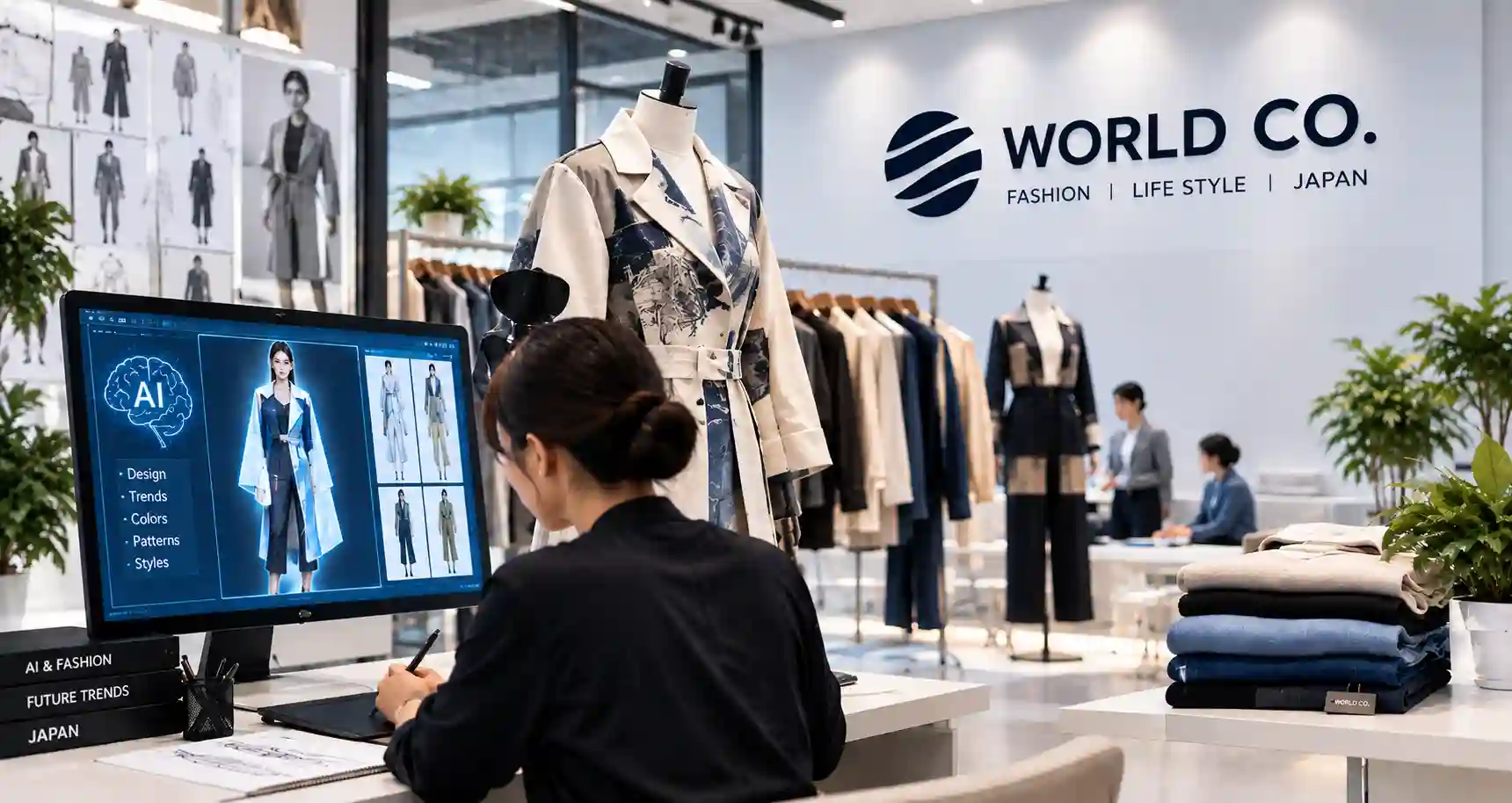

World Co., one of Japan's largest apparel companies, has launched a new brand called OO in which both the garments and the models shown wearing them are created using generative artificial intelligence. According to reporting by Nikkei Asia published August 5, 2026, some items from the AI-designed line sold out shortly after becoming available. The launch comes as World works to rebuild momentum following a rare profit decline in its fiscal year ended February 2026, and as generative AI tools become more widely adopted across Japan's fashion and retail industry.
World Co.'s Position in Japan's Apparel Industry
World Co., Ltd., headquartered in Kobe, was founded in 1959 and has grown into one of Japan's largest apparel groups, ranked as the fourth-largest apparel manufacturer in the country by domestic revenue based on fiscal 2024 results, according to the investment research platform Shared Research. The company operates across the full apparel value chain, from planning and manufacturing to logistics and retail, and manages a broad portfolio of brands spanning womenswear, menswear, childrenswear and lifestyle goods, including labels such as TAKEO KIKUCHI, PINK-latte and the golf apparel brand adabat. World is listed on the Tokyo Stock Exchange under the ticker code 3612.
Recent Financial Performance
World's consolidated results for the fiscal year ended February 2026 showed revenue of 284.014 billion yen, up 26 percent from the prior year, according to the company's earnings report and coverage by the Japanese fashion trade publication Fashionsnap. However, operating profit fell 4 percent to 16.028 billion yen, marking the company's first year-on-year profit decline since its post-pandemic recovery began. Ordinary profit came in at 14.203 billion yen, down 8.4 percent from the prior year and roughly 19.8 percent below the consensus estimate compiled by IFIS, a Japanese financial data provider, according to market data aggregator Monex Scouter.
Fashionsnap reported that the profit decline was driven largely by weak performance in World's core apparel business during the fourth quarter of the fiscal year, which it described as a significant slowdown following an otherwise steady post-pandemic recovery. The fiscal year also marked the final year of World's previous medium-term business plan, known as PLAN-W.
Revenue growth during the year was aided by the full consolidation of Right-on Co., a discount apparel and denim retail chain that became a wholly owned subsidiary of World during the fiscal year. Fashionsnap reported that Right-on's existing-store sales rose 5 percent year on year in its March 2026 monthly results following the change in ownership structure, with World targeting 20 billion yen in Right-on revenue for the fiscal year ending February 2027, an increase of 15 billion yen from the prior year, and said a return to profitability at the subsidiary was within sight.
Alongside its full-year results, World announced a new three-year medium-term business plan called VISION-W, covering the fiscal years ending February 2027 through February 2029. According to Fashionsnap's reporting on the plan, World described its ambition as establishing a "third pole" in the fashion industry, positioned alongside global SPA (specialty store retailer of private label apparel) companies and major retail suppliers, through what the company termed an "overwhelming diversity" strategy that includes accelerating mergers and acquisitions. The company said it aims to eventually reach 500 billion yen in revenue, with a longer-term ambition of 1 trillion yen. For the fiscal year ending February 2027, World's consolidated forecast calls for revenue of 300 billion yen, up 5.6 percent year on year, and business profit of 18.5 billion yen, up 12.4 percent.
World's most recently reported quarterly results, for the three months ended May 2026, the first quarter of the current fiscal year, showed revenue of 74.707 billion yen, up from 70.015 billion yen in the same quarter a year earlier, according to financial data compiled by Matsui Securities. Operating profit for the quarter rose to 7.293 billion yen from 6.774 billion yen, while net profit attributable to owners of the parent increased to 5.451 billion yen from 4.373 billion yen, an increase of roughly 25 percent. Because this quarter ended in May 2026, before the OO brand's reported August 2026 debut, these results do not yet reflect any specific sales contribution from the new AI-designed line.
How AI Is Being Used in the OO Brand
According to Nikkei Asia, World's OO brand makes heavy use of generative AI in its design process, with both the clothing items and the model imagery used to present them created through AI tools rather than conventional design and photography processes. The Nikkei Asia report, citing World, indicated that some OO items sold out shortly after their release, though the full scope of specific sales figures, item counts, or the proportion of the collection that sold out was not available in the portion of the report accessible for this article, as the full Nikkei Asia article sits behind a subscriber paywall. This article does not estimate or infer those figures beyond what has been confirmed.
Separately, World Co. has taken organizational steps toward building internal AI capability that provide relevant context for the OO launch, though they should be understood as background on the company's broader AI strategy rather than confirmed details of the OO brand's specific production process. Since September 2025, World's corporate strategy office has had a dedicated AI Initiative Lead role, according to a company biography published in connection with a speaking appearance at the FaW Tokyo 2026 spring trade event, organized by TV Tokyo. That biography describes the role as encompassing generative AI training for company executives, promotion of internal AI agent adoption, and company-wide AI literacy efforts. The same individual is described as personally working as an AI fashion designer using generative AI tools, and as an organizer of TOKYO AI Fashion Week, an AI-focused design event.
This organizational detail indicates that World has invested in generative AI capability and leadership at the corporate level in the period leading up to the OO brand's debut, but it does not, on its own, confirm which specific AI tools or vendors were used to produce the OO collection. No source available for this article named a specific AI model, software platform, or external technology partner used in the design of OO's garments or model imagery, and this article does not speculate on that detail.
Broader Use of Generative AI in Japan's Fashion Industry
World's OO launch is part of a wider pattern of generative AI adoption across Japan's fashion and apparel sector during 2025 and 2026. Several other examples illustrate the trend, though each involves different companies and technologies from those used by World.
TOKYO AI Fashion Week, an AI-focused fashion design contest and event series, ran a 2026 edition inviting entries built from AI-generated imagery, according to a report from the event announcement platform Koubo. The contest is associated with OpenFashion, a company that has developed generative AI tools aimed at supporting design generation, trend analysis and brand development for apparel companies. OpenFashion's generative AI platform, previously known as Maison AI, has since had its operations transferred to a separate company called AuthenticAI, according to a press release distributed via Oricon in connection with a related AI-generated T-shirt design contest.
Separately, a company called AI model Inc. was featured on the cover of a recent issue of the fashion and beauty trade publication WWD Japan to promote a new service called A/CLOUD, described as generative AI infrastructure for the apparel and beauty industries, according to a report by ASCII. In another example unrelated to World, interior goods and wallpaper brand WhO worked with Pixie Dust Technologies to generate new wallpaper pattern designs using an AI design technology called DeepWear, according to a report from the AI industry publication AIsmiley, illustrating that generative design tools are being applied beyond clothing into adjacent design categories in Japan.
Japan's major online fashion retailer ZOZO has also pointed to AI as a strategic priority. In a public message from ZOZO chief executive Kotaro Sawada published on the company's corporate website, Sawada described artificial intelligence as "a powerful tailwind" for the company's next stage of growth and said ZOZO is developing a fashion-specific AI agent intended to understand individual customer preferences, as part of a medium-term business plan targeting 2030. This reflects a company-level AI strategy focused on personalization and customer-facing recommendation, which is a different application of AI from World's use of generative AI in the design and imagery of the OO brand.
Market research also points to rapid growth in generative AI adoption within the fashion sector globally. According to a Generative AI in Fashion market report cited by the Japanese research distributor GII, the global market for generative AI in fashion was estimated at 180 million dollars in 2025 and was projected to grow to 250 million dollars in 2026, a year-on-year growth rate of roughly 38 percent, with the market expected to reach 740 million dollars by 2030. These figures represent market research estimates and forecasts rather than confirmed, audited industry data, and should be read as an indication of the pace of investment and interest in the category rather than a precise measurement.
Distinguishing Confirmed Facts From Company Statements and Estimates
Several elements of this report are directly confirmed by primary or closely sourced material: World's fiscal year 2026 revenue and profit figures come from the company's own earnings disclosure as reported by Fashionsnap and cross-checked against financial data aggregators including Monex Scouter and Matsui Securities. The existence and basic description of the OO brand, its use of generative AI for both garments and model imagery, and the report of items selling out shortly after release are attributed to Nikkei Asia's August 2026 report.
By contrast, the connection between World's internal AI Initiative Lead role and the OO brand's production is contextual rather than confirmed; this article presents it as relevant background on World's broader AI investment, not as a confirmed account of how OO itself was built. Similarly, the broader Japanese and global generative AI fashion market examples included in this article, such as OpenFashion, AI model Inc., WhO and ZOZO, are separate initiatives from separate companies, included to illustrate the wider industry trend rather than to describe World's own technology choices.
What This Means for World and Japan's Fashion Industry
World's launch of an AI-driven brand arrives at a moment when the company is working to regain momentum after its first profit decline since its pandemic-era recovery, and as it begins executing a new medium-term plan aimed at substantially expanding its scale over the coming years. The reported early sell-through of OO items suggests that AI-generated design and imagery can generate consumer interest, based on the information Nikkei Asia has reported, though the scale of that interest and its overall contribution to World's financial results have not yet been disclosed in verified figures, and World's most recent reported quarterly results predate the brand's debut.
More broadly, World's move reflects a pattern already visible elsewhere in Japan's fashion and retail industry, where companies ranging from large platforms like ZOZO to smaller specialized AI vendors are investing in generative AI for design, imagery, personalization and trend analysis. Whether generative AI design becomes a lasting part of how major Japanese apparel companies build their collections, or remains a limited-scale experiment confined to specific capsule brands like OO, will depend on results and disclosures that have not yet been published, and this article does not predict that outcome.
Further reading and useful links
Nexuswild welcomes factual corrections. Email [email protected] with evidence and the article URL.