
The Indian defence manufacturing and shipbuilding sector has been the cornerstone of one of the most remarkable wealth-creation cycles in the Indian equity markets over the past five years. Driven by the government's aggressive "Aatmanirbhar Bharat" (self-reliant India) indigenization mandate and massive capital allocations for naval modernization, Public Sector Undertaking (PSU) shipyards experienced unprecedented re-ratings. However, the momentum has shifted significantly in recent months. The stock market's relentless pursuit of growth visibility, combined with stretched valuation multiples and instances of profit booking, has led to a steep correction in the sector's most prominent names among shipyard stocks India has to offer.
As of September 2026, two of India’s premier government-owned shipbuilders - Mazagon Dock Shipbuilders Limited (MDL) and Cochin Shipyard Limited (CSL) - have seen their share prices plummet by approximately 40 percent and 53 percent, respectively, from their all-time highs touched in the previous year. While this sharp correction has alarmed retail investors, institutional market participants are closely monitoring the underlying business fundamentals. With shipyard stocks down heavily, the decline in stock prices has occurred precisely when the Ministry of Defence and the Ministry of Ports, Shipping and Waterways are preparing to execute the next massive wave of maritime infrastructure and naval combatant orders.
This comprehensive financial analysis examines the recent share-price declines of Mazagon Dock and Cochin Shipyard, breaking down their current order books, financial health, and valuation metrics. It further explores the upcoming multibillion-dollar defence and commercial shipbuilding pipeline in India, analyzing the potential catalysts and inherent execution risks that will dictate the shipbuilding stocks outlook for the medium term.
Two PSU Shipyard Stocks in Focus
To contextualize the recent market movements, it is essential to understand the distinct operational moats and strategic importance of the two shipyards in question.
Mazagon Dock Shipbuilders Limited (MDL)
Headquartered in Mumbai, Mazagon Dock is arguably the most critical shipyard in India's naval defence ecosystem. Administered by the Ministry of Defence, MDL holds the unique distinction of being the only shipyard in India equipped to build conventional submarines and advanced stealth destroyers. The yard's historical pedigree includes the successful delivery of the Scorpene-class (Kalvari-class) submarines, the Project 15B Visakhapatnam-class destroyers, and the Project 17A Nilgiri-class stealth frigates. Because of its specialized capabilities in sub-surface combatants, MDL operates with an almost monopolistic advantage in high-end naval combat shipbuilding.
Cochin Shipyard Limited (CSL)
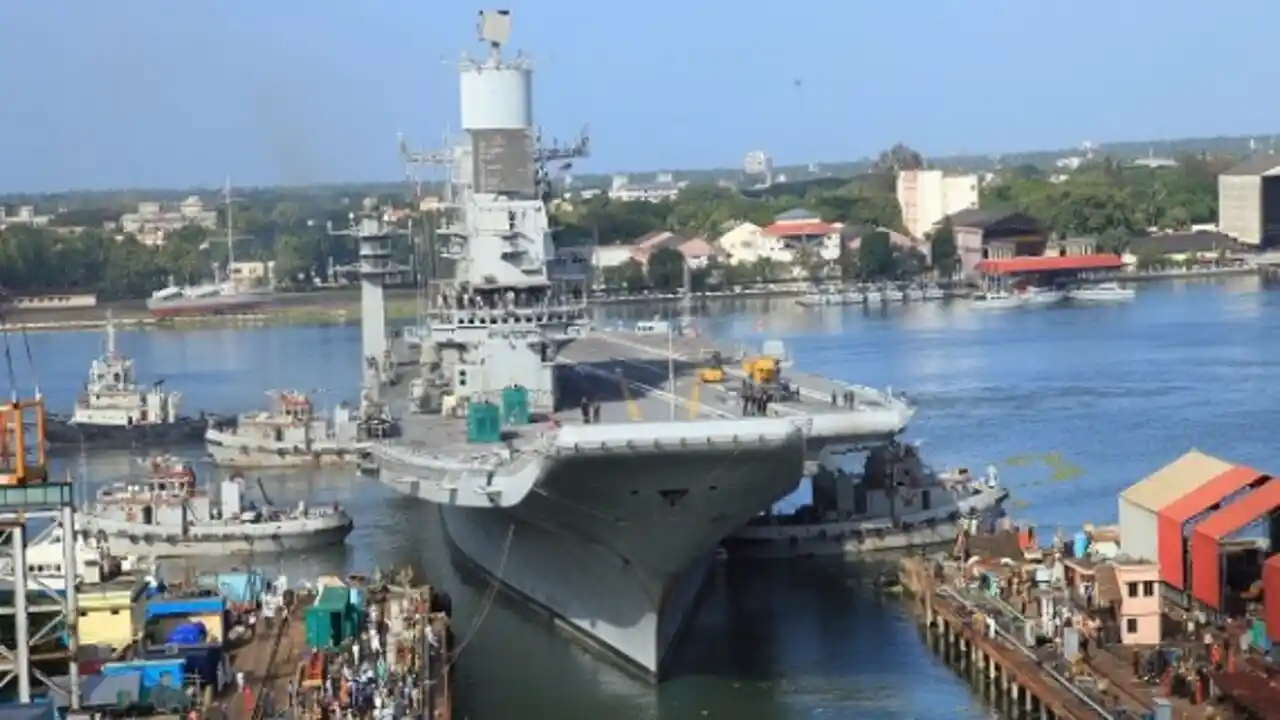
Located in Kochi, Kerala, Cochin Shipyard is India’s largest commercial shipbuilder and ship-repair facility. Also functioning as a critical defence contractor, CSL gained global recognition for successfully constructing India’s first Indigenous Aircraft Carrier (IAC-1), the INS Vikrant. While MDL is heavily concentrated on pure defence contracts, CSL maintains a highly diversified business model spanning defence shipbuilding, commercial vessel construction, advanced autonomous vessels for European clients, and a highly lucrative, high-margin ship-repair division.
Recent Share-Price Decline: The Market Correction
The extraordinary bull run, which initially commanded an unprecedented premium among defence stocks India has witnessed, pushed valuations to historic levels, setting the stage for a volatile correction when order inflows temporarily decelerated.
During the peak of the defence rally in May 2025, Mazagon Dock's stock price touched a record high of ₹3,778 on the National Stock Exchange (NSE). However, as market sentiment cooled and concerns regarding the company's shrinking backlog surfaced, the stock witnessed heavy profit booking. By the trading sessions of mid-September 2026, the stock had settled around the ₹2,280 mark. This represents a steep decline of approximately 40 percent from its lifetime high.
Cochin Shipyard experienced an even more dramatic price contraction. After hitting a lifetime peak of roughly ₹2,979, driven by exuberance over green-energy vessels and ship-repair expansions, the stock faced a severe downward channel. As of late September 2026, CSL shares were trading near ₹1,398. This marks a massive 53 percent decline from its historical peak, reflecting broader market anxiety over execution delays, rising input costs, and elevated borrowing levels.
Order Books and Major Contracts: A Tale of Two Backlogs
The divergent market narratives surrounding MDL and CSL are best understood by examining their respective order books. In the capital goods and shipbuilding sector, the "order-book-to-revenue ratio" is the ultimate metric, and the shipbuilding order book provides future earnings visibility.
Mazagon Dock: Rapid Execution Meets Shrinking Visibility
Mazagon Dock's primary challenge is a byproduct of its own operational efficiency. Over the past three years, the company has executed and delivered warships at a commendable pace. However, the Ministry of Defence has not finalized new mega-contracts fast enough to replace the executed projects.
According to its Q1 FY27 investor presentation filed in late 2026, MDL’s order book shrank to ₹18,218 crore as of June 30, 2026, down 11 percent from ₹20,535 crore in March 2026. To put this in perspective, the company boasted an order book of nearly ₹49,700 crore at the end of FY21. The current backlog relies heavily on the remaining work for the Project 17A stealth frigates (accounting for roughly ₹7,587 crore), alongside pending spares and refit work.
When measured against its robust FY26 revenue of ₹13,006 crore, Mazagon Dock currently possesses only about 1.4 years of revenue visibility. The market is pricing in the risk that if new orders are not signed imminently, the yard will face a revenue vacuum by FY28.
Cochin Shipyard: Strong Visibility with Expanding Repair Moats
Conversely, Cochin Shipyard has successfully maintained and grown its backlog. As of September 10, 2026, CSL’s updated order book stood at a robust ₹21,900 crore. Based on the company's annual revenue run rate, this provides strong earnings visibility for over five years.
CSL’s backlog is heavily supported by the Indian Navy's Next Generation Missile Vessels (NGMV) contract, ongoing commercial ship construction for European clients, and long-term ship-repair contracts. Furthermore, in September 2026, the CSL board approved a strategic 50:50 Joint Venture with DP World's Drydocks World Dubai to operate the International Ship Repair Facility (ISRF) in Kochi. This JV, valuing the facility at a minimum of ₹1,800 crore, significantly strengthens CSL’s long-term margin profile in the highly profitable global ship-repair market.
India’s Upcoming Shipbuilding Order Pipeline
While the current order books highlight near-term challenges - particularly for MDL - the macroeconomic and geopolitical landscape suggests a massive influx of new orders is on the horizon. The Indian government has made maritime security and domestic shipping capacity central pillars of its national security strategy.
The Project 75I Submarine Programme
The single largest catalyst for the India shipbuilding sector is the Indian Navy's Project 75 (India) [P75I] submarine acquisition programme. This mega-tender involves the construction of six advanced conventional submarines equipped with Air Independent Propulsion (AIP) systems. The contract value is estimated to easily exceed ₹43,000 crore. Mazagon Dock (in collaboration with Germany’s TKMS) is one of the two primary contenders for this project. Additionally, MDL is heavily anticipating a follow-on order for three more Kalvari-class (Scorpene) submarines. If MDL secures these contracts, its current "shrinking backlog" narrative will be instantly negated, pushing its order book well past the ₹1 lakh crore mark.
The Rs 69,725 Crore Maritime Package
Beyond military vessels, the commercial shipbuilding sector is poised for a historic government intervention. The Union Cabinet cleared a comprehensive ₹69,725 crore package aimed at revitalizing domestic commercial shipbuilding. This includes the establishment of a ₹25,000 crore Maritime Development Fund (MDF) to provide cheap, long-term financing to fleet owners, and a ₹19,989 crore scheme designed to elevate India’s national shipbuilding capacity to 4.5 million gross tonnes annually. Yards like Cochin Shipyard, with established commercial building docks, are perfectly positioned to capture the domestic demand generated by this subsidized financing.
Next-Generation Naval Combatants
The Indian Navy's Maritime Capability Perspective Plan envisions a 170-to-175 ship fleet by 2035. This necessitates the procurement of Next Generation Destroyers (NGD), Next Generation Corvettes (NGC), and additional fleet support ships. Both MDL and CSL, alongside other PSU yards like GRSE, will be the primary recipients of these impending tenders over the next 24 to 36 months.
Financial Performance and Valuation Analysis
To evaluate whether the 40–53% decline represents a buying opportunity or a rational market pricing of risk, investors must scrutinize the latest financial metrics and valuation multiples.
Mazagon Dock: High Earnings, Negative Cash Flows
MDL has demonstrated stellar revenue and profit growth. Between FY21 and FY26, the company’s sales grew at a Compound Annual Growth Rate (CAGR) of 26 percent, reaching ₹13,006 crore in FY26. Over the same period, EBITDA surged at a 59 percent CAGR to ₹2,268 crore, and Net Profit hit ₹2,578 crore in FY26.
However, a deeper dive into the financials reveals significant cash flow discrepancies. In FY26, a substantial portion of MDL’s pre-tax profit (approximately 35 percent, or ₹1,139 crore) was generated from "other income" - primarily interest earned on massive customer advances from the Ministry of Defence, rather than core operational shipbuilding margins. More alarmingly, as older projects near completion and advances are exhausted, the company's cash flow from operations in FY26 turned negative at ₹2,654 crore, with free cash flow dropping to a negative ₹2,828 crore.
Despite these cash flow concerns and only 1.4 years of order visibility, MDL trades at a Price-to-Earnings (PE) ratio of approximately 32x. While this is cheaper than its peak, it remains a demanding multiple for a heavy-engineering firm facing an impending revenue cliff if new submarine orders are delayed.
Cochin Shipyard: Margin Pressure and Rising Debt
Cochin Shipyard has historically been prized for its stable execution, but recent quarters have shown strain. During Q1 FY27, CSL's standalone net profit dipped to ₹136 crore, reflecting the impact of volatile steel prices and raw material inflation on construction margins.
The company's balance sheet has also taken on leverage to fund its expansion. CSL’s borrowings escalated from ₹501 crore in FY25 to roughly ₹1,575 crore in FY26, representing about 27 percent of its net worth. Consequently, interest costs doubled to ₹98 crore. Like MDL, CSL also reported negative cash from operations (negative ₹1,253 crore) and negative free cash flow (negative ₹1,391 crore) in FY26, driven by a ballooning inventory cycle that stretched to 425 days.
Despite possessing over five years of order book visibility and guiding for a blended 14 percent EBITDA margin over the next two years, the market has heavily penalized CSL’s near-term execution hiccups. At a current price of ₹1,398, CSL is trading at a staggering PE ratio of roughly 62x. The market is valuing CSL at 1.7 times its order book (compared to MDL at 5 times its order book), highlighting a massive premium placed on CSL's earnings despite the recent margin compression.
Potential Catalysts for a Re-rating
While the stocks are currently locked in a bearish trend, several imminent catalysts could trigger a structural reversal for these PSU shipyards. It is crucial to note that these are potential scenarios dependent on government action, not guaranteed outcomes.
- Award of the Project 75I Submarine Contract: The finalization and awarding of the six AIP-capable submarines will instantly solve Mazagon Dock's visibility crisis. Given the strategic urgency of matching regional naval deployments, defence analysts expect the Ministry of Defence to expedite this contract.
- Aggressive Capacity Expansion Initiatives: To secure future growth, Mazagon Dock has initiated an aggressive capital expenditure program. In mid-September 2026, MDL informed the exchanges that it agreed to anchor massive greenfield shipbuilding clusters at Dighi (Maharashtra) and Dugarajapatnam (Andhra Pradesh), targeting 1.2 million gross tonnes per site. With an estimated combined investment signal of ₹30,000 crore over the long term, these facilities will drastically expand MDL's footprint. The successful acquisition of 51 percent of Sri Lanka's Colombo Dockyard also opens new avenues for foreign commercial orders.
- Monetization of Ship Repair JVs: Cochin Shipyard's 50:50 Joint Venture with Drydocks World Dubai is a massive value-unlocking event. If CSL can successfully integrate Dubai's global maritime network into the Kochi International Ship Repair Facility, the high-margin repair business could offset the volatile raw-material costs associated with long-duration shipbuilding, driving sustained earnings upgrades.
- Export Order Breakthroughs: Both yards have been aggressively bidding for export contracts in Southeast Asia, the Middle East, and South America. Securing a major warship or offshore patrol vessel contract from a foreign navy would prove the global competitiveness of Indian PSU yards and trigger an immediate valuation re-rating.
Key Risks and Headwinds
Investing in PSU defence stocks carries a unique set of macroeconomic and operational risks. Investors must weigh the potential order pipeline against several formidable headwinds.
- Order Finalization Delays: The Indian defence procurement process is notoriously bureaucratic and subject to extensive delays. The Project 75I submarine tender has already faced multiple timeline revisions over the past decade. If this mega-order slips by another 12 to 18 months, Mazagon Dock will be forced to stretch its remaining ₹18,218 crore backlog across multiple financial years, resulting in a severe contraction in annual revenue and EPS.
- Cost Inflation and Margin Compression: Shipbuilding contracts are generally fixed-price or feature capped escalation clauses, yet they take 5 to 7 years to execute. Any sustained spike in global steel prices, specialized alloys, or critical imported propulsion components will severely erode operating margins. Cochin Shipyard’s recent margin dip is a direct reflection of this vulnerability.
- Execution and Supply Chain Risks: Modern warships heavily rely on integrated electronic warfare suites, gas turbines, and specialized weapon systems imported from Europe, Israel, and the United States. Global supply chain disruptions or geopolitical trade embargoes can halt domestic shipbuilding schedules, triggering massive financial penalties (liquidated damages) from the Indian Navy.
- Negative Operating Cash Flows: As highlighted in the FY26 financial data, both MDL and CSL are currently burning cash at an operating level. The reliance on upfront customer advances is decreasing as legacy projects conclude. If the yards are forced to rely on external commercial borrowings to fund working capital and their massive planned capex (such as MDL's Dighi cluster), rising interest costs will directly suppress net profitability.
Analyst and Company Views
The sharp 40–53% correction has polarized opinions within the financial and maritime analysis communities.
From a corporate perspective, the management of both PSUs remains highly optimistic about the medium-to-long-term trajectory. Cochin Shipyard's leadership recently guided the market toward a confident 14 percent blended EBITDA margin for the upcoming two fiscal years, emphasizing that they expect to convert 12 to 15 percent of their massive ₹21,900 crore order book into revenue annually. The formal approval of the Dubai Drydocks JV is viewed by CSL management as a transformative step in capturing the global commercial ship-repair market.
Mazagon Dock’s management is projecting supreme confidence through its capital allocation strategy. By initiating talks for massive greenfield clusters at Dighi and Dugarajapatnam and acquiring foreign assets like Colombo Dockyard, the leadership is signaling to the market that they anticipate an overwhelming volume of future orders that will far exceed their current Mumbai facility's capacity.
However, independent equity analysts urge caution regarding the timing of these future cash flows. Analysts point out that the market previously priced these stocks for perfection. Trading at 32x and 62x trailing earnings, any execution stumble or delay in the Ministry of Defence's procurement timelines results in immediate and brutal valuation downgrades. Sector experts note that while the maritime development package is a game-changer for the industry, translating those government allocations into signed shipyard contracts, and eventually into recognized revenue, is a multi-year process.
The 40 to 53 percent share-price decline experienced by Mazagon Dock Shipbuilders and Cochin Shipyard serves as a stark reminder of the cyclicality and volatility inherent in the capital goods and defence sectors. The correction has successfully stripped away much of the speculative froth that categorized the 2024-2025 defence bull run, bringing valuations slightly closer to historical norms. However, the underlying structural thesis for India's shipbuilding sector remains fully intact. The geopolitical necessity for a modernized, blue-water Indian Navy and the economic imperative to build domestic commercial shipping capacity guarantee that tens of thousands of crores will be injected into the sector over the next decade. For Mazagon Dock, the immediate future hinges entirely on the swift finalization of the Project 75I and Kalvari-class submarine orders to replenish a rapidly depleting backlog. For Cochin Shipyard, the focus rests on defending its operating margins against commodity inflation and successfully monetizing its new international ship-repair joint venture. While predicting the exact bottom of a stock market correction is impossible, investors are watching these two shipyard entities closely. If the anticipated mega-orders from the Indian Navy and the commercial maritime sector materialize in the coming quarters, MDL and CSL possess the infrastructural moats and strategic positioning necessary to benefit profoundly from India’s next major shipbuilding wave, charting the trajectory of these strategic PSU entities, a bellwether for Indian shipbuilding stocks.
Further reading and useful links
Reader questions
Frequently asked questions
Why have Mazagon Dock and Cochin Shipyard stocks fallen recently?
Both stocks corrected sharply - Mazagon Dock by roughly 40% and Cochin Shipyard by 53% - due to heavy profit booking after historic rallies, concerns over stretched valuation multiples, and slowing near-term order inflows.
What is the Project 75I submarine programme?
Project 75I is a mega-tender by the Indian Navy to acquire six advanced conventional submarines equipped with Air Independent Propulsion (AIP) systems. The contract value is estimated to exceed ₹43,000 crore, making it a critical catalyst for yards like Mazagon Dock.
How will the government's ₹69,725 crore package affect shipbuilders?
The package, approved by the Union Cabinet, aims to revitalize India's commercial shipbuilding sector. It includes establishing a Maritime Development Fund (MDF) and provides subsidized financing to fleet owners, generating significant domestic demand for commercial shipbuilders like Cochin Shipyard.
What is the new joint venture announced by Cochin Shipyard?
In September 2026, Cochin Shipyard executed a 50:50 Joint Venture agreement with DP World's Drydocks World Dubai to operate its International Ship Repair Facility (ISRF) in Kochi. This JV values the facility at roughly ₹1,800 crore and focuses on high-margin ship-repair operations.
Nexuswild welcomes factual corrections. Email [email protected] with evidence and the article URL.