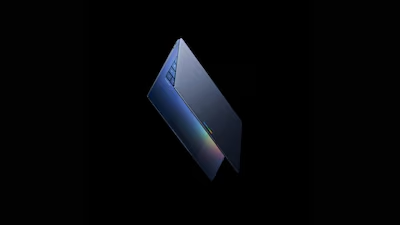

The personal computing landscape has entered a transformative era characterized by hardware that actively anticipates user needs rather than passively waiting for commands. In a landmark collaboration announced in September 2026, Google and Qualcomm Technologies, Inc. unveiled an entirely new category of premium mobile computing: the Googlebook. Powered by the highly advanced Snapdragon X Elite architecture, these AI-powered laptops are engineered specifically to run Google's Gemini Intelligence natively on the device.
For years, the technology industry has chased the vision of a truly intelligent computer - a device capable of understanding conversational context, executing multi-step workflows, and syncing flawlessly with mobile ecosystems. By pairing Qualcomm’s industry-leading power efficiency and neural processing capabilities with Google’s expansive generative AI and Android ecosystems, the two technology giants have materialized this vision. The Googlebook represents a strategic departure from legacy laptop designs, moving the industry past raw computing metrics and toward "agentic AI" - an environment where artificial intelligence acts as a proactive, deeply integrated assistant.
From advanced privacy protocols that process sensitive queries entirely offline to revolutionary features like Magic Pointer and Rambler that redefine user input, these devices set a new benchmark for modern productivity. This comprehensive analysis explores the hardware specifications, Gemini-driven software capabilities, Qualcomm processing power, and the broader industry significance of the first generation of Google Qualcomm AI laptops.
New AI-Powered Laptops: The Googlebook Era
The introduction of Googlebook marks the debut of purpose-built hardware optimized exclusively for an AI-first workflow. Initial launch partners Dell and HP have led the market, designing ultra-portable, premium laptops that leverage the unique thermal and processing advantages of the Snapdragon platform.
The HP Googlebook 14 exemplifies the ambitious hardware standards of this new laptop category. Designed for independent professionals, business owners, and intensive mobile users, the device is built around a vibrant 14-inch, up to 3K OLED touch display featuring a buttery-smooth 120Hz refresh rate. The visual clarity of the OLED panel is complemented by premium quad speakers that deliver rich, room-filling audio, making the hardware equally suited for intensive video conferencing and high-end media consumption.
Underneath the ultra-thin chassis, the device features up to 32GB of high-speed memory and up to 1TB of solid-state storage. Because AI workloads can generate substantial thermal output during extended sessions, the HP Googlebook utilizes advanced Vapor Chamber Thermal Cooling technology. This cooling solution enhances heat dissipation, allowing the laptop to maintain peak, quiet performance during demanding generative AI tasks without succumbing to thermal throttling. Additionally, it features a high-resolution 5MP web camera, ensuring that users look sharp and professional during remote communications.
Dell has matched this momentum with the introduction of the XPS Googlebook. Known for its premium craftsmanship, aerospace-grade materials, and edge-to-edge display aesthetics, the XPS line has been re-architected to fully house the Snapdragon X Elite platform alongside Google's Android-focused software experience. Both manufacturers have prioritized exceptional mobility, crafting devices that weigh mere fractions of traditional workstation laptops while delivering superior on-the-go performance.
Gemini Integration and AI Features
The defining characteristic of the Googlebook is its native integration with Gemini Intelligence. Rather than existing as a separate application or web portal, Gemini is woven directly into the core operating system, functioning as a proactive intelligence layer that observes, assists, and executes tasks based on user permission and context.
Magic Pointer
One of the most innovative interface breakthroughs is the "Magic Pointer" functionality. By simply wiggling the cursor, users can instantly activate Gemini Intelligence overlaid on their current workspace. The Magic Pointer utilizes the on-screen content as direct context for its AI. For example, a user reading a complex financial report can wiggle the pointer over a specific data table and instantly ask Gemini to summarize the figures, compare them to historical data, or generate an accompanying chart, without ever leaving the active window or copying and pasting text.
Rambler
Addressing the often-messy reality of human thought and dictation, Googlebook introduces "Rambler". Activated via a dedicated dictation key on the keyboard, Rambler is a highly advanced voice-to-text tool that acts as a real-time editor. When a user talks through their ideas, Rambler automatically removes filler words like "um" or "uh," structures fragmented sentences, and formats the output into clean, organized text. Whether brainstorming a creative project, outlining an email, or even dictating code syntax, Rambler turns a stream of consciousness into polished, ready-to-share notes.
Spark and Google AI Pro
Acting as a dedicated, 24/7 personal assistant, the "Spark" feature allows users to assign complex tasks to the device, close the laptop lid, and let the machine work independently. Furthermore, to ensure users can fully leverage these generative AI capabilities out of the box, devices like the HP Googlebook 14 include 12 months of Google AI Pro at no additional cost, unlocking expanded access to the most powerful Gemini models and 5 TB of cloud storage.
Agentic AI Workflows
The culmination of these features results in what the industry refers to as "Agentic AI." Unlike simple generative AI that answers a singular prompt, agentic AI takes a high-level, user-directed goal, independently breaks it down into logical steps, utilizes available software tools, and completes the entire workflow. Googlebooks can draft emails, generate original imagery, upscale designs, and organize calendars autonomously, freeing the user to focus on higher-level strategic thinking.
Qualcomm Snapdragon Technology
The technological foundation that makes this seamless AI experience possible is the Qualcomm Snapdragon X Elite platform. Designed from the ground up for extreme power efficiency and computational speed, this System-on-a-Chip (SoC) architecture represents a massive leap forward in personal computing.
At the heart of the Snapdragon X Elite is the Qualcomm Oryon CPU, which delivers lightning-fast responsiveness and handles traditional processing workloads with unprecedented speed. This is paired with the integrated Qualcomm Adreno GPU, engineered to provide crisp, immersive visuals required for high-refresh-rate OLED displays and creative design applications.
However, the crown jewel of the Snapdragon X Elite is its dedicated Neural Processing Unit (NPU) known as the Qualcomm Hexagon NPU. The NPU is specifically designed to accelerate complex mathematical equations required for machine learning and artificial intelligence, executing these tasks far more efficiently than a standard CPU or GPU. Current Snapdragon X Elite processors deliver an extraordinary 45 Trillion Operations Per Second (TOPS) of AI performance. This immense processing power allows the chip to run Large Language Models (LLMs) featuring over 13 billion parameters entirely on the device at blazing-fast speeds.
Furthermore, the architecture is incredibly power-efficient. By routing AI tasks to the dedicated NPU rather than the power-hungry CPU, the Snapdragon platform achieves remarkable energy preservation. Users can experience up to 19 hours of battery life on a single charge, allowing for multi-day usage for standard workloads without needing to carry a power adapter.
Looking toward the immediate future, Qualcomm has already confirmed that next-generation Snapdragon X2 Elite processors (slated for upcoming releases) will push this boundary even further, delivering up to 80 TOPS of AI performance. These future iterations will be capable of running multiple multimodal AI models simultaneously, processing text, video, and audio concurrently with zero latency.
On-Device AI and Performance: Redefining Privacy and Speed
Historically, the vast majority of consumer AI tools operated in the cloud. When a user asked a smart assistant a question, the audio or text was transmitted via the internet to a massive server farm, processed, and the result was transmitted back. While effective, this cloud-dependent model introduced three major bottlenecks: latency, reliance on constant internet connectivity, and severe data privacy concerns.
The Googlebook, powered by the Snapdragon X Elite, shifts this paradigm entirely to "On-Device AI". Because the NPU is powerful enough to run LLMs locally, features like real-time language translation, smart noise cancellation during video calls, and document analysis happen directly on the laptop's own processor and memory. This means that Gemini Intelligence remains fully functional even when the user is completely offline, working on an airplane or in a remote location without Wi-Fi.
Crucially, on-device AI offers a massive advantage in personal and corporate privacy. When a user asks Gemini to summarize a highly confidential legal document or analyze personal financial spreadsheets using the Magic Pointer, the data never leaves the laptop. It is not uploaded to a remote server, and it is not used to train external models. The Snapdragon X Elite chips utilize a dedicated, hardware-level security architecture that creates isolated, protected environments (secure enclaves) for processing sensitive data.
The SoC also features an updated dual Micro NPU located inside the ultra-low-power Qualcomm Sensing Hub. This dedicated hub manages background security and privacy features with minimal battery drain, enabling sophisticated biometric experiences like "wake-on-approach," where the laptop securely recognizes the authorized user and unlocks the screen before they even touch the keyboard.
The Native Android Ecosystem and Cross-Device Continuity
Beyond its AI capabilities, the Googlebook solves one of the longest-standing frustrations in personal technology: the fragmentation between the smartphone and the laptop. For years, mobile operating systems and desktop environments existed as isolated silos. With the introduction of these new AI laptops, Google and Qualcomm have bridged the gap, turning the laptop into a seamless extension of the mobile experience.
Because the Snapdragon X Elite relies on an Arm-based architecture similar to the processors powering modern smartphones, Googlebook laptops can support thousands of native Android applications and games. Users are no longer required to search for inferior web-based versions of their favorite mobile apps; they can download and run the native Android software directly on their 14-inch OLED screens with full keyboard and trackpad support. Furthermore, because the hardware utilizes Snapdragon Elite Gaming technology, users benefit from faster frame rates and enhanced graphics rendering, bringing premium mobile gaming natively to the laptop platform.
The cross-device connectivity is further enhanced by the "Cast my Apps" feature. Without requiring any complex software installations or cables, users can mirror and interact with their Android phone's applications directly on the Googlebook display. A user can respond to encrypted mobile text messages, manage mobile-only smart home applications, or order food from a local delivery app without ever taking their smartphone out of their pocket or leaving their primary laptop workflow.
This deep ecosystem integration means the laptop is no longer just a standalone computing device; it is a unified command center for the user's entire digital life, adapting to their habits and flowing with them throughout the day.
Pricing and Availability
The initial wave of AI-powered laptops is aggressively targeting the premium and upper-mid-range consumer electronics market. The hardware is specifically positioned for power users, independent professionals, content creators, and dedicated Android ecosystem enthusiasts who demand top-tier performance and proactive intelligence.
Pre-orders for the flagship devices from Dell and HP are currently open globally through the official Googlebook online storefront, as well as through the manufacturers' direct retail channels. While exact pricing tiers for the highest-end configurations of the XPS Googlebook and HP Googlebook 14 vary based on memory and storage customizations, the broader market entry point is highly competitive. Industry reports indicate that partner brands like Acer are also entering the ecosystem, launching hardware such as the OLED-equipped Googlebook 14 at a highly accessible $899 price point.
Buyers of premium models will also receive significant software-added value, including the aforementioned 12 months of Google AI Pro, and up to $350 in curated premium applications provided at no additional cost for a limited time following the launch window.
Industry Significance: A New Definition for the AI PC
The launch of the Googlebook represents a structural shift in the global technology market. During the initial phase of the "AI PC" movement, semiconductor manufacturers primarily competed on raw hardware metrics - debating NPU TOPS scores, clock speeds, and basic battery longevity. The collaboration between Google and Qualcomm pivots the industry's focus toward the actual experiential integration of AI.
As highlighted by industry analysts, the Googlebook points toward a much broader definition of an AI computer. By embedding local AI processing into a wider system where the computer natively understands context (via Magic Pointer) and assists users across interconnected smartphone and desktop tasks, the underlying hardware becomes almost invisible to the user. The Hexagon NPU provides the silent, powerful engine, while Gemini provides the intuitive, conversational interface.
Furthermore, extending Google's massive Android mobile footprint natively into the laptop sector creates a formidable computing environment. By removing the historical friction between mobile and PC, Qualcomm and Google are offering a cohesive, unified alternative that fundamentally reshapes how consumers evaluate their technology purchases.
Expert and Company Views
The strategic importance of this hardware launch has been heavily emphasized by the executive leadership driving the partnership. Kedar Kondap, Senior Vice President and General Manager of Compute and Gaming at Qualcomm Technologies, highlighted the transformative nature of the new silicon.
“The leading AI capabilities of Snapdragon X Elite have transformed personal computing and created new opportunities for more intelligent, personalized and productive experiences,” stated Kondap in the official launch announcement. He further emphasized the dual nature of the platform's success: “Snapdragon X Elite delivers extraordinary performance and efficiency, now paired with support for native Android apps and games for Googlebooks users. We are proud to work with Google as well as global OEMs, starting with Dell and HP, to enable the cutting-edge capabilities of this new category of laptops".
Representatives from hardware partners have echoed this enthusiasm. Dell's leadership noted that the XPS Googlebook brings together their legendary hardware craftsmanship with the long battery life of the Snapdragon platform, resulting in a premium device built specifically for modern digital users. HP similarly praised the combination of efficiency, edge AI, and native Android access as the necessary blueprint for keeping modern freelancers and business owners connected and highly productive.
Conclusion
The introduction of the Googlebook powered by Qualcomm’s Snapdragon X Elite represents one of the most significant architectural leaps in recent personal computing history. By moving away from cloud-dependent processing and bringing Google’s powerful Gemini Intelligence directly onto the local device, this new category of laptops delivers unprecedented privacy, zero-latency responsiveness, and remarkable offline capabilities.
Through innovative tools like Magic Pointer, Rambler, and agentic AI automation, the traditional barriers between human intent and computer execution are rapidly dissolving. Furthermore, the seamless integration of native Android applications and the Cast my Apps feature creates a unified, cross-device ecosystem that modern professionals have long demanded.
As Dell, HP, and other leading manufacturers bring these powerful, ultra-efficient devices to market, the standard for what a premium laptop must deliver has been permanently elevated. The era of the true AI PC has officially arrived, promising a future where technology is not just a tool we use, but an intelligent, proactive partner in our daily workflows.
Further reading and useful links
Reader questions
Frequently asked questions
What is the new Googlebook laptop category?
The Googlebook is a new premium class of mobile computing developed by Google and Qualcomm, powered by Snapdragon X Elite processors and engineered to run Google's Gemini Intelligence natively on-device.
What processor powers the Googlebook?
The initial generation is powered by Qualcomm's Snapdragon X Elite platform, featuring the Qualcomm Oryon CPU, Adreno GPU, and a Hexagon NPU delivering 45 TOPS of on-device AI performance.
Can Googlebook laptops run Android apps?
Yes, built on an Arm-based architecture, Googlebooks natively support thousands of Android applications and games, alongside features like 'Cast my Apps' for seamless phone-to-laptop mirroring.
What are key AI features like Magic Pointer and Rambler?
Magic Pointer triggers Gemini overlays by wiggling the cursor to analyze active screen content in context, while Rambler acts as a real-time dictation editor that cleans up filler words and structures spoken thoughts into organized text.
Nexuswild welcomes factual corrections. Email [email protected] with evidence and the article URL.