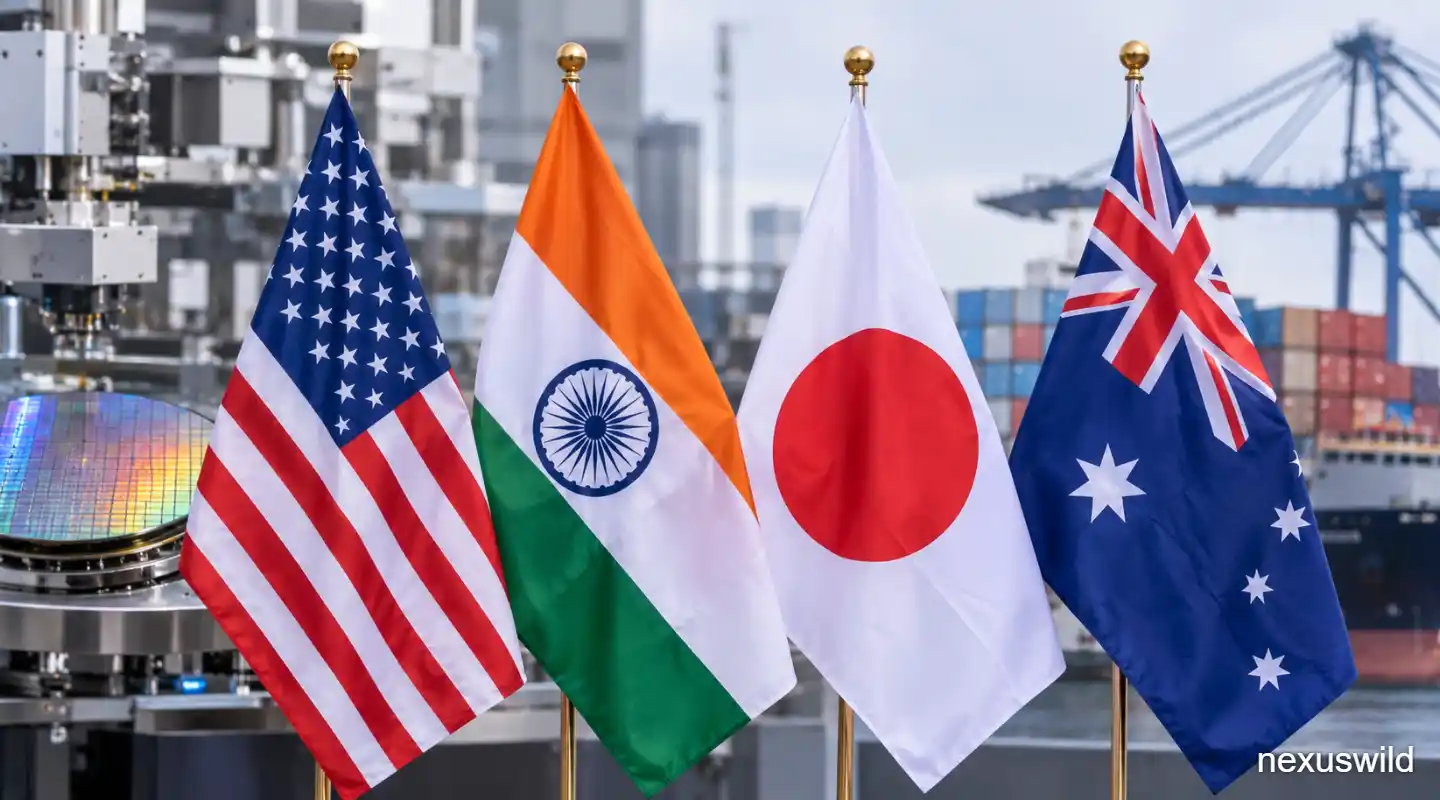

The United States, India, Japan and Australia have agreed to deepen economic and technological cooperation, placing global supply chain resilience, artificial intelligence, semiconductor security and critical minerals at the centre of their regional strategy. During a meeting in Atlanta, Georgia, on October 31, 2026, the four countries reaffirmed their commitment to building reliable supply networks and reducing vulnerabilities that could disrupt critical industries.
The meeting produced several important announcements, including more than $85 million in intended technical and financial assistance for trusted artificial intelligence technologies across the Indo-Pacific, a new effort to identify semiconductor supply chain vulnerabilities, stronger cooperation on critical minerals and a digital infrastructure initiative in Palau worth $20 million.
The discussions also addressed economic coercion, arbitrary export restrictions, industrial overcapacity and the importance of maintaining secure international shipping routes.
The announcements reflect a broader effort by the four countries to make regional economies less vulnerable to geopolitical tensions and concentrated production networks. However, the commitments represent planned cooperation and financial intentions rather than evidence that every project has already been funded, completed or deployed. Quad Nations Put Economic Security at the Centre of Regional Cooperation The latest meeting of foreign ministers from the United States, India, Japan and Australia has placed economic security at the centre of the Quad's regional agenda. The discussions took place on October 31 in Atlanta, where the four governments reviewed existing initiatives and explored ways to strengthen cooperation across strategic industries.
The Quad, formally known as the Quadrilateral Security Dialogue, is a diplomatic partnership between the four countries. It focuses on maintaining a free, open and stable Indo-Pacific through cooperation in areas such as maritime security, technology, infrastructure, economic development and disaster response.
Although the partnership is not a traditional military alliance, its economic and technological activities have become increasingly important as countries face growing competition over industrial capacity, access to resources and control of critical technologies.
In their joint statement, the foreign ministers highlighted the importance of reliable and open global supply chains. They also expressed concern about economic coercion, arbitrary export restrictions and non-market policies that can create industrial overcapacity and disrupt international markets.
The statement did not directly identify a particular country as the target of these concerns. Nevertheless, the discussion comes amid wider international tensions surrounding critical mineral exports, advanced technology and the concentration of manufacturing capacity.
For the four governments, the central challenge is to maintain access to essential goods and technologies even when international trade relationships become politically complicated.
This approach could have significant implications for businesses operating across Asia-Pacific, particularly manufacturers, technology companies, energy producers and infrastructure developers. Australian Minister for Foreign Affairs+1
More Than $85 Million Planned for Trusted Artificial Intelligence One of the most significant announcements from the meeting was the intention to provide more than $85 million in technical and financial assistance to support access to trusted artificial intelligence technologies across the Indo-Pacific.
The proposed assistance is expected to support regional access to advanced AI capabilities through initiatives including the Quad SI Accelerator.
Artificial intelligence is becoming an important component of economic competitiveness. Businesses are increasingly using AI for industrial automation, logistics management, financial services, healthcare, cybersecurity and data analysis.
However, access to advanced AI technology depends on more than software development. It also requires reliable computing infrastructure, advanced semiconductor hardware, data centres, electricity, skilled workers and secure communication networks.
The Quad's approach recognises that countries need access to a wider technology ecosystem to participate in the development and adoption of AI.
The reference to trusted technology is particularly important. Governments and businesses are increasingly concerned about data security, technology reliability, cybersecurity risks and dependence on external suppliers.
For developing economies in the Indo-Pacific, access to reliable AI infrastructure could create opportunities to improve public services, support local businesses and develop new technology industries.
Small and medium-sized businesses could benefit from AI-powered tools for customer service, inventory management, financial administration and productivity improvements. Governments could also explore applications in agriculture, transport, education and disaster management.
Nevertheless, financial assistance alone will not guarantee widespread AI adoption. Countries will need to develop technical skills, establish appropriate regulations and ensure that digital infrastructure is accessible beyond major commercial centres.
The $85 million commitment should therefore be viewed as an initial step towards wider regional technology cooperation rather than a complete solution to the Indo-Pacific's AI infrastructure requirements.
The joint statement describes the funding as an intention to provide assistance. It does not establish that the entire amount has already been distributed or that all projects are operational. Australian Minister for Foreign Affairs+1
Semiconductor Supply Chains Become a Strategic Priority Semiconductors are another major area of cooperation between the four countries. These components are essential to modern economic activity, supporting everything from smartphones and automobiles to data centres, telecommunications equipment, industrial machinery and defence systems.
As demand for computing power increases, semiconductor manufacturing has become one of the most strategically important industries in the global economy.
However, semiconductor production is highly interconnected. Different stages of the manufacturing process, including chip design, specialised equipment, wafer fabrication, packaging and testing, are concentrated in different countries.
This international production structure creates efficiency but also exposes companies to potential disruptions.
A shortage of specialised materials, restrictions on technology exports, manufacturing interruptions or geopolitical tensions can affect production across multiple industries.
The Quad countries have therefore agreed to launch a new effort to identify vulnerabilities and potential bottlenecks in semiconductor and related AI hardware supply chains before they create major disruptions.
The initiative is intended to improve understanding of where critical dependencies exist and how cooperation can strengthen the resilience of the technology ecosystem.
For businesses, identifying these vulnerabilities could become increasingly important when making long-term investment and sourcing decisions.
Automotive manufacturers, electronics producers and cloud computing companies depend on a continuous supply of advanced chips. Even a relatively small interruption in semiconductor availability can delay product launches, increase production costs and affect revenue.
India could gain opportunities from this cooperation as it continues to develop its semiconductor manufacturing ecosystem. The country has been seeking to attract investment in chip fabrication, assembly, testing and semiconductor-related infrastructure.
Japan brings significant experience in semiconductor materials and manufacturing equipment, while the United States remains an important centre for chip design, advanced technology development and specialised equipment. Australia also contributes strategic resources and regional economic cooperation.
Combining these capabilities could help create a more diversified semiconductor ecosystem.
However, establishing new manufacturing capacity is a long-term process. Semiconductor facilities require substantial investment, advanced engineering capabilities, reliable electricity and water supplies, specialised equipment and highly trained workers.
The Quad initiative does not mean that semiconductor production will immediately move away from existing manufacturing centres. Instead, its immediate focus is on identifying supply chain risks and exploring ways to prevent excessive dependence on vulnerable production networks.
This distinction is important because semiconductor supply chains cannot be reorganised overnight. A more diversified system will require years of investment, commercial partnerships and technological development. Australian Minister for Foreign Affairs+1
Critical Minerals Cooperation Gains Importance Critical minerals have become an increasingly important part of international economic and industrial policy.
Materials such as lithium, cobalt, nickel, graphite and rare earth elements are essential for several modern technologies. They are used in electric vehicle batteries, renewable energy systems, electronics, industrial equipment and advanced defence applications.
As demand for these technologies grows, access to reliable mineral supplies is becoming a major concern for governments and manufacturers.
The Quad countries have been working to strengthen critical mineral supply chains through cooperation in mining, processing, recycling and investment.
The October 31 meeting highlighted progress under the Quad Critical Minerals Initiative Framework, which was announced in May 2026.
One important area of cooperation is recovering valuable materials from electronic waste and industrial scrap. Recycling could help reduce dependence on newly mined resources while creating additional sources of minerals for manufacturing.
The four countries have also welcomed private-sector investment in waste collection networks, processing facilities and refineries.
In addition, the United States has committed $10 million to support infrastructure and facilities in India and ASEAN countries involved in recovering critical minerals from waste.
This initiative could support the development of a more circular industrial economy, where valuable materials are recovered and reused instead of being discarded after their initial use.
For India, the opportunity extends beyond mineral extraction. Developing domestic recycling, processing and refining capabilities could help the country strengthen its position in battery manufacturing, electric mobility and clean energy technology.
Japan could benefit from more reliable access to recovered materials for its manufacturing industries. Australia, which has an established mining sector and significant mineral resources, can contribute through exploration, production and resource development.
The United States also has an interest in strengthening alternative supply networks for industries that depend on critical minerals.
However, mineral supply chain diversification presents several challenges.
Mining and processing projects often require large amounts of capital, regulatory approvals, environmental assessments and long development periods. Recycling also requires efficient collection systems and technologies capable of recovering materials economically.
Furthermore, mineral processing capacity is not distributed equally across the world. Building alternative facilities will require sustained investment rather than short-term political commitments.
The Quad's focus on recycling and cooperation could help address some of these challenges, although the commercial viability of individual projects will remain an important factor.
The broader objective is to create a mineral supply network that is more diversified, transparent and capable of supporting future industrial demand. Australian Minister for Foreign Affairs+1
$20 Million Digital Infrastructure Initiative in Palau Digital infrastructure is another important part of the Quad's regional economic strategy.
The meeting also brought attention to a $20 million digital infrastructure project in Palau, a Pacific island country where reliable telecommunications connectivity is important for economic development, public services and regional integration.
Palau's geographic position makes digital connectivity particularly significant. Island economies often face infrastructure challenges because of long distances, relatively small populations and the high cost of building and maintaining telecommunications networks.
Reliable digital infrastructure can support government services, education, healthcare, tourism, financial services and commercial activity.
It can also help businesses connect with international markets and reduce the disadvantages associated with geographic isolation.
The Quad has already been working with Palau on telecommunications cooperation, including Open Radio Access Network (Open RAN) initiatives. These efforts are intended to support trusted suppliers and improve access to secure mobile connectivity.
The broader regional programme also includes work to develop resilient undersea cable networks.
Undersea cables carry a significant share of international internet and data traffic. Damage to these systems, whether caused by natural disasters, accidents or other disruptions, can affect connectivity across entire regions.
For Pacific island economies, additional connectivity routes and stronger telecommunications infrastructure could improve reliability and reduce the consequences of individual network failures.
The Palau initiative therefore fits into a wider effort to strengthen the Indo-Pacific's digital foundations.
From an economic perspective, better connectivity could help local companies participate in digital commerce, attract investment and improve access to international services.
However, infrastructure announcements should not be confused with completed development. The $20 million project represents an announced initiative, and its implementation will depend on project planning, funding arrangements, technical execution and cooperation with the Palauan government.
Its long-term impact will depend on whether the infrastructure provides affordable, reliable and sustainable connectivity for businesses and communities. Al-Monitor+1
Maritime Security and International Trade Routes The Quad discussions also highlighted the importance of maritime security and uninterrupted international trade.
The Indo-Pacific contains some of the world's most important shipping routes. Energy products, manufactured goods, agricultural commodities and industrial materials move through these waterways to reach international markets.
The Strait of Hormuz, the Red Sea and the Bab el-Mandeb Strait were specifically highlighted in the joint statement.
These waterways are strategically important for global commerce and energy transportation. Disruptions can increase shipping costs, delay deliveries and create uncertainty for businesses that depend on international supply chains.
For example, interruptions around major maritime routes can force shipping companies to consider alternative routes. Longer journeys can increase fuel consumption, insurance costs and transportation times.
Such disruptions can eventually affect the prices of imported goods, industrial inputs and energy products.
The Quad ministers reiterated the importance of protecting navigational rights and freedoms, ensuring the safety of vessels and maritime crews, and maintaining the uninterrupted movement of commerce in accordance with international law, including the United Nations Convention on the Law of the Sea.
This position reflects the connection between maritime security and economic stability.
A company may have access to raw materials and manufacturing facilities, but those advantages can be undermined if finished products cannot reach customers efficiently.
The four countries are therefore seeking to strengthen cooperation across maritime awareness, regional security and emergency response.
Their wider activities include the Indo-Pacific Maritime Surveillance Collaboration, which aims to improve information sharing and maritime domain awareness.
Such cooperation can help participating countries monitor maritime activity and improve their ability to respond to emerging risks.
For international businesses, greater maritime resilience could help reduce uncertainty in transportation networks. Nevertheless, the Quad's announcements do not guarantee that shipping disruptions will disappear. Geopolitical tensions, conflicts, accidents and natural disasters will continue to present risks to international trade. Australian Minister for Foreign Affairs+1
New Quad Business Leaders' Forum Could Expand Commercial Opportunities Beyond government-level cooperation, the four countries are also seeking to increase direct engagement between businesses.
The foreign ministers announced plans for the first-ever Quad Business Leaders' Forum. The proposed platform will bring together industry leaders, government representatives and policy experts from the four countries.
Its purpose is to strengthen commercial relationships and encourage cooperation across important economic sectors.
This development is significant because government agreements alone cannot establish functioning supply chains. Businesses must be willing to invest, manufacture, purchase materials and develop commercial partnerships.
A dedicated business forum could provide opportunities for companies to identify potential partners, discuss investment barriers and explore new commercial projects.
Possible areas of interest include semiconductor manufacturing, artificial intelligence, critical minerals, advanced telecommunications, energy infrastructure and digital services.
The initiative could be particularly relevant for companies looking to diversify their supplier networks or enter new markets.
For example, a Japanese manufacturer may explore partnerships with Indian suppliers, while an Australian mining company could seek investment opportunities with businesses involved in mineral processing and recycling.
Similarly, American technology companies could explore regional partnerships in AI infrastructure, cloud computing and advanced manufacturing.
The four governments are also planning further cooperation between their export credit agencies. These agencies support international trade and investment by helping businesses manage certain financial and commercial risks associated with overseas projects.
A meeting of Quad export credit agencies is scheduled to take place in Tokyo on November 18, 2026, to identify opportunities for practical cooperation.
If these discussions lead to commercially viable partnerships, they could help translate diplomatic commitments into investment and business activity.
However, the announcement of a business forum does not automatically mean that new contracts or investment agreements have been finalised. The results will depend on private-sector interest, project economics and the ability of governments to create supportive business conditions. Australian Minister for Foreign Affairs+1
What the Quad Agreement Means for India India is positioned to play an important role in the partnership because of its expanding manufacturing ambitions, technology industry and strategic location in the Indo-Pacific.
The initiatives could create opportunities across several sectors.
- Semiconductor manufacturing: India could attract additional investment in semiconductor assembly, testing, packaging and related manufacturing activities. Cooperation with Japan and the United States could also support access to specialised technology and industrial expertise.
- Critical minerals: Investment in recycling and processing facilities could help India develop alternative sources of essential industrial materials. This could support electric vehicle production, battery manufacturing and renewable energy development.
- Artificial intelligence: Access to trusted AI infrastructure and technical assistance could support Indian technology companies, research institutions and businesses adopting AI-based solutions.
- Digital infrastructure: Cooperation with regional partners could create opportunities for Indian telecommunications and technology companies to participate in international infrastructure projects.
- International trade: Stronger maritime cooperation and diversified supply networks could help Indian exporters and manufacturers manage transportation and sourcing risks.
India's participation also supports its broader ambition to become a more important manufacturing and technology destination.
However, these opportunities will depend on domestic infrastructure, workforce capabilities, investment conditions and the ability of Indian businesses to compete internationally.
The partnership could provide additional opportunities, but it will not automatically make India independent of international suppliers. Building competitive industrial capabilities requires long-term investment and consistent policy support. Challenges That Could Affect Implementation Despite the announcements, several challenges could influence how quickly the initiatives produce measurable economic results.
Geopolitical tensions: The Quad's concerns about export restrictions and economic coercion reflect wider tensions in international trade. If relations between major economies deteriorate, companies could face additional restrictions and uncertainty.
High infrastructure costs: Semiconductor manufacturing, mineral processing and telecommunications infrastructure require significant investment. Funding commitments must be supported by commercially sustainable projects.
Different national priorities: The four countries have different industrial strengths and economic interests. Reaching agreement on investment priorities, technology access and supply chain arrangements may take time.
Dependence on existing suppliers: Many industries remain dependent on established international production networks. Replacing suppliers or relocating manufacturing facilities can be expensive and technically complicated.
Regulatory and environmental requirements: Mining, semiconductor manufacturing and digital infrastructure projects must meet national regulations and environmental standards. These requirements can affect project timelines and costs.
Private-sector participation: Governments can establish frameworks and provide financial assistance, but long-term supply chain development requires active participation from manufacturers, investors, technology providers and logistics companies.
These challenges suggest that the success of the Quad's strategy will depend more on implementation than on announcements alone. What Happens Next? The next phase will involve translating the commitments into practical projects, investment decisions and measurable cooperation.
Several developments will be important to monitor.
The outcomes of these developments will provide a clearer picture of whether the partnership can move beyond diplomatic commitments and create sustainable economic benefits. Conclusion: Quad Partnership Signals a New Phase of Economic Cooperation The latest Quad meeting demonstrates how economic security, technological development and international trade are becoming increasingly interconnected.
- AI assistance: Further details about the allocation of the proposed $85 million and the projects supported through the Quad SI Accelerator.
- Semiconductor security: Identification of critical supply chain bottlenecks and opportunities to improve manufacturing resilience.
- Critical minerals: Progress in recycling infrastructure, processing facilities and private-sector investment.
- Palau infrastructure: Implementation arrangements and development progress for the $20 million digital infrastructure initiative.
- Business cooperation: The launch of the Quad Business Leaders' Forum and potential commercial partnerships.
- Export credit cooperation: Discussions scheduled for November 18 in Tokyo.
- Regional diplomacy: Further engagement between the four governments, including discussions around a possible leaders' summit in Manila.
The United States, India, Japan and Australia are seeking to strengthen their position in critical industries by improving supply chain resilience, expanding access to trusted AI technologies, identifying semiconductor vulnerabilities and diversifying critical mineral networks.
The initiatives also extend beyond the four member countries. Projects involving Palau and broader Indo-Pacific cooperation demonstrate an effort to improve the region's digital infrastructure, economic connectivity and maritime security.
For businesses, the announcements could influence future investment decisions, supplier relationships and technology partnerships. Manufacturers may increasingly consider geopolitical risks alongside traditional factors such as production costs, labour availability and market access.
India could benefit from new opportunities in semiconductors, AI, mineral processing and digital infrastructure, provided that these initiatives translate into meaningful investment and industrial development.
Nevertheless, the partnership's success cannot be measured by funding announcements or diplomatic statements alone. The real test will be whether the four countries can establish commercially viable projects, improve access to essential technologies and reduce vulnerabilities in international supply networks.
The Quad's latest commitments represent an important step towards that objective, but the long-term economic impact will depend on how effectively they are implemented.
Nexuswild welcomes factual corrections. Email contact@nexuswild.com with evidence and the article URL.