
Russia launched a large-scale missile and drone attack across Ukraine on October 7, killing at least 20 people, including children, and injuring around 50 as strikes hit residential areas and energy infrastructure in several parts of the country.
The attack involved roughly 70 missiles and about 130 drones, according to Ukrainian President Volodymyr Zelenskyy and the Ukrainian Air Force. Many of the missiles were ballistic, which remain among the most difficult threats for Ukraine’s air-defense network to intercept.
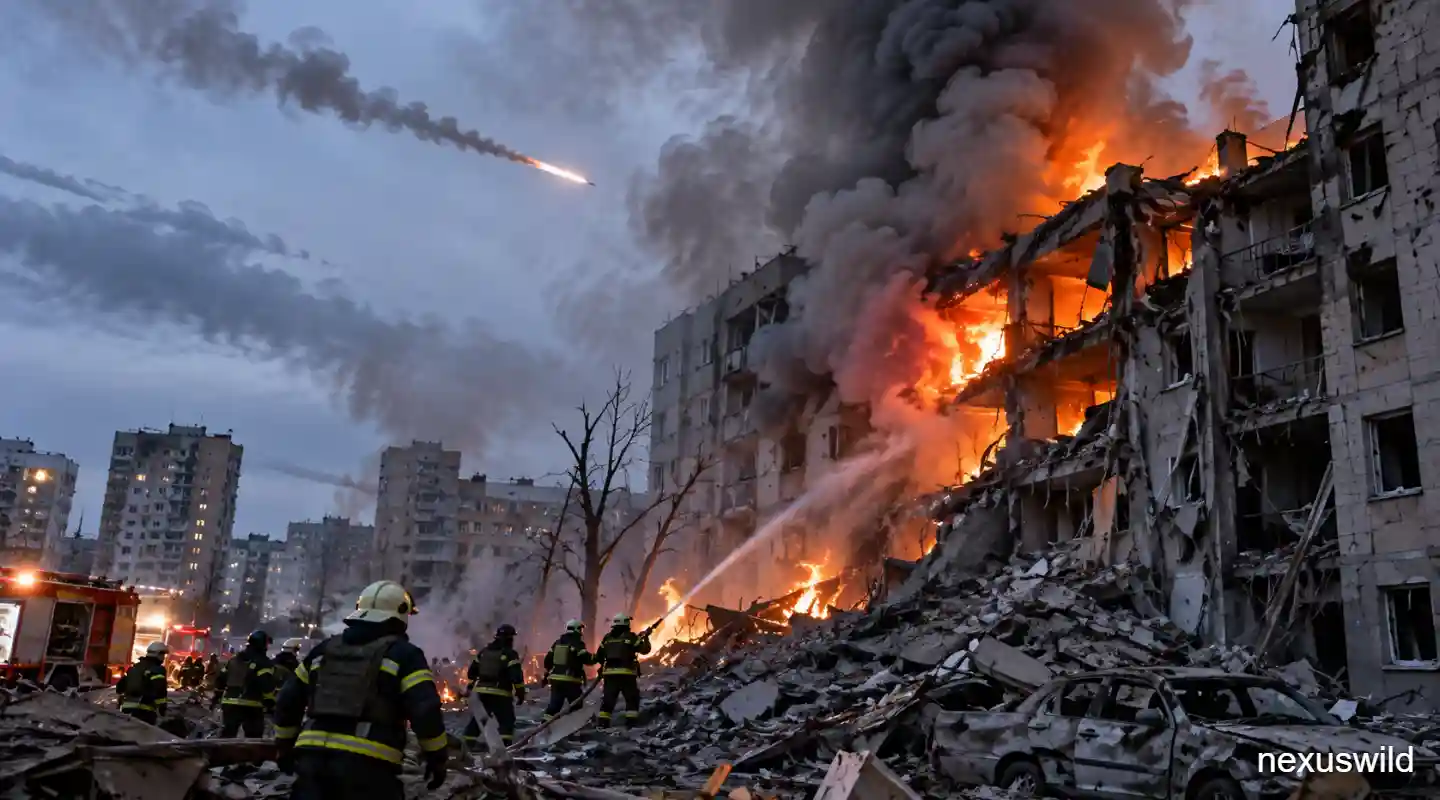
The northern city of Pryluky suffered the heaviest confirmed loss of life. A Russian missile struck a five-storey residential building there, killing at least 13 people, including four children, regional governor Vyacheslav Chaus said. Around 50 people were reported injured.
Pryluky Residential Building Hit
Emergency crews searched through the wreckage of the apartment building in Pryluky after the missile strike caused extensive structural damage.
The regional governor raised the confirmed death toll to 13 later on October 7.
The casualty figure could change further as rescue and recovery operations continue, making it important to distinguish the latest confirmed toll from earlier reports.
Civilians Also Killed in Kyiv and Other Cities
Fatal strikes were also reported in Kyiv, Oleksandria and Kremenchuk, according to Reuters.
In Kyiv’s Darnytskyi district, a strike hit a garage complex and caused a fire. City authorities said two people were killed, while rescuers pulled two others from the blaze alive.
Residents across the capital spent parts of the night sheltering in metro stations as air-raid warnings and explosions continued.
Russia Used Around 70 Missiles
Zelenskyy said Russia fired approximately 70 missiles, many of them ballistic, during the attack.
Ukraine also reported around 130 drones, including attack drones and decoys.
The combination of missiles and unmanned aircraft is designed to place heavy pressure on air-defense systems by forcing them to respond to several different types of threat simultaneously.
Ukraine has improved its ability to intercept drones, but ballistic missiles remain a significant vulnerability.
Ukraine Reports Improved Drone Interception
Ukrainian authorities said air defenses destroyed more than 80% of 46 jet-powered drones launched during the wider attack, according to Reuters.
Ukraine has increasingly encountered faster jet-powered drones in addition to conventional propeller-driven systems.
Their greater speed can reduce the time available for air-defense teams to detect and engage them.
Ukraine did not report intercepting every missile or drone involved in the attack.
Energy Infrastructure Was a Major Target
Zelenskyy said energy facilities were among the principal targets.
Damage caused emergency electricity cuts in five regions, according to Reuters.
Ukraine has repeatedly accused Russia of targeting electricity generation, transmission and heating infrastructure ahead of winter.
Moscow says its strikes are directed at infrastructure supporting Ukraine’s military operations.
The October 7 attack again showed how military and civilian infrastructure can become intertwined during large-scale strikes, particularly when energy networks supply both civilian communities and defense-related facilities.
Russia Says It Targeted Military-Industrial Facilities
Russia’s Defence Ministry described the operation as a massive strike against military-industrial facilities in Kyiv and other Ukrainian cities.
It said high-precision weapons and drones were used against targets linked to Ukraine’s defense sector.
Russia has repeatedly said it does not deliberately target civilians.
Ukrainian authorities, however, reported direct damage to residential buildings and civilian deaths during the latest attack.
The available evidence therefore supports reporting the civilian consequences separately from Russia’s stated targeting rationale.
Ballistic Missiles Remain a Major Challenge
Ukraine has developed an extensive air-defense network using Western and domestically produced systems.
But ballistic missiles remain particularly difficult to intercept because of their high speed and flight characteristics.
Zelenskyy again called for additional U.S.-made Patriot systems, which are among the few Western platforms Ukraine operates that are designed to engage certain ballistic threats.
Ukraine has repeatedly asked allies for more interceptors and additional batteries as Russia increases the scale and frequency of aerial attacks.
Attack Followed Ukrainian Warning
The strikes came one day after Zelenskyy said Ukrainian intelligence indicated that Russia was preparing another large-scale attack.
In an October 6 address, he said Ukraine’s forces were preparing within the limits of their available air-defense resources and again appealed to Western partners for additional assistance.
The warning did not specify exactly when or where the anticipated attack would occur.
Ukraine Has Also Intensified Strikes Inside Russia
The escalation has not been one-sided.
Ukraine has increased long-range drone and missile attacks against Russian oil, logistics and military facilities.
On October 6, Russian officials said Ukrainian drones killed two people in the Moscow region during one of the largest attacks on the area since the war began. Russian authorities reported more than 650 Ukrainian drones, with 185 intercepted or brought down in the Moscow region alone.
Ukrainian operations have frequently targeted refineries, oil storage facilities and logistics infrastructure that Kyiv says support Russia’s military.
Civilian casualties have also been reported in some Ukrainian strikes inside Russia.
Civilian Casualties Have Been Rising
The United Nations reported earlier in 2026 that civilian casualties in Ukraine had risen by more than one-third during the first half of the year compared with the corresponding period a year earlier.
The U.N. linked much of that increase to the expanding use of long-range drones and other weapons capable of striking cities far from the front line.
Large combined missile-and-drone attacks can increase the risk to civilians even when some incoming weapons are intercepted, because falling debris can also cause fires and structural damage.
Ukraine Seeks More Air-Defense Support
Kyiv continues to argue that additional Western air-defense systems are necessary to protect cities and critical infrastructure.
Patriot batteries are particularly important because of their ability to engage ballistic missiles.
European governments have also been financing additional interceptors, radar systems and Ukrainian-produced drone defenses.
Germany announced another €1 billion in military assistance during a visit to Kyiv on October 4, alongside support for radar systems and drone interception.
The effectiveness of those systems depends on availability of interceptors, deployment locations and the scale of individual Russian attacks.
Attack Comes as Winter Approaches
Energy infrastructure becomes especially important as Ukraine moves toward colder months.
Damage to generation plants, substations and transmission networks can leave communities without electricity, heating and water.
Emergency outages following the October 7 strikes demonstrate that the energy network remains vulnerable despite extensive repairs and additional air-defense deployments.
Ukraine has spent several years decentralizing and rebuilding parts of its power system to make it more resilient to attacks.
Civilian Toll Remains Subject to Revision
Initial casualty numbers during major strikes frequently change as emergency workers search damaged buildings.
The latest Reuters reporting puts the nationwide toll at at least 20 dead, while the Pryluky strike alone had reached 13 fatalities by later on October 7.
Figures from earlier reports showing 11 deaths therefore represent an earlier stage of the casualty count rather than the latest total.
Conclusion
Russia launched one of its largest recent missile and drone attacks on Ukraine on October 7, 2026, using approximately 70 missiles and around 130 drones, according to Ukrainian authorities.
At least 20 civilians were reported killed and around 50 injured as strikes hit multiple regions.
The deadliest confirmed incident occurred in Pryluky, where a missile destroyed part of a five-storey residential building and killed at least 13 people, including four children.
Russia said its operation targeted Ukraine’s military-industrial infrastructure. Ukrainian authorities said energy facilities were a major target and reported residential destruction and civilian deaths.
Emergency power cuts were imposed in several regions, while Kyiv renewed its appeal for additional air-defense systems capable of intercepting ballistic missiles.
The casualty toll remains provisional and could change as rescue operations and damage assessments continue.
Nexuswild welcomes factual corrections. Email contact@nexuswild.com with evidence and the article URL.