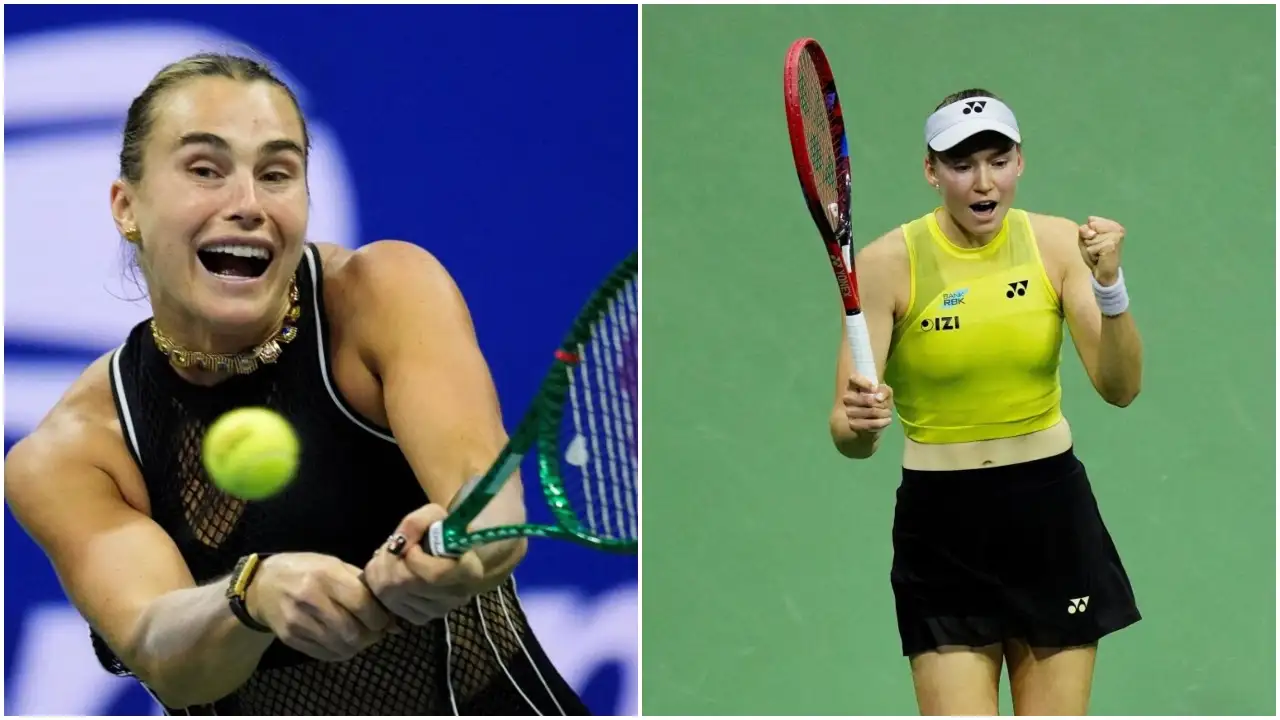

The last time the world's No. 1 and No. 2 women met in a US Open final, Serena Williams beat Victoria Azarenka in 2013. Thirteen years later, that exact matchup returns to Arthur Ashe Stadium on Saturday, and this time the outcome won't even decide who holds the top ranking. Elena Rybakina has already locked up world No. 1 for the first time in her career, regardless of what happens against Aryna Sabalenka in Saturday's final - a quirk of the WTA's points system that makes this one of the stranger, and still one of the most loaded, title matches in recent memory.
Sabalenka's Path to a Potential Three-Peat
Sabalenka, the top seed and two-time defending champion, arrives having dropped just one set all tournament until a three-set battle with Linda Noskova in the quarterfinals. She beat Camila Osorio, qualifier Polina Iatcenko, Kamilla Rakhimova and Taylor Townsend in the earlier rounds without much trouble, got past Noskova 7-6(1), 3-6, 7-6(7), then dismissed No. 3 seed Jessica Pegula 7-5, 6-2 in Thursday's semifinal - her 10th career win over the American.
It's Sabalenka's fourth consecutive US Open final, a run matched by no one since Serena Williams, and a title on Saturday would be her fifth major overall and the first three-peat at Flushing Meadows since Williams won three straight from 2012 to 2014.
Rybakina's Resilient Run
Rybakina's path has been considerably bumpier, and in some ways more telling. The No. 2 seed opened with wins over wildcard Thea Frodin, Jessica Bouzas Maneiro and Yuliia Starodubtseva before handling former two-time champion Naomi Osaka 6-1, 6-4 in the fourth round. In the quarterfinals she dropped the first set to qualifier Zheng Qinwen - the first set she'd lost all tournament - before rallying to win 3-6, 6-1, 6-4 and clinch the No. 1 ranking outright.
She followed that by digging out of another one-set deficit in the semifinal, beating No. 4 seed Coco Gauff 3-6, 6-4, 6-4 in front of a partisan New York crowd. It's her first US Open final and, remarkably, her first appearance past the fourth round at the tournament in her career.
The Ranking Shift and the Rivalry
The ranking change is significant on its own terms. Sabalenka had held No. 1 continuously since October 21, 2024 - a 99-week reign - and needed to win the title this week to keep it. Rybakina only needed to reach the semifinals, and her quarterfinal win over Zheng did the job before she'd even walked off Arthur Ashe. She becomes the first Kazakhstani player to top the WTA rankings.
Asked about ending Sabalenka's run, Rybakina played it down: "It's just a number right now," she told reporters - pointing instead to the trophy still up for grabs.
That trophy chase has been building for a while. Saturday's final will be the 18th career meeting between the two, with Sabalenka leading the head-to-head 10-7. They've already played three times this year: Sabalenka won their Miami semifinal and then edged Rybakina in three sets in the Indian Wells final, saving a championship point along the way. Rybakina's lone win over Sabalenka in 2026 was the biggest of the three - the Australian Open final in January, which also handed her the second major title of her career.
It also means Saturday marks the third time the pair has met in a Grand Slam final, following Sabalenka's win at the 2023 Australian Open and Rybakina's at this year's edition of the same tournament. Add in last October's WTA Finals, where Rybakina beat Sabalenka in straight sets to win the season-ending title, and the rivalry has essentially decided who's playing the best tennis on tour for the better part of a year.
Résumés and Context
Sabalenka's résumé needs little introduction: two Australian Open titles (2023, 2024) and two US Open titles (2024, 2025) give her four majors already, and a win Saturday would move her level with players who've historically dominated this specific event - only Chris Evert, with four straight US Open titles from 1975 to 1978, and Williams have won three or more in a row in the Open Era. Rybakina's collection is shorter but no less serious: the 2022 Wimbledon title, beating Ons Jabeur in the final, and this year's Australian Open crown. A US Open title would be her third major and would arrive in her fourth appearance in a Grand Slam final overall.
What makes Rybakina's run to this final notable beyond the results is the context around it. She played through an ankle injury sustained in Cincinnati on the eve of the tournament, and by her own team's account has spent the past year rediscovering the level that made her Wimbledon champion in 2022. She has posted 47 match wins in 2026, second on tour only to Pegula, and between last October and March put together a 12-match winning streak against top-10 opponents - seven of them against top-5 players, two against the reigning world No. 1. Beating both Gauff and Osaka en route to this final, plus the Olympic gold medalist Zheng in the quarterfinal, is a fair summary of how that form has translated at the majors this season.
A Contrast in Styles
Stylistically, the final sets up as a contrast in how each player generates power rather than a mismatch in weaponry - both rank among the tour's hardest hitters and most dangerous servers. Sabalenka's game is built on first-strike aggression: heavy serving, a forehand she's willing to swing at full tilt from anywhere on the court, and a level of risk that has occasionally produced double-fault trouble but more often overwhelms opponents before rallies develop.
Rybakina has traditionally leaned on one of the tour's most efficient serves and a flatter, more compact ball-striking style, but Sabalenka herself flagged how much that game has rounded out. She described Rybakina as a big server who has considerably improved her baseline play in recent years, adding that she expected a match that would be both physically and mentally demanding. That improvement - more variety, better movement, fewer routine errors - is largely why Rybakina is walking into Saturday not as a specialist who occasionally beats the best, but as the newly minted No. 1.
High Stakes in Flushing Meadows
The financial stakes match the sporting ones. This year's US Open distributed a record $108 million in prize money across the draw, with Saturday's women's singles champion taking home $5.5 million and the runner-up $2.8 million.
Beyond the check, there's a ranking-adjacent subplot that has needled some observers: because Rybakina secured No. 1 before the final was even played, a loss on Saturday wouldn't cost her the top spot she just earned - an outcome that strikes some as an odd wrinkle in how the rankings system rewards a full season of results over a single trophy.
None of that changes what's at stake for either player once the match starts. Sabalenka is chasing tennis history specific to this tournament and doesn't want to hand back a title she's defended twice. Rybakina, ranking already secured, is playing for the one thing that ranking points can't buy - her first US Open trophy, and a share of a rivalry she's now split evenly across her last four meetings with the best player she's shared a court with all year. The match is scheduled for 4 p.m. local time Saturday at Arthur Ashe Stadium, broadcast on ESPN in the United States.
Further reading and useful links
Reader questions
Frequently asked questions
Who is playing in the 2026 US Open women's singles final?
The 2026 US Open women's final will be contested between the world's top two players: Aryna Sabalenka and Elena Rybakina.
Who will be the new world No. 1 after the US Open?
Elena Rybakina has already secured the world No. 1 ranking, ending Aryna Sabalenka's 99-week reign at the top.
What is the head-to-head record between Sabalenka and Rybakina?
Going into the 2026 US Open final, Sabalenka leads their overall head-to-head record 10-7.
Nexuswild welcomes factual corrections. Email [email protected] with evidence and the article URL.