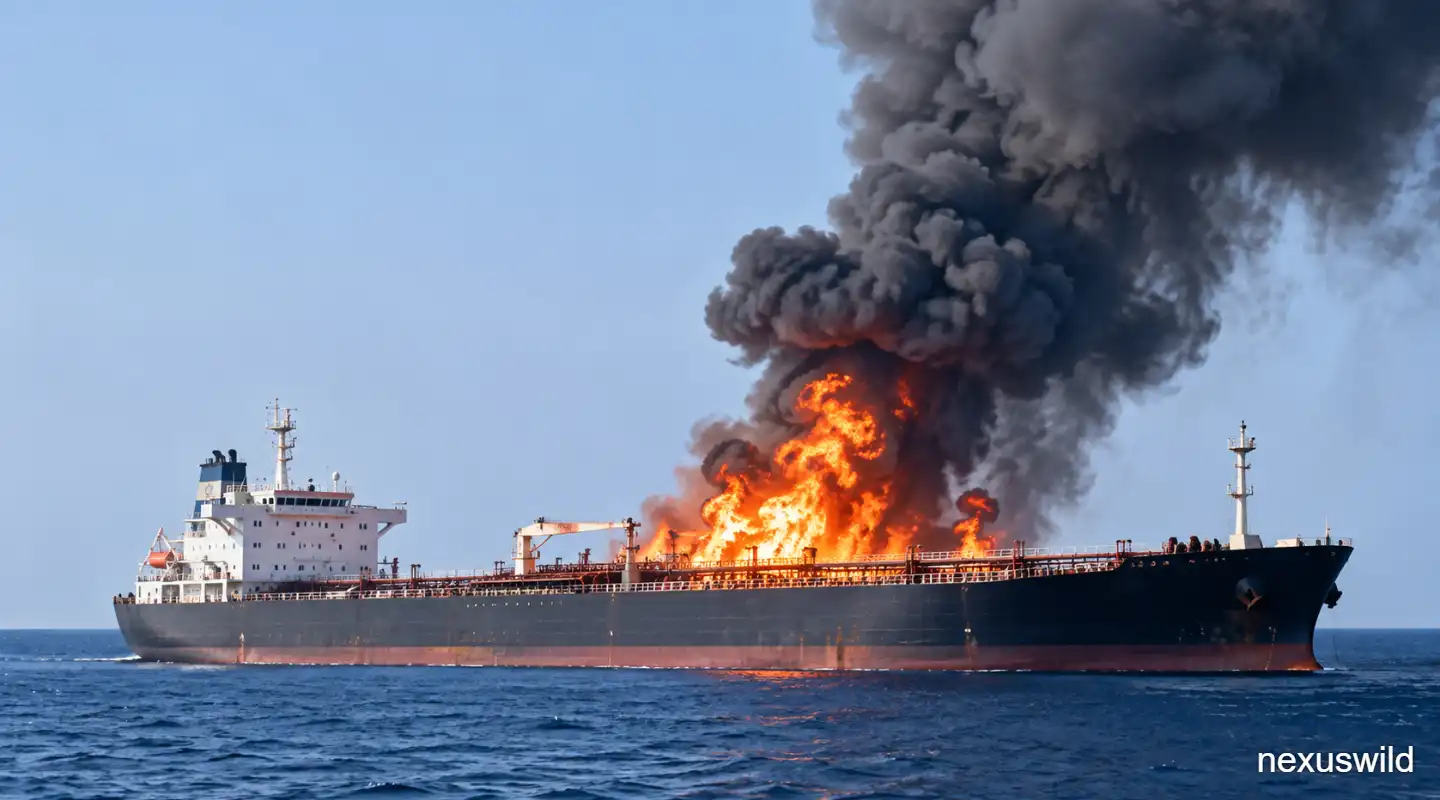

A Liberian-flagged oil tanker carrying 23 Indian crew members caught fire off Russia’s Black Sea coast after what Russian authorities described as an attack by an unmanned vessel, adding to mounting concerns over the safety of commercial shipping in the region.
The tanker, identified as the Aframax Rio, was hit near the Russian resort city of Sochi on October 6, according to Russia’s Transport Ministry.
All 23 people aboard were rescued and no injuries were reported, the ministry said. The crew was made up entirely of Indian nationals.
The incident triggered a large fire aboard the vessel and sent thick black smoke over the Black Sea coastline.
Russian Authorities Say Naval Drone Hit Tanker
Russia’s Transport Ministry said the Aframax Rio was attacked by what it described as naval drones, setting the tanker ablaze.
Emergency crews were dispatched to the vessel, although the intensity of the fire initially made it difficult for firefighters to approach.
Authorities later said the blaze had been brought under control after its intensity declined.
Russia attributed the incident to an unmanned maritime attack, but there was no immediate independently verified evidence establishing who launched the drone.
That distinction is important because some media reports described the incident as a Ukrainian attack, while the available official information primarily confirms that an unmanned vessel struck the tanker.
All 23 Indian Crew Members Rescued
The most important confirmed development was the safe evacuation of the crew.
Russia’s Transport Ministry said emergency personnel rescued all 23 seafarers aboard Aframax Rio, and none was reported injured.
The entire crew consisted of Indian nationals.
Initial reports circulated conflicting information about possible injuries, but Reuters, citing the Russian Transport Ministry, reported that there were no injuries among the crew.
That makes the official Russian account the stronger basis for reporting the crew’s condition.
Tanker Was Carrying Crude Oil
The Aframax Rio was carrying crude oil when the incident occurred.
Russian authorities said oil was burning in the Black Sea following the attack, while images and videos from the area showed a large column of black smoke visible from the Sochi coast.
The extent of any oil spill or environmental damage was not immediately clear.
Local authorities began monitoring water and air quality as emergency crews responded.
Officials in the nearby Sirius federal territory temporarily restricted access to beaches and sections of the coastline as a precaution.
Beaches Near Sochi Temporarily Closed
Authorities in Sirius, a federal territory adjacent to Sochi, closed beaches following the incident.
The restrictions were intended to keep civilians away from the emergency area while firefighters and environmental teams assessed the situation.
Local monitoring teams were also deployed to check pollution levels in the surrounding area.
Early assessments cited by local authorities did not indicate dangerous levels of air pollution, although monitoring continued while the tanker fire was being contained.
Aframax Rio Is Liberian-Flagged
The vessel involved is reported to be the Liberian-flagged Aframax Rio.
Aframax tankers are large crude carriers generally designed to transport hundreds of thousands of barrels of oil and are commonly used for regional and international crude shipments.
Maritime tracking information cited in reporting showed the vessel operating near Russia’s Black Sea coastline before the incident.
Some reports have also linked the vessel to trade in Russian crude.
However, the tanker’s cargo history and any sanctions status should be distinguished from the circumstances of the October 6 attack itself.
Ukraine’s Responsibility Has Not Been Independently Confirmed
Several reports described the incident as a Ukrainian drone strike.
Russia’s account confirms that the ship was struck by a maritime drone or unmanned vessel, but the available reporting did not include an immediate public Ukrainian claim of responsibility for the attack on Aframax Rio.
For that reason, describing it as a reported or suspected drone attack is more precise than definitively attributing it to Ukraine without qualification.
The Black Sea has become a major zone of drone warfare during the Russia-Ukraine conflict, with both military and commercial infrastructure increasingly exposed to attacks.
Incident Comes Amid Growing Black Sea Shipping Risks
The Aframax Rio fire occurred during a period of heightened danger for commercial vessels operating across the Black Sea.
On the same day, two other merchant ships were hit by drones in Bulgaria’s exclusive economic zone.
One vessel sank, while another was damaged and crew members were injured, according to Bulgarian authorities. The origin of those drones had not been conclusively established at the time of reporting.
A separate commercial-vessel incident off Romania also involved Indian crew members shortly before the Sochi tanker fire.
The clustering of incidents has increased concern that civilian shipping is being drawn further into the regional conflict.
India Voices Concern Over Threats to Seafarers
India has expressed concern about attacks that endanger commercial sailors in the Black Sea.
Following recent vessel incidents involving Indian nationals, India’s Ministry of External Affairs emphasized the importance of protecting seafarers and commercial shipping and reiterated support for dialogue and diplomacy.
India has a large global maritime workforce, meaning attacks on commercial vessels in major shipping corridors can directly affect Indian nationals even when India is not a party to the conflict.
The safety of crews has consequently become an important diplomatic and maritime-security issue.
Why Black Sea Tanker Traffic Matters
The Black Sea is an important route for energy and agricultural exports.
Russian oil, petroleum products and grain move through ports along the country’s southern coast, while Ukraine, Romania, Bulgaria and other regional states also depend on Black Sea trade routes.
Disruption to commercial shipping can increase:
- tanker insurance premiums;
- freight costs;
- voyage times;
- security expenses; and
- uncertainty over energy and commodity deliveries.
Individual incidents do not automatically cause a significant global supply disruption, but repeated attacks can increase the cost and difficulty of moving cargo through the region.
Maritime Insurance Risks Are Rising
Drone attacks create a particular challenge for insurers because commercial ships can be exposed far from conventional front lines.
War-risk insurance premiums typically rise when shipowners face a greater probability of damage, crew injury or port closures.
Shipping companies may also change routes or delay voyages when threats increase.
Those costs can eventually feed into the delivered price of oil and other commodities even if the underlying cargo remains available.
Fire Raises Environmental Concerns
The burning tanker also created concerns about marine pollution.
Russian authorities said crude oil was burning on the water around the vessel following the attack.
The scale of any spill had not been independently quantified in the initial reports.
Oil released into the Black Sea could potentially affect coastal ecosystems depending on the volume, currents, weather and speed of containment efforts.
Authorities therefore deployed monitoring teams along the coast while emergency operations continued.
Sochi Is Far From the Main Ground Front
Sochi lies on Russia’s northeastern Black Sea coast, hundreds of kilometers from the central land front in Ukraine.
The city is an important Russian resort and transportation center.
The tanker incident demonstrates how long-range unmanned systems have expanded the geographic reach of the conflict beyond traditional battlefield areas.
Ports, energy infrastructure and vessels across the Black Sea have increasingly become vulnerable to aerial and maritime drones.
Commercial Vessels Face Greater Exposure
Unlike naval ships, commercial tankers generally operate with civilian crews and are designed for transport rather than combat.
That makes attacks involving merchant vessels particularly significant from a maritime-safety perspective.
International shipping relies on the assumption that crews and commercial vessels can operate through recognized sea lanes with manageable levels of risk.
As drone attacks become more common, shipowners, governments and insurers may need to reconsider how vessels operate in high-risk zones.
Attribution Remains Critical
The Aframax Rio incident also illustrates the importance of separating confirmed facts from battlefield claims.
Confirmed information includes:
The ship caught fire.
The vessel was identified as Aframax Rio.
It carried a crew of 23 Indian nationals.
All 23 crew members were rescued.
Russian authorities said an unmanned vessel or naval drone struck the tanker.
What had not been independently established in the initial reporting was the identity of the attacker.
That uncertainty should remain explicit until additional evidence or a credible claim of responsibility emerges.
Conclusion
A Liberian-flagged oil tanker carrying 23 Indian seafarers caught fire off Russia’s Black Sea coast near Sochi on October 6 after what Russian authorities described as an attack by a naval drone.
The vessel was identified as the Aframax Rio.
Russia’s Transport Ministry said all 23 Indian crew members were rescued and no injuries were reported.
The attack caused a major fire and prompted beach closures and environmental monitoring around the Sochi and Sirius coastline.
While several reports have attributed the strike to Ukraine, responsibility had not been independently confirmed in the initial official reporting.
The incident comes amid a wider rise in attacks on commercial vessels across the Black Sea, increasing concerns about crew safety, shipping costs, environmental damage and the security of international maritime trade.
Nexuswild welcomes factual corrections. Email contact@nexuswild.com with evidence and the article URL.