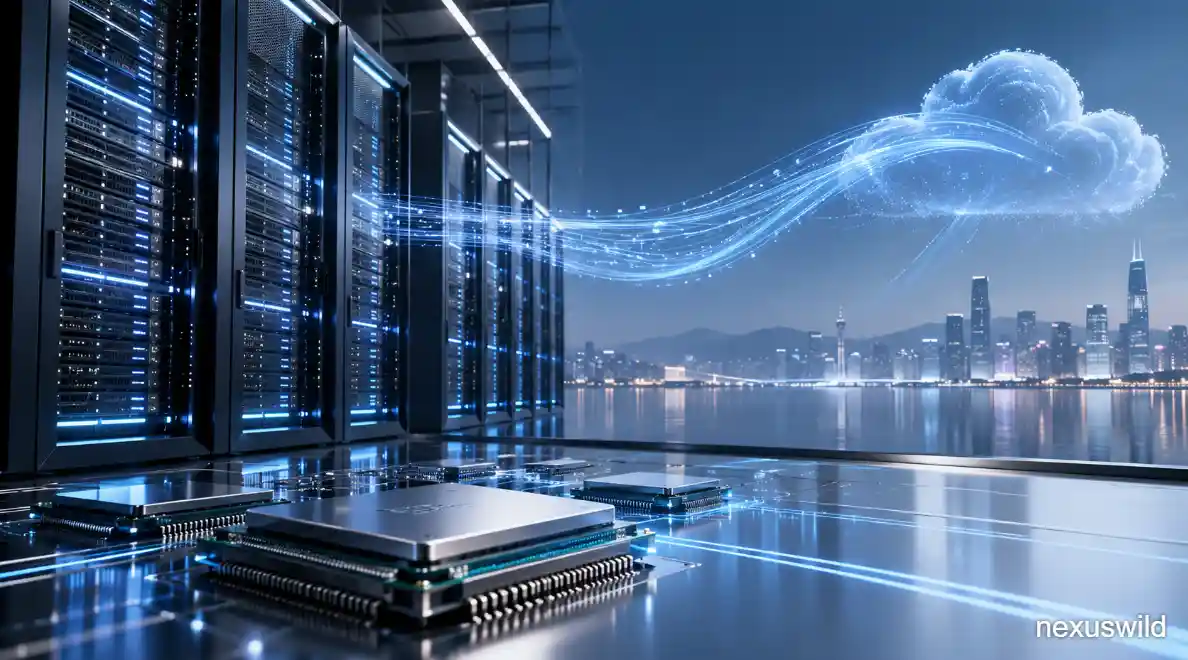

Tencent’s reported agreement to access 100,000 advanced AI chips through Oracle illustrates how computing capacity itself is becoming a competitive advantage.
The artificial intelligence race was once described mainly as a contest for better algorithms.
It is increasingly becoming a contest for access to machines.
Tencent has reportedly agreed to lease access to around 100,000 advanced artificial intelligence chips through Oracle, a transaction that could be worth approximately $7 billion over five years, according to a Financial Times report cited by Reuters.
If completed on the reported terms, the arrangement would rank among Tencent's largest overseas computing agreements and underline how urgently major technology companies are searching for high-performance infrastructure.
The chips are expected to operate from Oracle data centres in Southeast Asia rather than physically moving into Tencent-owned facilities in China.
That detail is important.
Modern AI infrastructure does not necessarily have to be owned directly by the company using it. Increasingly, businesses rent enormous clusters of accelerators from specialist cloud providers.
This turns computing power into something resembling industrial capacity.
A company building a factory needs reliable supplies of electricity, materials and machinery. An AI company needs data centres, high-speed networking, processors, memory and energy.
Without those inputs, even sophisticated software has limited commercial value.
Tencent has strong reasons to secure more capacity.
Like its global peers, the Chinese technology group is developing large language models and expanding artificial intelligence across consumer applications, enterprise tools, advertising, gaming and content creation.
The amount of computing required for those activities can be enormous.
Training a major model is expensive, but inference, the process of generating answers or images after a model has been trained, can become an even larger long-term expense when millions of users begin interacting with AI products every day.
That creates a simple economic reality.
The companies capable of securing large quantities of efficient computing power may be able to introduce products faster, serve more users and lower the cost of each AI interaction.
For cloud providers, this is creating an equally significant opportunity.
Oracle spent years competing against much larger cloud businesses operated by Amazon, Microsoft and Google. The AI boom has given it another opening.
Companies desperate for accelerators are willing to consider infrastructure providers they might previously have overlooked, particularly when those providers can guarantee large blocks of capacity.
The result is a cloud market increasingly shaped by hardware availability rather than software features alone.
There is also a geopolitical dimension.
Access to the world's most advanced semiconductors has become constrained by technology export controls and a broader push by governments to protect strategic computing infrastructure.
For Chinese technology companies, sourcing enough top-tier AI capacity has consequently become more complicated.
Leasing computing capacity located in overseas data centres illustrates how businesses are adapting to that environment.
At the same time, Chinese semiconductor companies are racing to build increasingly capable domestic alternatives. That means the present dependence on overseas infrastructure should not automatically be assumed to last indefinitely.
What the Tencent story reveals most clearly is how capital-intensive artificial intelligence has become.
The early internet created enormous companies with relatively modest physical infrastructure compared with traditional industries.
AI is moving in another direction.
The largest participants are signing multibillion-dollar cloud contracts, building enormous data centres and competing for electricity supplies alongside semiconductor capacity.
Those requirements raise barriers to entry.
A small startup can still build a clever AI product, but competing at the frontier increasingly requires access to resources usually associated with multinational corporations.
Tencent's reported deal therefore represents something larger than another cloud contract.
It is evidence that computing capacity itself has become strategic inventory.
Companies once competed over who had the most users, the most data or the best software engineers.
Nexuswild welcomes factual corrections. Email contact@nexuswild.com with evidence and the article URL.