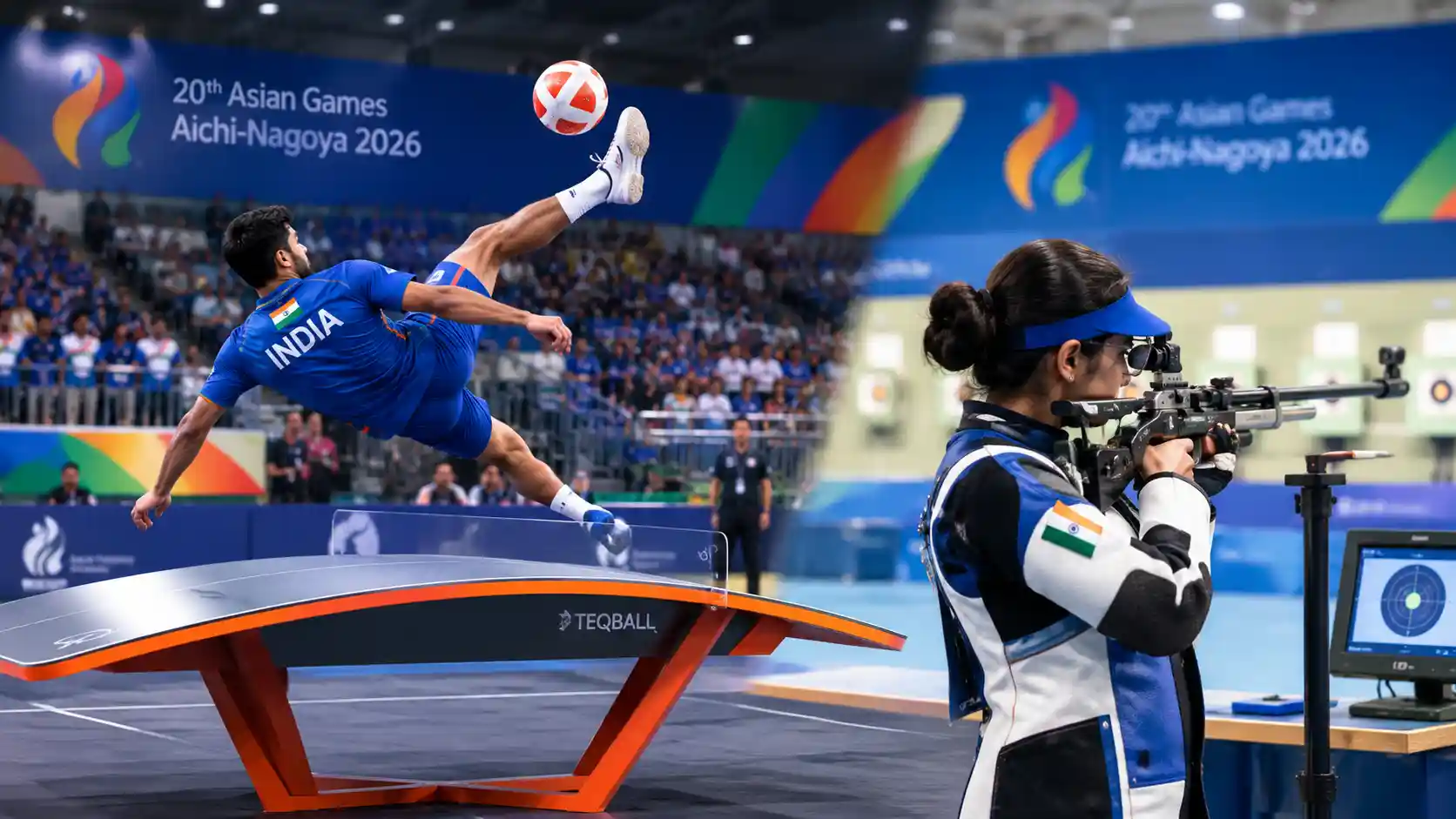

Teqball, a fast-paced hybrid of football and table tennis, made its debut at the Asian Games in Nagoya, Japan, this month, drawing attention as one of six new sports introduced at the 2026 edition of the continental multi-sport event. The competition, held from September 17 to 20, 2026, produced its first-ever Asian Games medalists, crowned an underdog champion, and featured storylines ranging from a 40-year-old Japanese comedian competing on the international stage to an Indian debutante who came within a single point of a historic medal.
Teqball Explained: How the Game Is Played
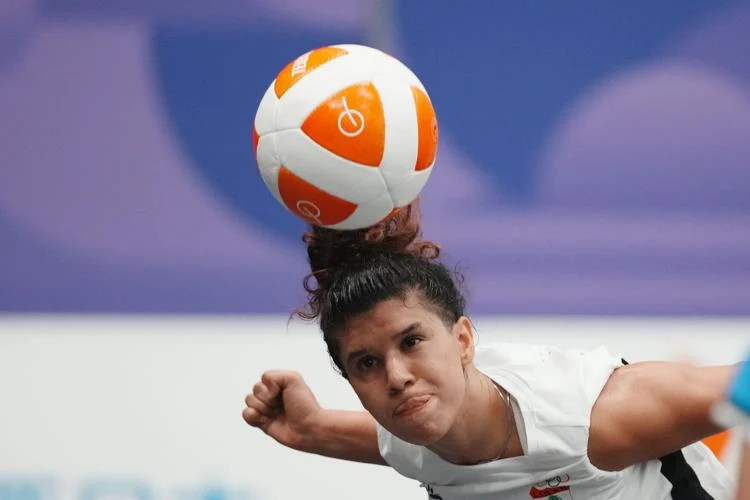
Teqball is played on a specially designed, curved table that resembles an oversized table tennis table bent into a smooth arc. Two players, or two pairs in doubles events, stand on opposite sides of the table and use their feet, thighs, chest, shoulders or head, but never their hands or arms, to return the ball over the table's raised centre and back onto their opponent's side. The curved shape of the table means the ball bounces back predictably toward the player who struck it, allowing for extended rallies built around close ball control, quick footwork and improvisational technique.
The sport was invented in 2014 in Hungary by three football enthusiasts, Gabor Borsanyi, Gyorgy Gattyan and Viktor Huszar, who reportedly built the first prototype table in a garage. Because it draws so heavily on football skills, first touch, juggling and volleying technique in particular, teqball has attracted a following among current and former footballers around the world, and top-level matches often feature the same kind of improvisational flair associated with street football.
Teqball is frequently compared to sepak takraw, a sport popular across Southeast Asia in which players use their feet, knees, chest and head to send a rattan or synthetic ball over a net, often incorporating acrobatic bicycle kicks. While sepak takraw is played over a net on a court, teqball is played over the raised centre of a curved table, giving the two sports a related but visually distinct character.
Matches are typically contested as the best of three sets, with each set won by the first player or pair to reach 12 points, provided they lead by at least two points; if the score reaches 11-11, play continues until one side establishes a two-point advantage. An unusual feature of competitive teqball is the "edge ball," which occurs when the ball strikes the edge of the curved table and deflects unpredictably; when this happens, the point is typically replayed rather than awarded, since the resulting bounce is considered outside the normal run of play.
Teqball's International Development and Growing Presence in Asia
Since its invention just over a decade ago, teqball has expanded rapidly through a structured international competition system overseen by the International Teqball Federation, known as FITEQ. The sport has featured at the European Games, appearing at the 2023 edition, and has increasingly found a place within Asia's own multi-sport event calendar. According to a February 2026 announcement from FITEQ, teqball had already been included as a medal sport at the Asian Youth Games in Bahrain and the Southeast Asian Games in Thailand before its Asian Games debut, with further appearances following at the Asian Beach Games in China and a planned appearance at the Asian Indoor and Martial Arts Games in Saudi Arabia later in 2026.
FITEQ Secretary General Laszlo Vajda described the sport's addition to the Asian Games program as "another major achievement and recognition in the global reach" of teqball, tying the milestone to the federation's longer-term ambition of eventual Olympic recognition. That ambition was reinforced further at the Asian level in April 2026, when teqball featured at the Asian Beach Games in Sanya, China, played on a version of the curved table set into a sandy surface. That event, held from April 25 to 27, marked what organizers described as the first adult teqball tournament held at an Asian level, drawing 63 athletes from 13 national Olympic committees across men's doubles, women's doubles and mixed doubles, with Thailand sweeping gold in all three events.
The Asian Games Debut: Dates, Venue and Format
The Olympic Council of Asia confirmed teqball as an official medal sport for the 20th Asian Games in a circular issued by Director General Husain Al Musallam in March 2026, alongside the racquet sport padel. At Aichi-Nagoya 2026, teqball was one of six sports appearing at the Asian Games for the first time, alongside mixed martial arts, padel, surfing, BMX freestyle and virtual taekwondo, part of a broader effort by organizers to diversify the Games' sporting program with newer, fast-growing disciplines.
Competition was held at the Nagoya City Higashi Sports Center from September 17 to 20, 2026, two days before the Games' formal opening ceremony on September 19, meaning teqball athletes were among the very first competitors in action at these Asian Games. According to figures compiled for the event, 55 athletes from 15 nations took part across five medal events: men's singles, women's singles, men's doubles, women's doubles and mixed doubles.
The competition format followed a structure common to teqball's major tournaments: athletes were first divided into round-robin groups, with results determining whether they advanced directly to the semifinals, entered the quarterfinals, or were eliminated. Players eliminated in the quarterfinals were given a second chance through a repechage round, from which the winners advanced to the bronze medal match, while quarterfinal and semifinal winners progressed toward the gold medal final.
Participating Nations and Notable Storylines
Fifteen nations sent athletes to compete in teqball at these Asian Games, reflecting the sport's broadening base across the region. Myanmar, Indonesia, Japan, India, Vietnam, South Korea, Cambodia, the Philippines, Thailand and Kuwait were among the countries whose athletes featured prominently in results from the tournament, alongside further competing nations.
The event produced a range of personal stories that illustrated teqball's still-developing but rapidly diversifying player base. Japan's Takahiro Nodomi, who also works as a comedian, competed at the age of 40 after taking up the sport in his late thirties, having played football only until high school. "I played football until high school, gave up, started teqball in my late 30s, and made it to this big stage at 40," Nodomi said after his competition. "If the message that 'even old guys can work hard' reached everyone, then I feel I was able to release some [pressure]." The Philippines, by contrast, fielded a notably young men's team that included three 14-year-old competitors, among them Prince Agustin, who competed in both the men's singles and mixed doubles events, reaching the men's singles bronze medal match before falling short of the podium.
Key Players and Results
The inaugural Asian Games teqball champion was Myanmar's Wai Khin Hnin, known in some reporting as Khin Hnin Wai, who won the first-ever gold medal in the sport's Asian Games history by defeating Indonesia's Ima Sumaya, who competes under a single name, 2-1 in the women's singles final, with a score line of 10-12, 12-8, 12-9. Wai Khin Hnin lost the opening set before rallying to win the next two, sealing the title in a match watched by Barcelona and Spain football legend Carles Puyol. Speaking afterward, Wai Khin Hnin said her next goal was to win gold for Myanmar at the 2027 Southeast Asian Games. Sumaya, the runner-up, had earlier eliminated India's Quimcy Joaquim Dsouza in the semifinals before falling to Wai Khin Hnin in the final, taking the silver medal.
The bronze medal in women's singles went to Japan's Yuina Sakamoto, the tournament's top seed and world number 7, who defeated Dsouza 2-0 in a closely fought bronze medal match, with both sets decided by the narrowest possible margin, 12-11 and 12-11. Dsouza held a set point in the opening game and led 10-8 in the second before Sakamoto fought back on both occasions to seal the win in front of a home crowd. The defeat left Dsouza in fourth place in the women's singles event.
India's teqball campaign, though ultimately medal-less, produced one of the tournament's more compelling individual storylines. Dsouza, a 24-year-old from Mumbai making her Asian Games debut, opened her campaign by upsetting Sakamoto 2-1 in the group stage, winning 10-12, 12-11, 13-11 in a match lasting 43 minutes, before beating Cambodia's Koemyean DY 2-0 to top her group and earn a bye directly into the semifinals. There, she narrowly lost 1-2 to Sumaya, with the deciding set going 12-7 in Sumaya's favour after Dsouza had built an early lead, before her eventual defeat in the women's singles bronze medal match to Sakamoto in a rematch of her group-stage upset. Dsouza also competed in mixed doubles alongside Mohamed Anas Imran Beg, where the pair finished third in their five-team group, lost their quarterfinal to Vietnam's Gia Nghi Trinh and Hoang Minh Tan Nguyen, then won a repechage match 2-0 against the Philippines' Jhoana Abulencia and Prince Agustin to reach the bronze medal match, which they also lost, ending India's teqball campaign without a medal at the sport's Asian Games debut.
India's men's doubles pairing of Declan Marshall Gonsalves and Beg, meanwhile, were eliminated at the group stage, losing to Vietnam and South Korea. The pair had previously shown they could compete at a high level internationally, having upset Romania's Arnold Szilagyi and Hunor Kristaly in the round of 16 at the 2024 World Teqball Championships in Ho Chi Minh City, Vietnam, winning both sets 12-11, before facing the tournament's defending champions in the next round.
Athlete Preparation and Background
Dsouza's path to teqball illustrates a pattern common among many of the sport's competitors internationally: a background in football preceding a switch to the newer discipline. Before taking up teqball in 2022, she represented Maharashtra's under-19 football team. Since switching sports, she has become a seven-time national teqball champion in India and reached a career-best individual world ranking of 24 in FITEQ's rankings, having finished ninth in the women's singles event at the 2026 World Teqball Championships in the lead-up to these Asian Games. Her semifinal run in Nagoya was described in Indian media coverage as a significant milestone for the sport in the country, even though it ultimately fell short of a podium finish.
Why Teqball's Asian Games Debut Matters
Teqball's inclusion at the Asian Games represents a notable step in the sport's broader international development strategy, which has focused heavily on securing appearances at established multi-sport events as a pathway toward wider recognition. Having already featured at the European Games, the Asian Youth Games and the Southeast Asian Games before arriving at the Asian Games, and having debuted separately at the Asian Beach Games earlier in 2026, teqball has built a presence across a range of major regional and continental competitions in a relatively short period since its 2014 invention.
For a sport still working to establish itself on the international sporting calendar, exposure at an event of the Asian Games' scale, held alongside more than 11,000 athletes from 45 countries and regions competing across 43 sports through October 4, offers a level of visibility that smaller standalone tournaments cannot match. The diversity of competitors on display in Nagoya, from a 40-year-old Japanese comedian to teenage Philippine players to India's Dsouza, whose near-miss run captured domestic attention despite the absence of a medal, illustrated both the sport's accessibility to newcomers and its capacity to produce compelling competitive storylines even in its first appearance at this level.
Whether teqball's Asian Games debut translates into further growth, expanded national federation support across the region, or progress toward FITEQ's stated ambition of eventual Olympic recognition remains to be seen, and this article does not speculate on those longer-term outcomes. What is confirmed is that the sport's first Asian Games competition produced a full set of medalists, a wide geographic spread of competing nations, and enough close, competitive matches, including two bronze medal matches decided by the narrowest possible margins, to suggest a genuine, developing competitive depth across the region rather than a one-sided exhibition.
Conclusion
Teqball's debut at the 2026 Asian Games in Nagoya delivered on its billing as a new sport worth watching, producing an inaugural champion in Myanmar's Wai Khin Hnin, a runner-up in Indonesia's Ima Sumaya, and a bronze medalist in Japan's Yuina Sakamoto, while India's Quimcy Dsouza narrowly missed out on the podium in both singles and mixed doubles despite a standout run through the group stage and semifinals. With 55 athletes from 15 nations competing across five events at the Nagoya City Higashi Sports Center, and a broader international development pathway already running through the European Games, the Asian Youth Games, the Southeast Asian Games and the Asian Beach Games, teqball's Asian Games debut marked a further step in the sport's decade-long expansion since its invention in Hungary in 2014, even as its longer-term trajectory within the international sporting calendar remains to be determined.
Further reading and useful links
Reader questions
Frequently asked questions
What is teqball and how is it played?
Teqball is a hybrid of football and table tennis played on a specially designed curved table. Players use any part of their body except their hands and arms to return the ball over the table's raised center.
Who won the first Asian Games gold medal in teqball?
Myanmar's Wai Khin Hnin won the inaugural Asian Games teqball gold medal by defeating Indonesia's Ima Sumaya 2-1 in the women's singles final.
How did India perform in teqball at the 2026 Asian Games?
India's Quimcy Dsouza reached the women's singles semifinals and the mixed doubles bronze medal match, but narrowly missed a medal in both. The men's doubles pair exited at the group stage.
Nexuswild welcomes factual corrections. Email [email protected] with evidence and the article URL.