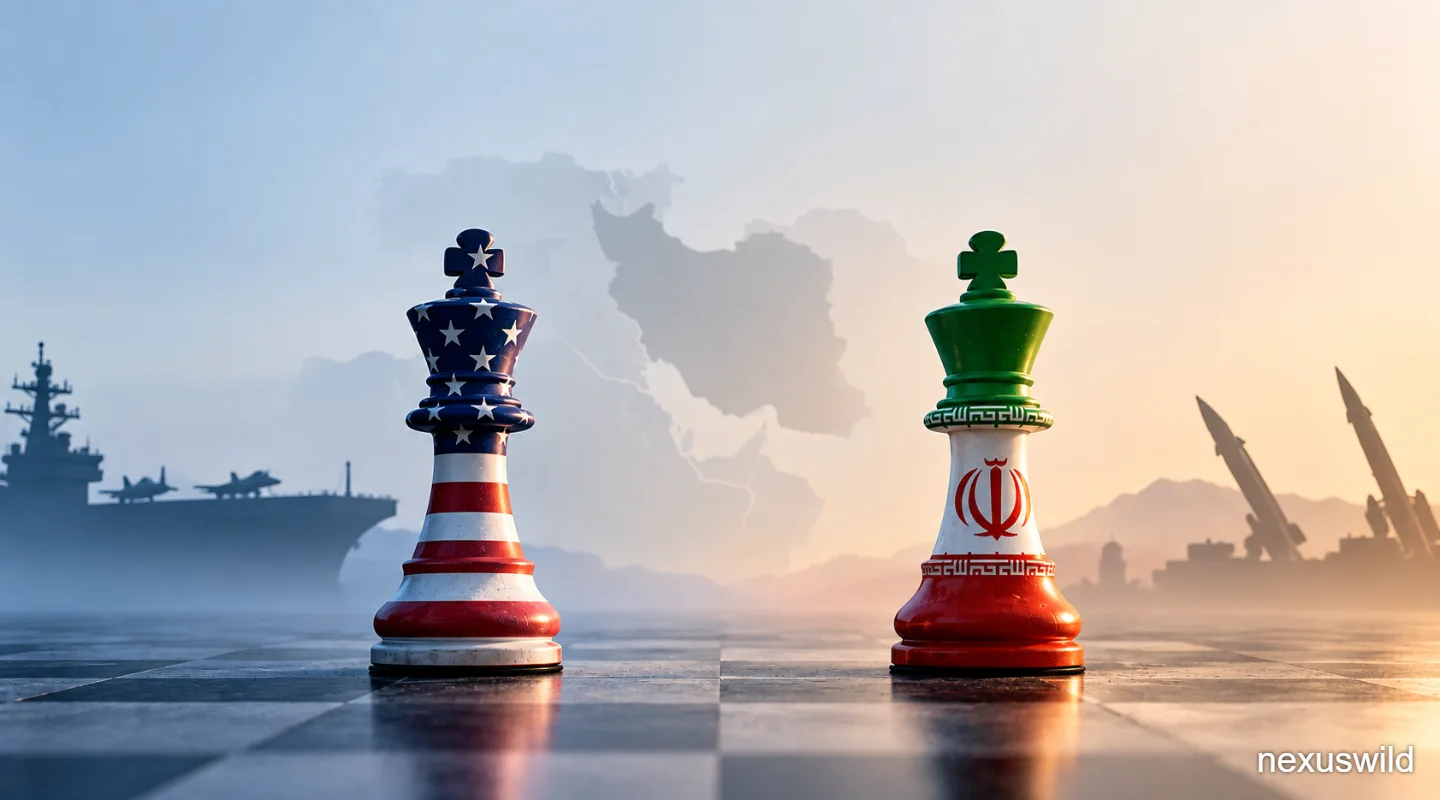

U.S. President Donald Trump is keeping his next move toward Iran undisclosed as senior administration officials review the direction of a seven-month conflict that has alternated between major fighting, temporary pauses and continued diplomatic contacts.
Asked by reporters on Friday, October 2, what he planned to do next on Iran, Trump declined to provide specifics.
“If I told you, you would have a major story,” Trump said, adding: “But you will see.”
His remarks came as senior national-security officials reportedly gathered at Camp David to discuss Iran and the expanding conflict involving Yemen's Houthis.
The combination of continued diplomatic exchanges, a significant U.S. military buildup and high-level internal deliberations marks a new stage in the confrontation, but does not establish whether Washington has decided on further large-scale military action.
U.S.-Iran Conflict Remains Unresolved
The current conflict began with U.S.-Israeli attacks on Iran on February 28, 2026.
A ceasefire on April 8 ended an initial 40-day period of intense fighting, but hostilities have continued intermittently since then. Diplomatic negotiations have also repeatedly resumed and stalled.
Trump has publicly left open the possibility of additional military action while refusing to describe potential targets or timing.
In an interview conducted in late September, he said renewed bombing after the November 3 U.S. midterm elections was “possible,” but declined to explain what such an operation might involve.
Those statements indicate that military options remain under consideration. They do not confirm that Trump has authorised another major campaign.
Senior Officials Reportedly Meet at Camp David
Three U.S. officials said senior members of Trump's national-security team met for several hours at Camp David on October 2 to discuss the Iran conflict and developments involving Saudi Arabia and the Houthis in Yemen.
According to that account, Vice President JD Vance chaired the meeting. Participants included Secretary of State Marco Rubio, Defense Secretary Pete Hegseth, White House envoy Steve Witkoff, CIA Director John Ratcliffe and Joint Chiefs of Staff Chairman Gen. Dan Caine.
The White House declined to comment on the meeting.
Because details of the discussion come from unnamed officials rather than a formal White House account, reports about what was considered or decided should not be treated as an official announcement of U.S. policy.
Trump's public remarks later that day provided no clarification about whether a decision had been reached.
U.S. Expands Military Presence
At the same time, Washington is increasing its military presence in the Middle East.
The U.S. military is sending roughly 9,000 additional sailors and Marines aboard naval forces that include the USS Theodore Roosevelt carrier strike group and the USS Makin Island amphibious readiness group, according to a U.S. official familiar with the deployment.
The reinforcement could leave three American aircraft carriers in the region by late October and raise the naval presence to more than 20,000 sailors and Marines, alongside hundreds of aircraft.
The deployment gives U.S. commanders additional defensive and offensive capacity and greater flexibility if regional conditions deteriorate.
It should not, however, be interpreted by itself as proof that another major strike has been ordered. Military deployments can support deterrence, force protection, ongoing operations and contingency planning as well as preparations for offensive action.
Diplomacy Has Not Ended
Despite the military buildup, diplomatic channels remain open.
Iran presented a proposal through Qatari mediators during the United Nations General Assembly in New York. Tehran said the plan could lead to the reopening of the Strait of Hormuz and an end to hostilities within seven days under specified conditions.
Iran's stated demands included lifting the U.S. blockade on Iranian ports, releasing at least $12 billion in frozen Iranian funds and waiving sanctions on Iranian oil sales. Tehran has also argued that negotiations over its nuclear programme should follow agreement on its other conditions.
Trump publicly rejected the proposal as insufficient.
Iranian officials subsequently said Tehran had received an official U.S. response through diplomatic channels, although they did not disclose its contents. President Masoud Pezeshkian said Iran would continue trying to reach an agreement and called for a “win-win” approach.
Mediators including Qatar and Pakistan have remained involved.
The existence of those contacts shows that diplomacy has not collapsed, but there is no verified agreement as of October 3.
Iran Also Signals Readiness to Respond
Iran has maintained that it wants a diplomatic resolution while also preparing for the possibility of renewed U.S. attacks.
Several Iranian officials said military commanders had been reviewing potential responses if Washington resumes large-scale strikes. No final Iranian decision had been made, according to those accounts.
That dual approach mirrors the broader state of the conflict: both sides are maintaining military options while negotiations continue indirectly.
Conclusion
As of October 3, 2026, Trump has not publicly disclosed what his administration will do next regarding Iran.
Senior U.S. officials have reportedly held intensive discussions at Camp David, American naval forces are being reinforced in the region and Trump continues to keep the possibility of further military operations open.
At the same time, Iran and the United States remain connected through mediators, with Tehran continuing to promote a negotiated settlement despite significant disagreements over sanctions, the Strait of Hormuz and Iran's nuclear programme.
The current evidence therefore points to simultaneous military preparation and diplomatic engagement rather than a confirmed shift toward either renewed full-scale operations or a negotiated settlement.
What comes next remains a decision that Washington and Tehran have not publicly resolved.
Nexuswild welcomes factual corrections. Email contact@nexuswild.com with evidence and the article URL.