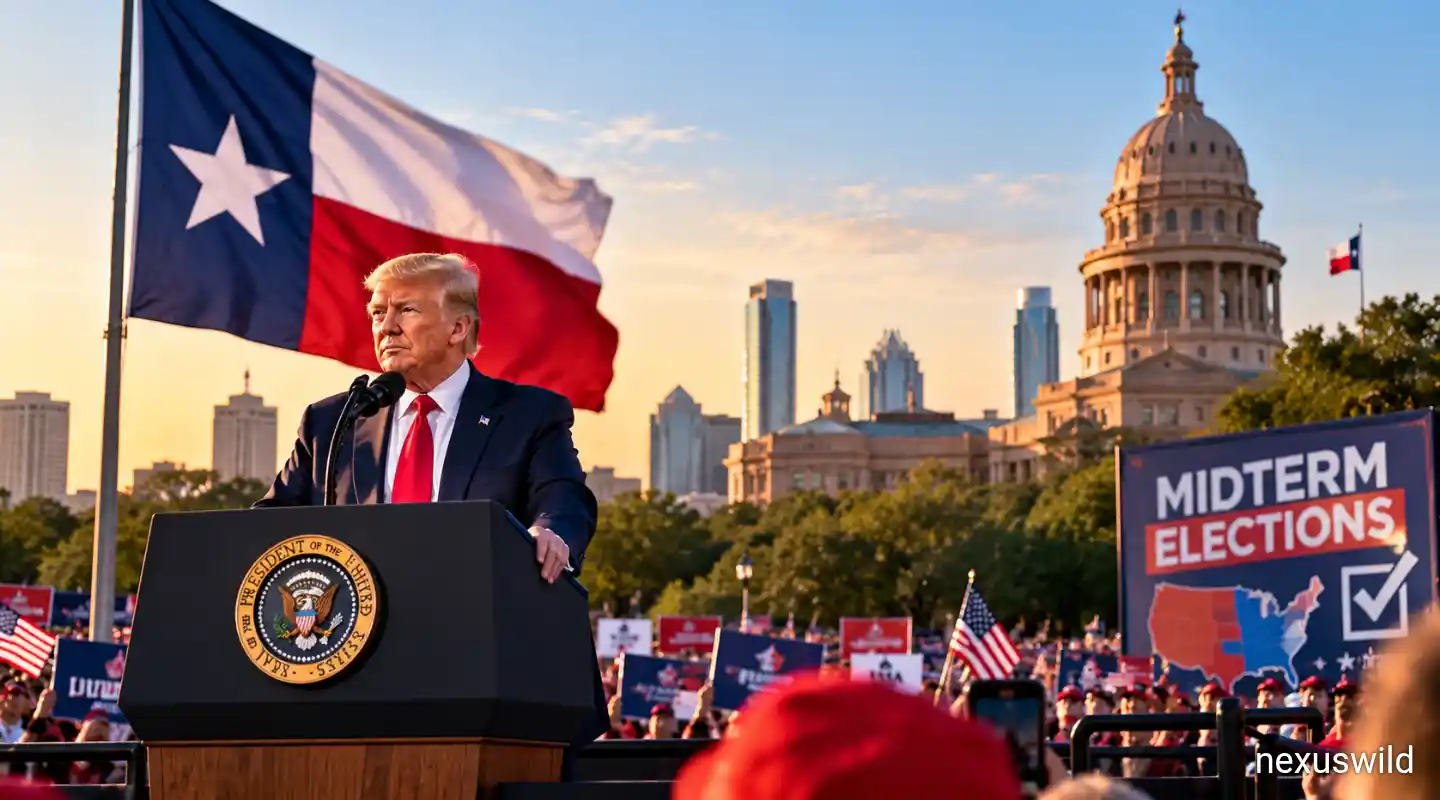

President Donald Trump returned to Texas on October 7 for a campaign rally in San Antonio, seeking to energize Republican voters as races that once appeared relatively secure for the party have become more competitive ahead of the November 3 midterm elections.
Trump appeared with Republican U.S. Senate nominee Ken Paxton at Freeman Coliseum, making his third trip to Texas in roughly a month as the party works to defend a state that has long been central to its national electoral coalition.
Paxton is running against Democratic nominee James Talarico in a contest that has drawn substantial national attention and spending.
Republicans are also defending competitive congressional territory in South Texas, while Governor Greg Abbott is seeking another term in a race that has attracted more attention than Republicans initially expected.
Trump Makes Third Texas Visit in a Month
The San Antonio rally reflects the importance Republicans are placing on turnout in Texas.
Trump won the state by about 14 percentage points in the 2024 presidential election, but the political environment has become less predictable heading into the 2026 midterms.
The president has intensified his campaign schedule across the country, appearing in states that Republicans historically would not have considered major defensive priorities.
Texas has become part of that effort.
Trump’s latest visit followed earlier appearances in the state during September as Republicans sought to consolidate support before early voting and Election Day.
Ken Paxton Is at the Center of the Senate Fight
The most prominent Texas contest is the race for the U.S. Senate.
Paxton, the longtime Texas attorney general, won the Republican nomination after Trump backed him over incumbent Senator John Cornyn during the party’s primary process.
Trump emphasized Paxton’s loyalty during the San Antonio rally and urged Republican voters to support him in November.
Paxton thanked Trump for campaigning in the state and framed the election as important for preserving Republican representation in Washington.
The Democratic nominee, state lawmaker James Talarico, has focused much of his campaign on economic issues, healthcare and criticism of Republican governance.
Polling Shows a Competitive Senate Contest
Recent polling has shown the Senate race to be closely contested.
A New York Times/Siena College poll released October 3 showed Talarico at 51% and Paxton at 45% among likely voters.
That is a single poll rather than a prediction of the final result.
Polling can change substantially before Election Day, particularly depending on turnout and late campaign developments.
The numbers nevertheless help explain why national Republican organizations have devoted substantial resources to a Senate seat the party once expected to defend more comfortably.
Republicans Are Spending Heavily in Texas
Republican-aligned organizations have sharply increased spending in Texas during the closing weeks of the campaign.
More than $100 million in combined outside spending has recently been directed toward supporting Republican candidates in the state, according to current campaign-finance reporting.
The spending underscores how the national political map has shifted.
Texas remains Republican-leaning overall, but competitive statewide and congressional contests have forced the party to commit resources that could otherwise have been deployed in traditional swing states.
Democrats, meanwhile, see Texas as an opportunity to expand the number of races Republicans are required to defend.
Trump’s National Approval Has Weakened
The campaign is unfolding as Trump’s national approval ratings have declined.
A nationwide poll completed in early October put his approval rating at 32%.
The same survey found Democrats ahead 44% to 37% among registered voters in the national congressional preference question.
National polling does not translate directly into results in Texas.
State-specific turnout, candidate quality, local issues and district boundaries can all produce outcomes different from national trends.
But the numbers have increased pressure on Republican candidates running in competitive races.
Republican Voter Enthusiasm Is Another Concern
Turnout is particularly important in midterm elections because participation is generally lower than in presidential years.
The latest national survey found a noticeable enthusiasm gap between people who voted for the two major presidential candidates in 2024.
About 48% of voters who backed Kamala Harris in 2024 described themselves as very enthusiastic about voting in the 2026 midterms, compared with 30% of Trump’s 2024 voters.
That finding does not establish how individual races will end.
It does, however, explain why Trump has embarked on an aggressive rally schedule designed to mobilize voters who supported him in 2024.
Hispanic Voters Are Important in Texas
Hispanic voters are particularly important to the political environment in Texas.
Trump made significant gains among Hispanic voters during the 2024 election and won nearly half of their vote nationally, helping Republicans improve their performance in South Texas.
The latest national polling, however, put Trump’s approval among Hispanic adults at approximately 24%.
That decline has drawn attention because South Texas contains several heavily Hispanic congressional districts where Republicans had hoped to build on their recent gains.
The extent to which national approval numbers translate into congressional voting behavior remains uncertain.
South Texas House Races Have Tightened
Republicans are also defending competitive U.S. House races in South Texas.
The region became increasingly competitive during the Trump era as Republican candidates improved their performance among Hispanic voters.
New congressional boundaries were adopted with the expectation that Republicans could expand their representation.
Some races, however, have become closer than party strategists initially anticipated.
One closely watched contest involves Republican Eric Flores and Democratic Representative Vicente Gonzalez in the Rio Grande Valley.
The district was redrawn in a way expected to improve Republican prospects, but current reporting describes the contest as competitive.
Redistricting Was Supposed to Help Republicans
Texas was part of an unusual mid-decade redistricting effort designed to improve Republican prospects in the House.
Republican-led redistricting in Texas and Florida had initially been expected to create opportunities for as many as nine additional GOP seats between the two states.
But district boundaries cannot fully insulate candidates from changes in the national political environment.
Economic dissatisfaction, fuel prices and disputes over federal policy have made some districts more competitive than the party expected when the maps were drawn.
That does not mean the redistricting effort will fail, only that several races remain actively contested.
Cost of Living Remains a Major Campaign Issue
Economic concerns are among the dominant issues in the midterm campaign.
Voters continue to report frustration with the cost of living, particularly fuel prices and other household expenses.
The conflict with Iran has contributed to higher energy prices, adding political pressure on the administration and Republican candidates.
Trump has defended his administration’s actions, arguing that national-security concerns justify the economic costs associated with the conflict.
Democratic candidates have instead emphasized the effect of higher fuel and consumer prices on households.
Those competing arguments have become increasingly prominent in congressional and statewide races.
Iran War Has Become a Dividing Issue
The conflict with Iran has also produced differences within the Republican Party.
A review of competitive congressional contests found that several vulnerable Republican candidates have distanced themselves from Trump on individual policies, including the Iran conflict.
Some have supported efforts to limit presidential war powers or publicly called for an end to the fighting.
The broader pattern does not amount to a complete break with Trump.
Most Republican candidates continue to support large parts of the administration’s agenda while selectively emphasizing differences on issues important to their own districts.
Trump Remains Central to Republican Turnout Strategy
Despite his weaker national approval ratings, Trump remains the party’s most visible campaign figure.
Republicans are betting that his ability to mobilize voters who do not always participate in midterm elections can help offset Democratic enthusiasm.
Trump himself has argued that his rallies are important to preserving Republican control of Congress.
That strategy creates a balancing act for candidates.
Trump remains highly popular with much of the Republican base, but competitive races are often decided by independents and voters who do not identify strongly with either party.
Some Republican Candidates Are Creating Distance
That tension is visible nationally.
A review of 62 competitive House and Senate contests found that candidates in 41 races had either publicly diverged from Trump on certain policies or reduced the prominence of their association with him.
The differences were generally tactical rather than ideological.
Candidates often continued supporting Trump overall while taking separate positions on issues such as Iran, data-center development or trade.
The pattern shows how Republicans are attempting to retain Trump-aligned voters while also appealing to swing voters.
Greg Abbott Skipped the San Antonio Rally
Texas Governor Greg Abbott, normally a close Trump ally, did not attend the San Antonio event.
His schedule included another public appearance, and his campaign said he had separate campaign commitments.
Abbott is seeking another term and is facing a race that current reporting describes as closer than Republicans originally anticipated.
His absence should not automatically be interpreted as a political split with Trump.
The two remain publicly aligned on many policy issues.
Protesters Interrupt Trump’s Speech
The San Antonio rally was repeatedly interrupted by protesters.
At least a dozen demonstrators disrupted Trump during the event, including one protester who appeared relatively close to the stage.
Trump continued speaking after the interruptions.
The event remained focused largely on mobilizing Republican voters and attacking Democratic candidates.
Protests have also appeared at other campaign events during the closing weeks of the election cycle.
Trump Attacks Talarico
Trump repeatedly criticized Talarico during his remarks and urged voters to support Paxton.
Talarico responded by accepting Trump’s call for the two Senate candidates to debate.
The Senate campaign has increasingly drawn national attention because control of the chamber is closely contested.
A Republican loss in Texas would make the party’s path to retaining its Senate majority more difficult, although control will ultimately depend on results across multiple states.
Paxton’s Relationship With Trump Has Drawn Attention
Paxton has generally presented himself as a strong Trump ally.
However, comments recorded earlier in the campaign created questions about whether he believed some Trump-centered campaign events had hurt Republican polling.
Paxton’s campaign disputed interpretations suggesting that the comments amounted to criticism of the president.
The episode illustrates the broader dilemma facing Republican candidates.
They need strong turnout from Trump-aligned voters while also competing for independents and more moderate voters.
Trump Is Campaigning Beyond Traditional Swing States
Texas is part of a broader campaign push.
Trump has recently appeared in states including Alabama, Ohio, Oklahoma, Nebraska and Texas, while Vice President JD Vance has also campaigned for Republican candidates around the country.
Several of those states normally lean Republican.
The decision to spend presidential campaign time there shows how the 2026 environment has expanded the number of races drawing national attention.
Republicans are attempting to protect existing seats while Democrats seek to broaden the battlefield.
Control of Congress Is at Stake
All 435 seats in the U.S. House of Representatives are being contested in the November 3 election, along with the regular cycle of Senate seats.
In Texas, voters will also choose a governor and other statewide officials, as well as all 38 U.S. House members representing the state.
The Texas Senate contest is therefore only one part of a much larger midterm election.
Results in the state could affect both congressional control and the direction of Texas government for the next several years.
Election Day Is November 3
Texas voters will cast their general-election ballots on Tuesday, November 3, 2026.
The Texas secretary of state has already certified candidate information and election materials for federal, state and district races.
As the campaign enters its final weeks, both parties are increasing advertising, organizing and candidate appearances.
Turnout will be particularly important in races where polling margins remain narrow.
Texas Is Still Republican-Leaning, but Several Races Are Competitive
The state should not be described as having completely transformed into a conventional swing state based on the current election alone.
Republicans continue to hold substantial institutional and electoral advantages in Texas, and Trump won the state comfortably in 2024.
The more precise description is that several important 2026 races are more competitive than Republicans expected.
Those include the U.S. Senate race and multiple congressional contests, particularly in South Texas.
That distinction avoids overstating what current polling can establish.
Conclusion
Donald Trump’s return to Texas shows how the 2026 midterm campaign has expanded into territory Republicans once expected to defend with less difficulty.
His October 7 rally in San Antonio, his third Texas trip in roughly a month, focused heavily on supporting Republican Senate nominee Ken Paxton against Democrat James Talarico.
Recent polling has shown the Senate contest close, while Republicans are also defending competitive House seats in South Texas and Governor Greg Abbott is facing a more closely watched reelection campaign.
At the same time, national surveys show weaker approval for Trump and a Democratic advantage in voter enthusiasm, adding pressure on Republicans to increase turnout.
Texas remains a Republican-leaning state, and individual polls should not be treated as election forecasts.
But the level of presidential attention, outside spending and campaigning in the state demonstrates that Republicans are treating several Texas contests as genuinely competitive heading into the November 3, 2026 midterm elections.
Nexuswild welcomes factual corrections. Email contact@nexuswild.com with evidence and the article URL.