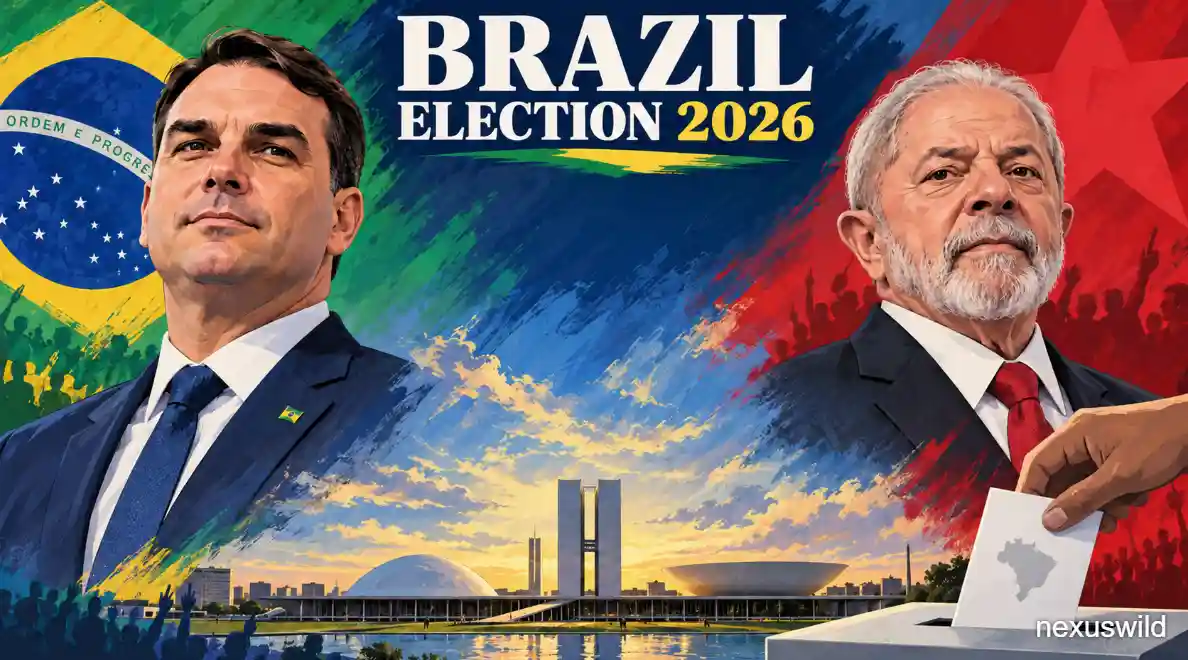

Brazil’s presidential election will be decided in a second round on October 25 after Senator Flávio Bolsonaro finished ahead of incumbent President Luiz Inácio Lula da Silva in the first round but fell short of the majority required for an outright victory.
The completed national count showed Bolsonaro, the candidate of the Liberal Party, or PL, with 47.03% of valid votes, while Lula, representing the Workers’ Party, or PT, received 45.16%.
Final figures based on the electoral authority’s count put Bolsonaro at 56,104,503 votes and Lula at 53,879,538 votes. The result placed the two candidates comfortably ahead of the rest of the presidential field and qualified them for the runoff.
Brazil’s Superior Electoral Court, known by its Portuguese initials TSE, had already formally confirmed early Monday that Bolsonaro and Lula would advance after 99.99% of polling sections had been counted. The court reported the same percentage shares of 47.03% and 45.16%.
Why Brazil Is Holding a Second Round
Brazil elects its president under a majority system. A candidate must receive an absolute majority of valid votes in the first round to be elected immediately. Blank and invalid ballots are excluded when that threshold is calculated.
The TSE states that if no presidential candidate obtains more than half of valid votes, the two highest-placed candidates proceed to a second election.
Although Bolsonaro finished first on October 4, his 47.03% share remained below the required majority. Lula’s 45.16% also fell short, making a runoff mandatory.
The TSE’s official 2026 election calendar schedules the second round for Sunday, October 25, 2026. The date applies to the presidential election as well as gubernatorial races requiring a second round.
Votes cast in the first round do not carry over. The runoff is a separate election between Bolsonaro and Lula, with the candidate receiving the greater number of valid votes becoming president.
Who Is Flávio Bolsonaro?
Flávio Bolsonaro, 45, is a lawyer, former state legislator and senator representing Rio de Janeiro. He is the son of former President Jair Bolsonaro and is contesting the Brazilian presidency for the first time. His running mate is federal deputy Alfredo Gaspar.
He represents the Liberal Party, or PL, which occupies the right of Brazil’s political spectrum. International reporting throughout the campaign has described Bolsonaro as a right-wing candidate whose political base overlaps significantly with the conservative movement associated with his father.
On economic policy, Bolsonaro has presented himself as more market-oriented than Lula. Reporting on his campaign has highlighted proposals focused on tighter fiscal policy, lower public spending and a more business-friendly approach, although several significant details of his fiscal plans remained unresolved during the campaign.
Public security has also been central to his campaign. Bolsonaro has promoted a tougher approach to crime and has repeatedly sought to make concerns about organized crime and violence an electoral issue.
Those positions are campaign policies and political arguments, rather than findings of the electoral authority.
Lula Seeks Another Term
Luiz Inácio Lula da Silva, 80, is Brazil’s incumbent president and the candidate of the Workers’ Party, or PT.
Lula previously governed Brazil from 2003 through 2010 and returned to the presidency in January 2023. He is now seeking another non-consecutive term. His vice-presidential candidate is Geraldo Alckmin, a former governor of São Paulo and member of the Brazilian Socialist Party.
Lula remains one of the most prominent figures on Brazil’s political left. His governments have traditionally placed greater emphasis on social programmes, income support and a larger role for the state in addressing poverty and inequality.
During the 2026 campaign, Lula pointed to low unemployment, higher incomes and declining inequality as evidence that economic conditions had improved under his government. Those arguments formed part of his re-election case and should be distinguished from the official election result itself.
His campaign also promoted measures aimed at household finances and social protection, while advisers discussed ways to stabilise public debt and eventually create conditions for lower interest rates. Reporting before the election noted, however, that both leading campaigns left some difficult fiscal choices unspecified.
Economy and Cost of Living Remain Central Issues
Economic conditions have been one of the most persistent themes of the 2026 campaign.
Brazil entered the election with contrasting indicators. Employment and income data provided Lula with positive economic arguments, but many households continued to face pressure from food prices, borrowing costs and debt.
Reporting in the final weeks of the campaign found that dissatisfaction with the cost of living remained significant despite easing inflation and strong labour-market indicators. Household debt also complicated the government’s effort to translate improving headline statistics into broader voter confidence.
Brazil’s fiscal outlook has been another point of debate. Both candidates have argued that public finances require attention, but their approaches differ over the role of spending, welfare programmes, fiscal restraint and private investment.
These economic positions are campaign proposals rather than guarantees of future policy.
Public Security Shapes the Political Debate
Crime and public security have also played a major role.
Concerns over organized criminal groups and violent crime intensified pressure on Lula’s administration during the campaign. His government increased federal involvement in security initiatives, including programmes designed to improve intelligence sharing and coordination among different levels of government.
Bolsonaro has argued for a more forceful law-and-order strategy and has used public concern about crime as a major part of his challenge to the government.
Security concerns have been particularly politically important in areas where violent crime has remained high, including parts of northeastern Brazil traditionally considered favourable territory for Lula’s party.
The candidates’ competing descriptions of responsibility for crime, and the effectiveness of their proposed responses, remain political arguments rather than conclusions established by the election authorities.
Corruption and Political Controversies Remain Part of the Campaign
Corruption and political integrity have continued to feature in Brazil’s election debate.
Reporting during the first-round campaign described corruption scandals and allegations involving figures across the political spectrum as one of several issues influencing voters, alongside economic anxiety and public security.
Such allegations require careful distinction from proven wrongdoing. Claims made by campaigns about opponents should not be treated as established facts unless supported by court rulings, official investigations or other independently verified evidence.
The campaign has also unfolded against the broader legacy of Brazil’s intensely polarised politics following the 2022 election, contributing to a contest in which institutional questions and political trust have remained prominent alongside conventional economic and security issues.
First-Round Result Differed From Some Pre-Election Expectations
Polling conducted before the vote generally showed a close contest, and some surveys had indicated Lula could finish narrowly ahead in the first round.
The official result produced the opposite order, with Bolsonaro finishing first by almost two percentage points. Pre-election polling and the final vote are separate measures: polls estimate voter preferences from samples, while the TSE count records ballots actually cast.
The first-round outcome therefore supersedes polling as the authoritative measure of voter support on October 4.
Analysts, financial-market participants and political parties have since offered differing interpretations of the result. Those assessments do not alter the official count and do not establish the likely result of the second round.
What Happens Before October 25
The runoff gives Bolsonaro and Lula three weeks to seek support from voters who backed eliminated candidates, abstained in the first round or remain undecided.
Both campaigns are expected to sharpen their focus on economic management, household finances, public security and political integrity. Congressional results may also influence the wider political debate because the next president will have to work with a legislature in which conservative parties strengthened their position in the first round.
However, the congressional balance does not determine the presidential runoff. The presidency will be decided directly by valid votes cast on October 25.
Conclusion
Brazil’s 2026 presidential election has moved to a decisive second round after Flávio Bolsonaro received 47.03% of valid first-round votes and Luiz Inácio Lula da Silva received 45.16%.
Neither candidate reached the absolute majority required for a first-round victory, triggering a runoff under Brazil’s electoral rules.
The second round is officially scheduled for October 25, 2026. Bolsonaro and Lula will enter that vote from sharply different political traditions and with competing approaches to economic management, social policy and public security.
The first-round result establishes who will contest the runoff, but it does not determine its outcome. The next president will be decided by the valid votes cast in the second round.
Nexuswild welcomes factual corrections. Email contact@nexuswild.com with evidence and the article URL.