
The United States has introduced new export-control requirements targeting a route through which companies in restricted jurisdictions could access advanced American artificial intelligence computing power without physically importing the chips into their home countries.
The US Department of Commerce's Bureau of Industry and Security (BIS) released an interim final rule on November 16, 2026. The regulation became effective on November 19 and extends licensing oversight to certain advanced computing equipment and overseas data-centre arrangements that provide remote access to restricted entities.
The development has important implications for Chinese technology companies, particularly Tencent and Alibaba, which are investing heavily in AI models, cloud infrastructure and domestic semiconductor capabilities.
Tencent President Martin Lau warned that the restrictions could delay future AI model development. Alibaba management also said the changing rules could affect products and services planned for the following year, while highlighting the growing importance of its internally developed T-Head chips.
The policy also places additional compliance responsibilities on international data-centre operators, semiconductor exporters and other participants in the AI computing supply chain.
What the New US BIS Rule Changes
The new regulation, titled Addressing Remote Access to Advanced Semiconductors, is designed to address access to advanced US computing technology through overseas infrastructure.
Previously, a company restricted from directly importing certain advanced processors into China could potentially obtain computing capacity by renting access to chips installed in a data centre located in another country.
Under such an arrangement, the physical accelerator remains outside China, while the customer remotely accesses its computing capabilities through cloud infrastructure or other data-centre services.
The new BIS rule addresses this arrangement by introducing licensing requirements for covered advanced computing items intended for data-centre use when the relevant parties know that the infrastructure will provide restricted customers with access to prohibited levels of computing capacity.
The regulation applies to companies headquartered in Macau or destinations specified under Country Group D:5 of the US Export Administration Regulations, which includes China.
The threshold is more than 12 million aggregate total processing performance, or TPP, supplied through an individual data centre or linked data-centre infrastructure.
Importantly, linked facilities can include digitally connected infrastructure. The regulation therefore does not limit the assessment to physically adjacent buildings or a single geographical campus.
The 12-million-TPP threshold is a regulatory performance measure. It should not be converted into a fixed number of Nvidia H100, H200 or Blackwell accelerators without specifying the exact hardware and applicable TPP calculations.
Southeast Asia Becomes a More Important Compliance Region
The rule has implications beyond China and the United States.
BIS also introduced additional licensing requirements for covered advanced semiconductor exports, re-exports and in-country transfers involving Indonesia, Malaysia, Singapore, Thailand and Brazil.
These locations have become important parts of the international semiconductor and data-centre ecosystem.
Singapore, Malaysia and Indonesia, in particular, have attracted investment in cloud infrastructure, data-centre facilities and AI computing capacity.
For international operators, the new requirements increase the importance of understanding who ultimately owns, controls and uses the computing infrastructure.
A data-centre provider may have a customer registered in one country but still need to examine its ultimate parent company and relevant end users.
The rule also makes linked computing capacity important. A provider cannot necessarily avoid the threshold by distributing workloads across several digitally connected facilities.
This creates a more demanding compliance environment for companies operating multi-country cloud and AI infrastructure.
However, the regulation does not mean that all AI data-centre activity in these countries is prohibited. Its restrictions apply to specified covered items, destinations, end uses and licensing conditions.
The 90-Day Requirement for Existing Data Centres
The interim final rule includes a transition provision for certain existing infrastructure.
Data centres already providing significant computing capacity to companies headquartered in China, Macau or other covered destinations before the rule's publication must obtain the required BIS licence within 90 days of the November 19 effective date if they intend to continue providing those services.
This provision is particularly relevant to operators that have existing long-term compute-rental contracts with Chinese AI developers.
The transition period provides a defined compliance window, but it does not guarantee that every existing arrangement will receive approval.
Operators will need to review their customers, ownership structures, computing capacity, contractual commitments and intended end uses.
The rule also provides a conditional exclusion for commercial recommender systems, subject to disclosure and due-diligence requirements. This is not a general exemption for every AI recommendation application.
The practical outcome will depend on how BIS evaluates licence applications and how companies document their compliance procedures.
Tencent Warns That AI Model Development Could Slow
Tencent has directly highlighted the potential effect of the new restrictions.
During its November 18, 2026, third-quarter earnings discussion, company president Martin Lau said the measures could set back Chinese technology companies and delay the development of future AI model versions.
His warning focused on the importance of advanced overseas computing capacity for training large AI models.
The distinction between training and inference matters.
Inference involves using an existing model to generate outputs. Training involves developing or substantially improving the model through computationally intensive processes.
Tencent executives indicated that domestic chips can already support model inference workloads. However, access to high-performance accelerators remains important for the training of flagship models.
If access to overseas advanced computing capacity becomes more difficult, Chinese developers may need to adjust training schedules, resource allocation and model-development plans.
This does not mean that AI development in China will stop. Instead, the restrictions could change the hardware mix and infrastructure arrangements available to companies.
Tencent's Q3 Capital Expenditure Reaches RMB65.1 Billion
Tencent's financial results illustrate the scale of investment taking place in AI infrastructure.
For the third quarter of 2026, Tencent reported revenue of RMB207.3 billion, representing year-over-year growth of approximately 8%.
Capital expenditure payments reached RMB65.1 billion, increasing 225% compared with the same quarter of the previous year.
The company attributed substantial cash requirements to computing procurement supporting several activities:
- Enhancements to its Hy family of AI models.
- Inference requirements for WorkBuddy.
- AI development across Tencent's products and services.
- Computing capacity for external cloud customers.
Tencent also reported negative free cash flow of RMB69.1 billion for the quarter.
The company explained that compute-related prepayments were a significant factor. Excluding those prepayments, its reported free cash flow would have been positive RMB16.9 billion.
This qualification matters because the headline free-cash-flow figure reflects a substantial investment cycle rather than only the recurring operating economics of Tencent's existing business.
The company is attempting to secure enough computing capacity to support its AI ambitions while preparing for a more uncertain international hardware environment.
The 225% year-over-year increase in capital expenditure payments should not automatically be interpreted as a permanent increase in the company's spending rate. Tencent management indicated that some unusually large compute prepayments were concentrated in the second and third quarters.
Alibaba Faces Uncertainty Over Overseas Computing Expansion
Alibaba has also acknowledged that the changing US regulatory environment could affect its AI infrastructure plans.
During its September-quarter 2026 results discussion, management said the new restrictions on computing capacity could affect products and services planned for the following year.
The company said it was still assessing the precise implications because the regulation contains several detailed provisions.
Alibaba uses computing infrastructure across different geographical markets and said it intends to continue operating in compliance with applicable laws and regulations.
The regulatory change is especially relevant to the company's international data-centre strategy.
Alibaba has been expanding its cloud business to serve customers across multiple sectors, including internet services, automotive, financial services and biotechnology.
Restrictions affecting access to certain advanced computing hardware could influence where the company builds infrastructure, how it allocates computing resources and how quickly it can expand selected services.
Management has indicated that it may adjust longer-term infrastructure plans in response to the evolving supply-chain environment.
The company's approach is increasingly focused on combining international cloud operations with domestically developed computing technology.
Alibaba's AI Cloud Revenue Continues to Grow
The regulatory concerns arrive during a period of strong growth in Alibaba's AI cloud business.
For the quarter ended September 30, 2026, revenue from AI Cloud and Compute Services increased 53% year over year to RMB60.973 billion.
Revenue from external customers grew 64%, while recurring external-customer revenue increased 67%.
Alibaba also reported that AI-related product revenue reached RMB17.918 billion, marking its thirteenth consecutive quarter of triple-digit year-over-year growth.
These figures demonstrate the increasing importance of AI workloads to the company's cloud business.
However, the growth figures should not be interpreted as evidence that the new restrictions have already materially reduced Alibaba's reported revenue.
The quarter ended September 30, before the new BIS rule became effective.
The potential impact is primarily a forward-looking issue involving infrastructure availability, international expansion, model-development timelines and future product delivery.
T-Head Becomes Central to Alibaba's Domestic Compute Strategy
Alibaba is positioning its semiconductor subsidiary, T-Head, as a major component of its long-term AI infrastructure strategy.
The company has been developing its own AI chips and supporting software infrastructure to reduce reliance on externally sourced computing hardware.
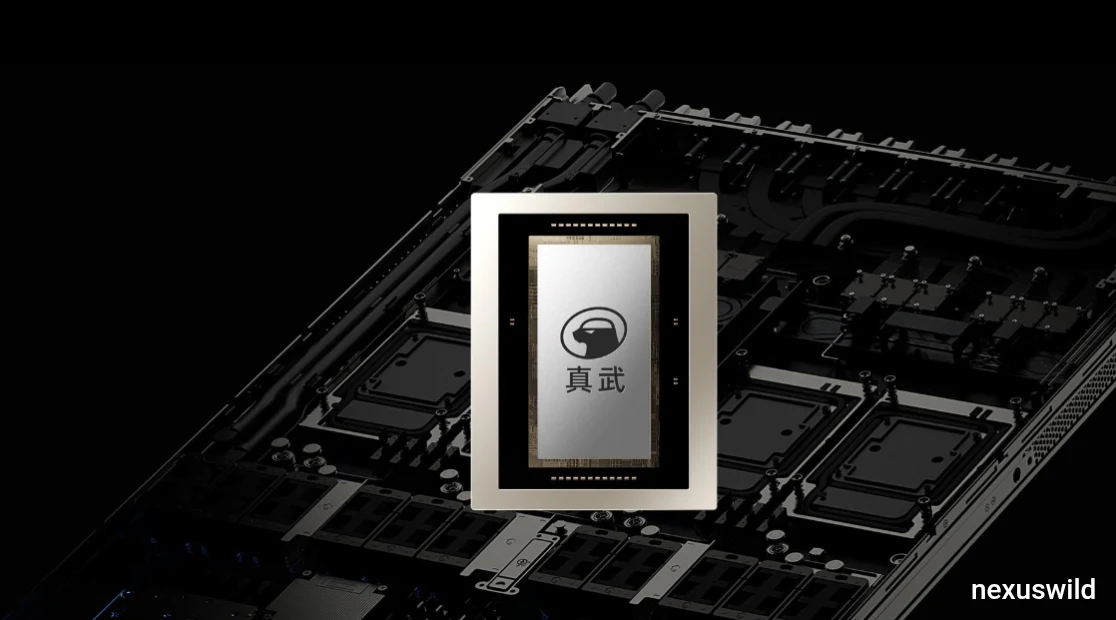
At the September 2026 Apsara Conference, T-Head introduced its next-generation Zhenwu V900 chip for AI training and inference.
Alibaba scheduled its commercial release for the first quarter of 2027.
The company has also developed the Zhenwu M890 supernode instance, which it says can support inference workloads involving models with more than two trillion parameters.
During the earnings discussion, CEO Wu Yongming said Alibaba was already using its current-generation T-Head chips to train the next generation of its models.
He expects domestic computing capacity to become increasingly important as production expands through 2027 and 2028.
Management also indicated that most of its additional AI chip supply during 2027 and 2028 is expected to come from internally developed T-Head chips.
This strategy is not simply about replacing imported GPUs. It involves developing a broader technology stack that includes processors, interconnects, software tools, infrastructure and model-development systems.
The success of this approach will depend on production capacity, chip performance, software compatibility, power efficiency and the availability of supporting components.
Moonshot AI's Reported Indonesian Compute Deal Cancellation
The regulatory changes have already been linked to a reported change in an overseas computing arrangement involving Chinese AI startup Moonshot AI, the developer of the Kimi model family.
According to reporting by The Information, Moonshot abandoned a deal worth approximately $150 million to rent access to Nvidia Blackwell Ultra B300 accelerators through a data centre in Indonesia.
The arrangement was reportedly intended to provide access to a large computing cluster, with operations expected to begin as early as 2027.
The report cited people familiar with the agreement. Moonshot did not publicly confirm the cancellation in the cited reporting.
The case illustrates the potential commercial uncertainty facing overseas AI infrastructure projects that depend on serving Chinese customers.
A data-centre operator may invest in expensive accelerators and power infrastructure based on a long-term rental agreement. If regulatory approval becomes uncertain, the economics of the project could change.
For infrastructure investors, the issue extends beyond hardware procurement. It includes customer eligibility, contract enforceability, licensing risk and the ability to redirect computing capacity to alternative customers.
However, one reported cancellation does not establish that every similar project in Indonesia or elsewhere in Southeast Asia will be cancelled.
US House Discloses Nearly 880,000 Approved AI Chip Licences
Another major development emerged on November 19, when the US House Foreign Affairs Committee released information concerning advanced AI chip export licences approved by BIS.
The committee said that BIS had approved 879,868 covered integrated circuits for Chinese companies across 21 licence applications, based on information available as of May 11, 2026.
The disclosed approvals included:
- Alibaba and subsidiaries: 75,000 chips.
- Tencent and subsidiaries: 150,000 chips.
- Baidu: 43,000 chips.
- BYD: 4,000 chips.
The committee also said that companies had submitted applications involving approximately 3.44 million covered chips.
The figures cover licence applications and approvals, not confirmed physical deliveries.
This distinction is essential. A regulatory approval does not establish that every authorised chip was exported, received or installed in the intended data centre.
The committee's disclosure has increased scrutiny of how US export controls were administered during the six-month period from December 2025 through May 2026.
It also raised questions about end-user verification, potential diversion risks and the involvement of intermediary companies in international chip transactions.
The disclosure does not, by itself, establish that all approved transactions violated US law. It provides information about the scale and recipients of approved licence applications and forms part of a wider political and regulatory debate.
Why the Two US Developments Matter Together
The new BIS remote-access rule and the House committee's disclosure concern different parts of the export-control system.
The committee disclosure looks backwards at previously approved licence applications and the administration of existing controls.
The November 2026 interim final rule introduces additional requirements addressing access to advanced computing through overseas data centres.
Together, they highlight two separate questions:
- How should the United States evaluate and approve physical exports of advanced computing hardware?
- How should it regulate access to the same computing capabilities when the hardware is located in a third country and accessed remotely?
The second question has become increasingly important as cloud infrastructure allows customers to use powerful accelerators without owning or physically possessing them.
The new rule attempts to bring certain remote-compute arrangements within the reach of export-control requirements.
Implications for Southeast Asian Data-Centre Operators
The policy creates new considerations for data-centre operators and cloud providers across Southeast Asia.
Operators may need to strengthen several compliance processes.
Customer ownership checks: Providers may need to identify ultimate parent companies and indirect ownership or control relationships, rather than relying only on the immediate contracting entity.
Compute-capacity monitoring: Operators will need to understand the aggregate TPP available to covered customers, including across linked facilities.
Contract review: Existing agreements may require regulatory review, revised end-use representations or adjustments to service conditions.
Licensing preparation: Qualifying existing data centres that want to continue providing covered compute access will need to obtain the required authorisation within the prescribed transition period.
Customer diversification: Infrastructure operators may examine alternative customer segments if particular contracts become difficult to execute.
These requirements could increase legal, compliance and administrative costs.
They may also affect the financing and planning of projects whose business models depend heavily on a small number of large international AI customers.
Nevertheless, the rule does not make Southeast Asia unavailable for AI infrastructure investment. Its effect depends on the hardware, customer, end use, ownership structure and applicable licence requirements.
Could Domestic Chinese Chips Replace Nvidia Accelerators?
One of the longer-term consequences could be a faster transition towards domestic Chinese semiconductor and computing ecosystems.
Alibaba's T-Head roadmap provides one example of this strategy.
Chinese technology companies are also exploring domestic accelerators, alternative chip architectures, software frameworks and specialised inference hardware.
However, substituting an advanced GPU is not simply a matter of purchasing another processor.
A complete AI computing system depends on several interconnected components:
- Accelerator performance.
- High-bandwidth memory.
- Interconnect technology.
- Software libraries and compiler support.
- Model optimisation.
- Data-centre networking.
- Power supply and cooling.
- Manufacturing capacity and advanced packaging.
Even if a domestic processor is suitable for a particular training workload, the availability of sufficient quantities and supporting software remains important.
Training large foundation models also requires reliable access to thousands of accelerators and efficient communication between them.
The transition may therefore occur gradually, with companies using a mixture of domestic processors and other legally available computing resources.
Alibaba's statements indicate that it expects domestic capacity to become the principal source of additional AI chip supply in 2027 and 2028. That is a company roadmap, not proof that all technical and manufacturing challenges have already been resolved.
What This Means for the Global AI Infrastructure Market
The new restrictions could influence how international AI infrastructure is financed and deployed.
Data-centre investors may need to consider regulatory exposure alongside electricity availability, land costs, network connectivity and customer demand.
Cloud providers may also need to develop more detail
Nexuswild welcomes factual corrections. Email contact@nexuswild.com with evidence and the article URL.