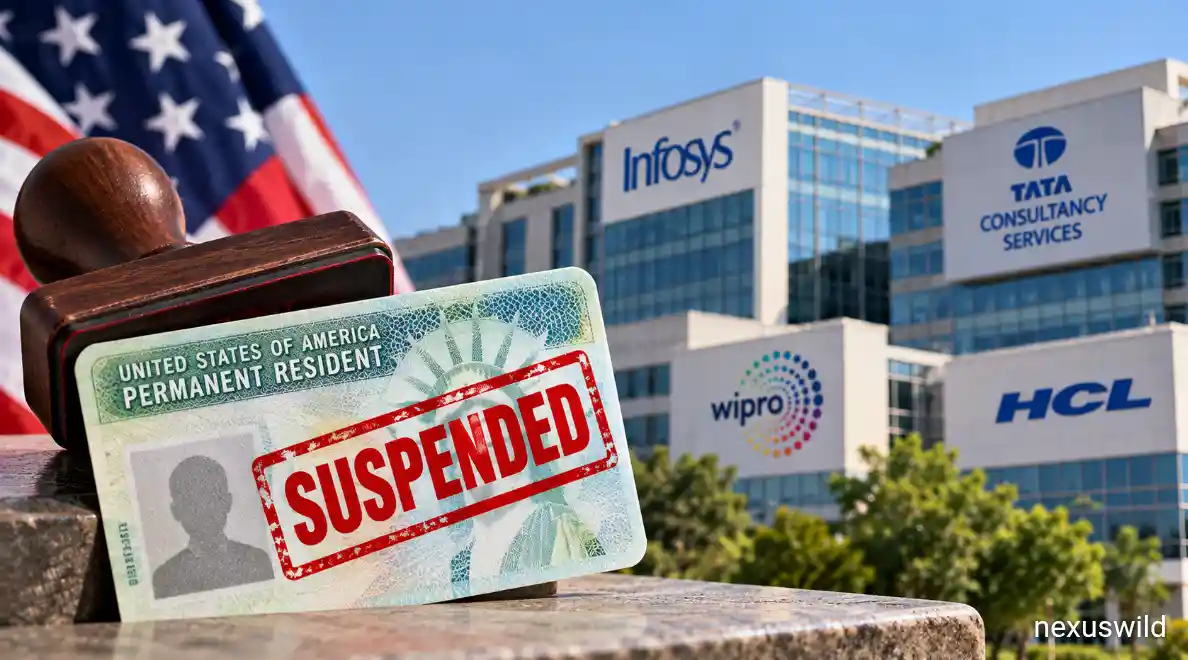

The United States has suspended major technology and outsourcing companies, including Infosys, Tata Consultancy Services (TCS), Wipro and HCL Technologies, from a key employment-based immigration programme used by employers to sponsor foreign workers for permanent residency.
Announced by the US Department of Labor in October 2026, the action also covers Cognizant, Capgemini, Microsoft and Adobe. The department said it would stop accepting new applications and processing pending applications under the Permanent Labor Certification programme, known as PERM, involving the affected companies. The suspensions follow federal investigations into alleged misuse of employment-based immigration rules.
The decision places an important step in the US green card process on hold for employees whose employers rely on PERM. However, the announcement does not automatically cancel existing green cards or H-1B visas.
What Is the PERM Programme?
PERM is a labour certification process administered by the US Department of Labor. Employers generally need this certification before proceeding with certain employment-based green card applications for foreign workers.
The process requires employers to complete recruitment steps intended to establish that there are no qualified, available US workers for the position and that employing a foreign worker will not adversely affect the wages and working conditions of similarly employed American workers. Once labour certification is approved, the employer can proceed to the next stage of the green card process, subject to other immigration requirements.
PERM is separate from the H-1B visa programme. H-1B status allows eligible foreign professionals to work temporarily in the United States, while a green card provides permanent resident status.
Why Has the US Taken This Action?
US officials have alleged that some companies used employment-based immigration programmes in ways that disadvantaged American workers. Labour Secretary Keith Sonderling and Vice President JD Vance cited concerns about foreign hiring, alleged misuse of visa rules and the replacement of US employees.
The administration has not publicly provided detailed, company-specific findings establishing the alleged violations for every firm included in the suspension. The allegations should therefore be distinguished from proven wrongdoing.
Microsoft, one of the companies affected, said that most of its H-1B applications in the previous fiscal year involved extending or changing the status of existing employees rather than hiring new workers. The company also said its US workforce was predominantly American.
What It Means for Indian IT Professionals
The suspension could disrupt the immigration plans of Indian professionals whose employers sponsor them for permanent residency.
Employees who have not yet entered the PERM process may face delays in starting their employer-sponsored green card applications. Those with pending labour certification applications may also be affected while the suspension remains in force.
The impact could be particularly important for Indian nationals because demand for employment-based green cards has historically exceeded the available supply, creating long waiting periods in several categories. Delays can also complicate planning for workers approaching the ordinary six-year H-1B limit, although certain eligible employees can qualify for extensions under specific immigration rules.
The immediate consequences will depend on each employee's immigration stage, the status of existing approvals and any subsequent government decisions.
What Happens Next?
The next developments to watch include the progress of federal investigations, any company responses, and whether the Department of Labor changes or lifts the suspensions.
For affected employees, the distinction between a temporary work visa and permanent residency is crucial. The announcement does not automatically revoke existing H-1B status or approved green cards, but it may interrupt an important route toward permanent residency for workers sponsored by the affected employers.
The suspension places additional uncertainty around employment-based immigration for Indian technology professionals in the United States. Its longer-term effects will depend on the duration of the restrictions, the findings of the investigations and any subsequent legal or administrative action.
Nexuswild welcomes factual corrections. Email contact@nexuswild.com with evidence and the article URL.