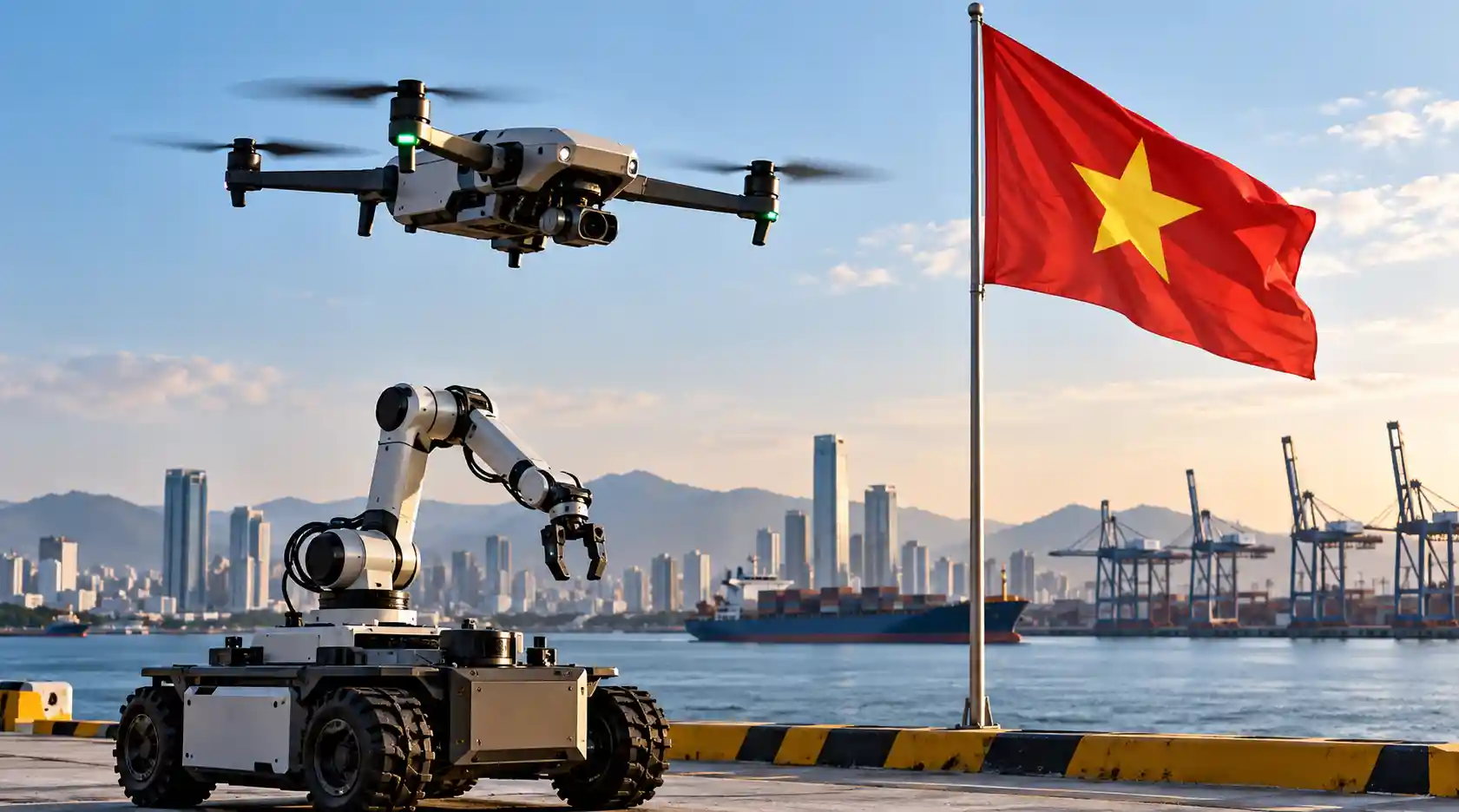

For the past decade, Vietnam has been heavily favored as a global assembly hub for consumer electronics and smartphones. Now, the country is actively working to climb higher up the global supply chain. Rather than simply assembling imported parts, Vietnamese industrial leaders are pushing for true technology transfer, aiming to build domestic capabilities in highly advanced sectors like uncrewed aerial vehicles (UAVs) and maritime engineering.
This strategic shift took a major step forward on September 26, 2026, when Saigon Telecommunications Technology Corp (Saigontel) officially announced an expanded cooperation framework with a suite of U.S. technology companies. The goal is ambitious: to localize core technologies and build domestic manufacturing capabilities in drones, robotics, automation, and marine technology.
By prioritizing technology transfer over simple procurement, Vietnam is positioning itself to not just use advanced industrial tech, but to eventually engineer and manufacture it locally.
Saigontel’s Latest Technology Cooperation
The latest agreements highlight a highly targeted approach to industrial partnerships. During a formal exchange late in September, Saigontel and its private innovation center, SoiHub, solidified partnerships with U.S.-based firms to bring advanced engineering capabilities to Vietnam.
Among the key agreements were separate deals signed with Cheves Capital and MOBY Robotics Inc. These partnerships are explicitly focused on technology localization and transfer for robotics and marine automation. Additionally, the broader cooperation framework included an agreement with U.S. electric vehicle developer Ryvid Inc., which focuses on integrated technology solutions, powertrain systems, and batteries.
Rather than announcing an immediate roll-out of fully manufactured commercial products, the companies outlined a methodical implementation timeline. Initial phases will rely heavily on SoiHub, which will coordinate directly with Vietnamese research institutes and universities to rigorously evaluate, test, and adapt the imported U.S. technology for local deployment.
What Technology Localization Means
In the context of the Vietnam technology localization push, "localization" implies a multi-stage integration process. It represents a fundamental departure from merely importing off-the-shelf robotics from foreign suppliers.
In practical terms, the Saigontel partnership will begin with technology demonstrations and localized software adaptations. From there, it transitions into local assembly - importing complex components while relying on Vietnamese labor and engineering to put the systems together. The ultimate goal of this technology transfer is domestic manufacturing, where local suppliers are eventually integrated into the supply chain to source components, write accompanying software, and independently service the hardware.
By involving universities in the testing phase, Saigontel is ensuring that local engineers gain the hands-on technical know-how required to sustain these industries long after the initial blueprints are handed over.
Drones, Robotics and Marine Automation
The specific focus on marine automation Vietnam and industrial robotics is deeply strategic. With a coastline stretching over 3,200 kilometers, Vietnam's economy is inherently tied to maritime logistics and offshore resources.
According to the joint statements accompanying the Saigontel agreements, the partnership is designed to give Vietnam critical access to core technologies for offshore economic activities. The immediate applications of this localized tech will target oil and gas exploration, port logistics, and the maintenance of marine infrastructure. Autonomous marine drones (USVs) and underwater robotics (ROVs) are increasingly vital for inspecting offshore platforms, mapping seabeds, and optimizing port operations without risking human divers or deploying expensive crewed vessels.
Similarly, localizing drone technology Vietnam can vastly improve domestic supply chains, offering advanced aerial inspection capabilities for agriculture, infrastructure, and heavy industrial parks.
Vietnam’s Growing Industrial Technology Ecosystem
This move by Saigontel perfectly encapsulates Vietnam's broader macroeconomic ambitions. As global technology companies diversify their manufacturing footprints away from a singular reliance on China, Vietnam advanced manufacturing has become a top priority for Hanoi.
The country already hosts massive electronics manufacturing operations for giants like Samsung, Intel, and Foxconn. However, breaking into the robotics manufacturing Vietnam sector requires a different ecosystem - one that prioritizes precision engineering, artificial intelligence, and proprietary intellectual property over high-volume, low-margin assembly. Saigontel’s strategy utilizes its network of green and smart industrial parks to create localized hubs where U.S. technology partners can safely deploy and test their innovations.
Opportunities for Local Suppliers and Workforce
A successful technology transfer relies as much on human capital as it does on hardware. By utilizing SoiHub to bridge the gap between U.S. tech firms and Vietnamese academia, the initiative creates immediate opportunities for workforce development.
Vietnamese software developers and mechatronics engineering students will have the opportunity to train on proprietary U.S. systems. As these pilot projects mature into local assembly lines, domestic suppliers - ranging from specialized metal fabricators to sensor manufacturers - will have the opportunity to bid for component contracts, deepening the local supply chain.
Challenges to Technology Localization
Despite the optimistic framework, localizing advanced robotics and aerospace technology is fraught with challenges.
First is the issue of component dependence. Even if drones or marine robots are assembled in Vietnam, critical high-end components like specialized semiconductors, lidar sensors, and high-density battery cells will likely need to be imported for years to come.
Second is the protection of intellectual property (IP). U.S. technology companies remain highly cautious about technology transfer, requiring robust cybersecurity frameworks and stringent legal protections before handing over proprietary software source code or engineering schematics. Furthermore, establishing a commercial-scale domestic manufacturing sector is highly capital intensive, requiring sustained investment well beyond the initial pilot testing phases.
Company and Expert Views
In their official communications, the partnered companies emphasized that this collaboration is about building foundational capabilities. The stated objective is to equip Vietnam with the technological autonomy required to safely and efficiently manage its own offshore economic assets.
Industry analysts tracking the Southeast Asian technology sector note that partnerships like the one between Saigontel and MOBY Robotics are critical stepping stones. Rather than attempting to build a domestic robotics industry from scratch - which can take decades - licensing and localizing established U.S. technology accelerates the learning curve for Vietnamese engineers and regulators.
What Comes Next
Investors and industry watchers should view this development as the opening stage of a long-term strategy. The immediate next steps will involve SoiHub establishing testing parameters and importing prototype systems for evaluation by Vietnamese research institutes. Readers should clearly distinguish this current testing and evaluation phase from full-scale commercial manufacturing, which remains several years away.
Conclusion
Saigontel’s expanded cooperation with U.S. technology firms marks a compelling milestone in Vietnam’s industrial evolution. By focusing on high-value sectors like marine automation and industrial robotics, Vietnam is signaling its intent to become a creator and manager of advanced technology, rather than just a global assembly line. While challenges surrounding supply-chain integration and technical training remain, this partnership provides a clear roadmap for how developing economies can leverage international cooperation to build resilient, domestic advanced manufacturing ecosystems.
Further reading and useful links
Reader questions
Frequently asked questions
What is the goal of Saigontel's partnership with U.S. tech companies?
Saigontel aims to localize core technologies and build domestic manufacturing capabilities in Vietnam for uncrewed aerial vehicles (drones), industrial robotics, and marine automation.
Which U.S. companies are involved in the Saigontel agreement?
Partners include MOBY Robotics Inc., Cheves Capital, and EV developer Ryvid Inc.
What are the immediate practical applications of marine automation in Vietnam?
Localized marine tech will immediately target oil and gas exploration, port logistics, and the maintenance of offshore marine infrastructure using autonomous vessels and underwater robotics.
What role does SoiHub play in this technology transfer?
SoiHub, Saigontel's private innovation center, coordinates directly with Vietnamese research institutes and universities to evaluate, test, and adapt imported U.S. technology for local deployment.
Nexuswild welcomes factual corrections. Email [email protected] with evidence and the article URL.