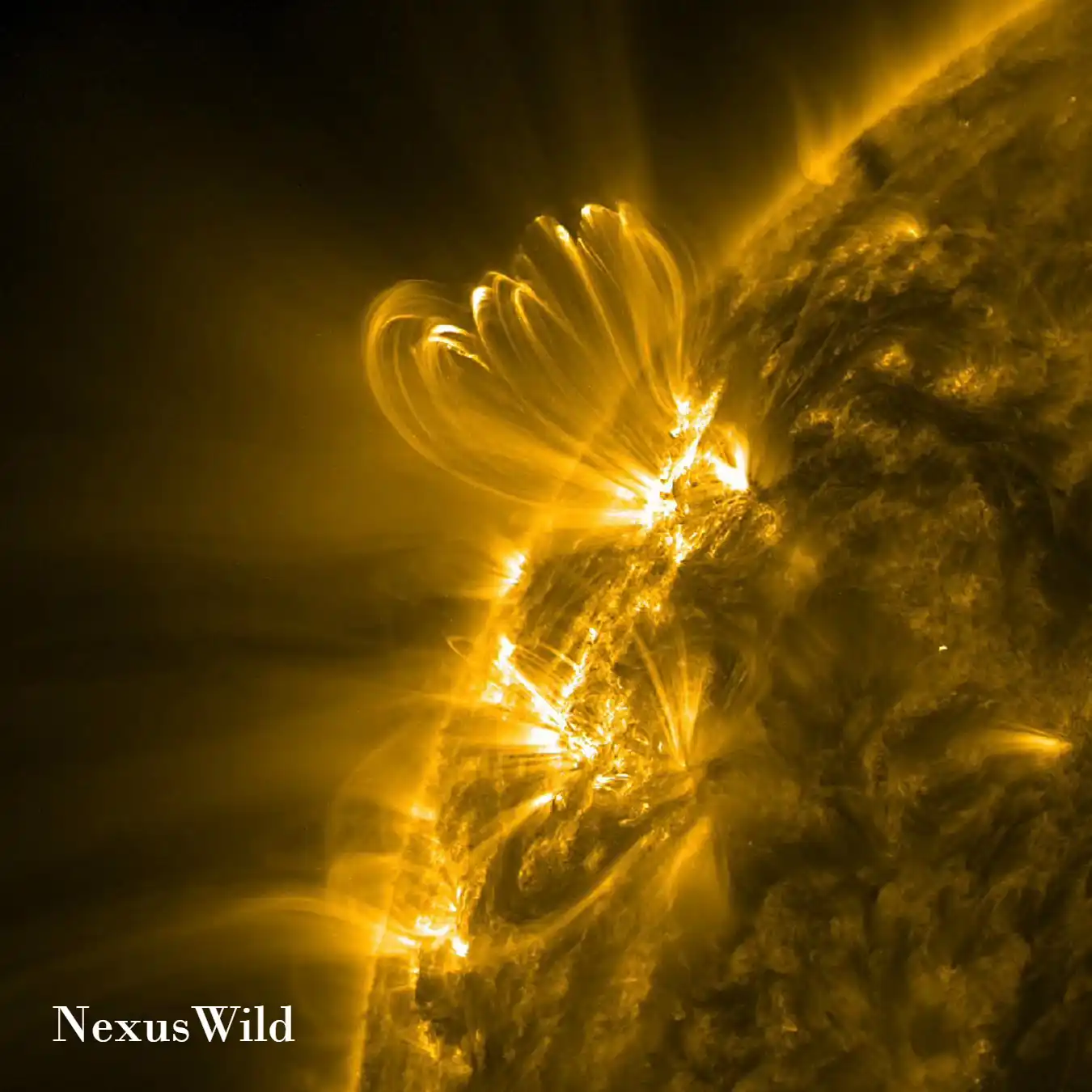

Scientists analyzing data from India's Aditya-L1 solar observatory have identified small, short-lived brightenings in the Sun's lower atmosphere that repeatedly appear in the hours before major solar flares erupt[cite: 1]. The finding, published in the peer-reviewed journal Monthly Notices of the Royal Astronomical Society, adds to a growing body of evidence that the Sun may offer subtle clues before it releases some of its most powerful bursts of radiation, though researchers caution the discovery is not yet a tool for reliably predicting individual flares[cite: 1].
The New Discovery
The research team examined seven M-class and X-class solar flares, the two most powerful categories on the scale used to classify flare intensity[cite: 1]. Within the active regions that went on to produce these flares, the scientists identified 102 small transient brightenings occurring before flare onset[cite: 1]. These events were detected almost exclusively in a specific ultraviolet wavelength associated with the chromosphere, the Sun's lower atmospheric layer, and were largely absent from broader continuum-light images, indicating they originated specifically in that layer rather than deeper down[cite: 1].
In most cases, the brightenings clustered near polarity inversion lines, boundaries where the Sun's magnetic field switches direction and where magnetic tension tends to build[cite: 1]. Crucially, these clusters also lined up with the location where the major flare later occurred[cite: 1]. Some of the ultraviolet brightenings had corresponding signatures in X-ray data collected at the same time, suggesting the small chromospheric events were sometimes linked to modest releases of energy detectable higher in the solar atmosphere[cite: 1].
How Aditya-L1 Detected Them
The findings rely on three instruments aboard Aditya-L1, India's first dedicated solar observatory, launched by the Indian Space Research Organisation[cite: 1]. The Solar Ultraviolet Imaging Telescope, or SUIT, captures spatially resolved images of the Sun in near-ultraviolet wavelengths, allowing scientists to see fine structure in the chromosphere. The Solar Low Energy X-ray Spectrometer, or SoLEXS, and the High Energy L1 Orbiting X-ray Spectrometer, or HEL1OS, measure X-rays emitted from higher, hotter layers of the solar atmosphere, including the corona.
A key part of the analysis focused on the Mg II h line, an ultraviolet spectral feature observed at a wavelength of about 2803 angstroms[cite: 1]. This spectral line is particularly sensitive to conditions in the chromosphere and is widely used by solar physicists as a diagnostic of activity in that layer[cite: 1]. By tracking changes in this specific filter, the SUIT instrument allowed researchers to isolate brightenings tied to chromospheric processes rather than emission from deeper in the Sun[cite: 1].
Why Aditya-L1's Location Matters
Aditya-L1 operates near the Sun-Earth Lagrange Point 1, commonly called L1, located roughly 1.5 million kilometers from Earth in the direction of the Sun. At this location, the gravitational pull of the Sun and Earth roughly balance in a way that allows a spacecraft to maintain a stable position relative to both bodies with minimal fuel use.
This vantage point is valuable because it offers an unobstructed, continuous view of the Sun without the day-night interruptions that affect Earth-orbiting satellites, since the spacecraft is never blocked by Earth's shadow. That near-continuous observing capability is part of what allowed researchers to track brightenings occurring in the hours leading up to a flare, rather than catching only isolated snapshots[cite: 1].
Pre-Flare Dynamics and Forecasting Potential
Solar flares originate in active regions, areas of the Sun's surface where magnetic fields are unusually strong and complex, often marked by sunspots[cite: 1]. The new Aditya-L1 findings suggest that before a large-scale magnetic reconnection event, an active region may undergo a series of smaller, localized reconnection events, appearing as the transient brightenings the researchers identified[cite: 1].
However, the study does not mean scientists can now reliably predict every solar flare hours in advance[cite: 1]. Researchers have not yet established how consistently these brightenings appear before flares in general, nor how often similar small-scale brightenings occur in active regions without being followed by a major eruption[cite: 1]. The authors describe this work as opening a new observational window for studying pre-flare activity, not as delivering an operational prediction tool[cite: 1].
Other Recent Evidence
The Aditya-L1 findings sit within a broader and active area of solar physics research looking for measurable signs that precede flares[cite: 1]. One 2026 study applied a machine-learning model to detect hot-onset precursor events in GOES X-ray data, training on 180 previously recorded flares and reporting an average lead time of about 17.9 minutes relative to NOAA's R3 strong radio-blackout alert threshold.
A separate 2026 effort, an artificial intelligence system called EarlyDetect developed by a team led by the New Jersey Institute of Technology, analyzes acoustic and magnetic data from NASA's Solar Dynamics Observatory to detect signs that a new active region is forming beneath the Sun's visible surface. The system reported the ability to flag emerging active regions roughly nine hours before they become visible on average, though predicting an active region's emergence is not the same as predicting a solar flare.
Why Solar-Flare Forecasting Matters
Powerful solar flares release bursts of X-rays and extreme ultraviolet radiation that can reach Earth's upper atmosphere within minutes, temporarily disturbing the ionosphere. This can degrade or interrupt high-frequency radio communications, particularly affecting aviation communications on polar routes, and can introduce errors into satellite-based navigation systems.
The Manipal Centre for Natural Sciences-led study emphasizes that much larger datasets, covering many more flares and many more active regions that did not flare, will be needed before precursor signals can be turned into dependable operational warnings[cite: 1].
Further reading and useful links
Reader questions
Frequently asked questions
What did Aditya-L1 discover about solar flares?
Scientists using Aditya-L1 data identified small, transient brightenings in the Sun's lower atmosphere that repeatedly appear in the hours before major M-class and X-class solar flares erupt.[cite: 1]
Can this discovery be used to predict solar flares?
Not yet. While the findings offer potential clues for space-weather forecasting, researchers emphasize that larger datasets are needed to determine how consistently these brightenings appear and to avoid false alarms before they can be used as a reliable prediction tool.[cite: 1]
What instruments on Aditya-L1 were used for this study?
The study relied on the Solar Ultraviolet Imaging Telescope (SUIT) to observe the chromosphere, alongside the SoLEXS and HEL1OS instruments, which measure X-rays emitted from the hotter corona.[cite: 1]
Nexuswild welcomes factual corrections. Email contact@nexuswild.com with evidence and the article URL.