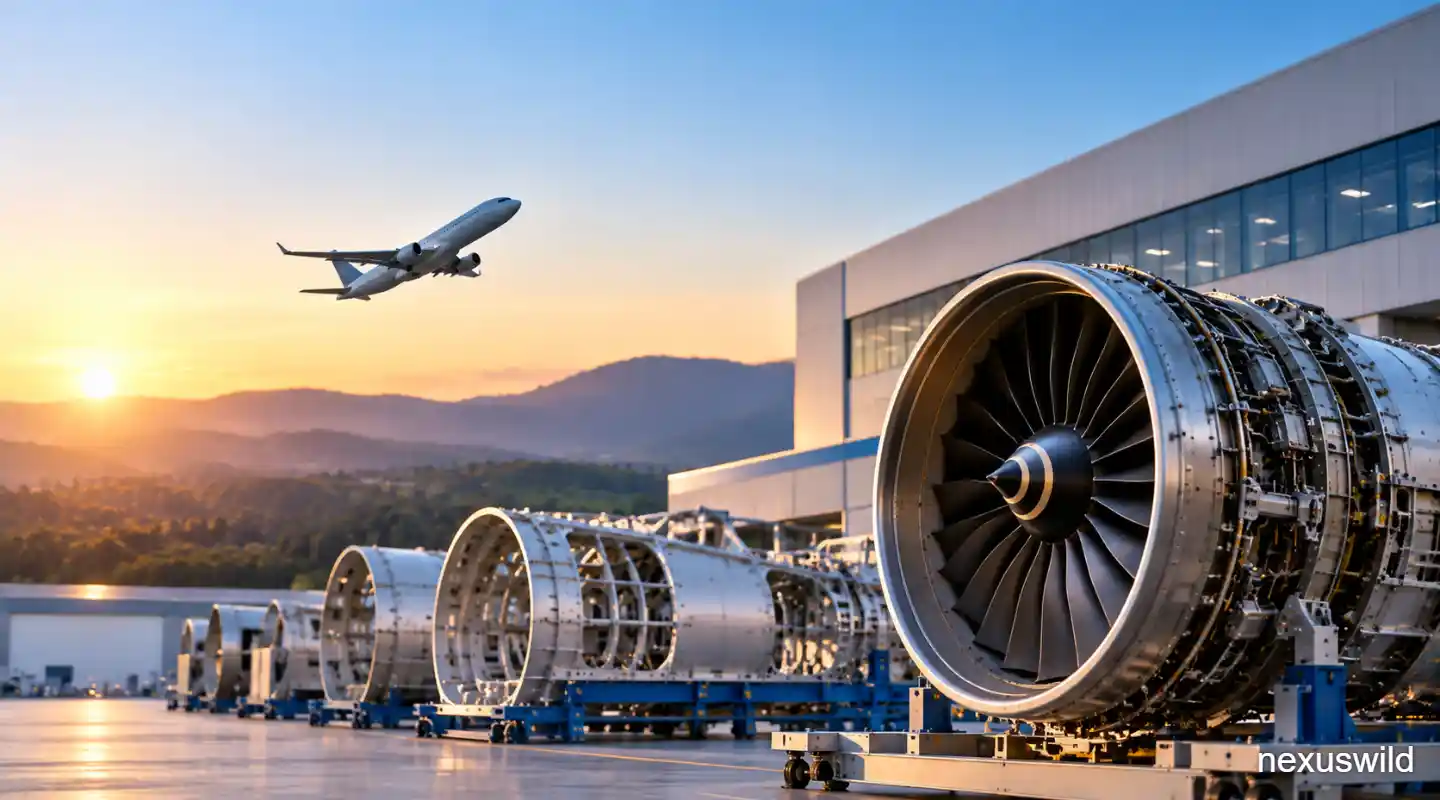

Aerospace manufacturing has an inconvenient habit: a single component can travel thousands of kilometres before it becomes part of an aircraft.
A forged piece of metal may be produced in one country, machined in another, sent elsewhere for heat treatment or surface finishing, and then moved again for assembly. Every additional journey adds lead time, inventory, paperwork and another point at which a global supply chain can slow down.
At its aerospace cluster near Belagavi in Karnataka, Aequs has spent more than a decade trying to compress that journey into a single industrial ecosystem.
The company now combines forging and heat treatment, precision machining, specialised surface processing and aerostructure assembly within its Special Economic Zone. Its customer base includes major international aerospace groups, and its current programmes include direct relationships with Airbus and Boeing. Aequs's June 2026 investor presentation describes the campus as a vertically integrated aerospace manufacturing ecosystem serving aircraft programmes including the A220, A320, A330, A350, Boeing 737, 767, 777 and 787.
The significance is not simply that aircraft parts are being manufactured in India. It is how much of the manufacturing process can increasingly remain in India before those parts leave for final aircraft production.
Building an Aerospace Ecosystem in Belagavi
Aequs began manufacturing operations at its Belagavi Special Economic Zone in the 2009-10 period. Over time, the site expanded beyond precision machining to include capabilities that Indian aerospace suppliers had often needed to obtain from overseas facilities.
Today, the company's aerospace operations include machining of engine, landing-system, actuation, wing, fuselage, interior and pylon components. Its current investor material puts its annual aerospace machining capacity in India at about 1.83 million hours.
But machining is only one part of the model.
Through SQuAD Forging India, its joint venture with France's Aubert & Duval, the Belagavi ecosystem includes closed-die forging and heat-treatment capabilities for aluminium, steel, titanium and nickel-based alloys. The facility operates a 10,000-tonne hydraulic press, alongside additional forging and metallurgical infrastructure.
That allows a component to begin much closer to its raw-material stage before moving into precision manufacturing.
Why Surface Treatment Matters
One of the less visible but critical parts of aerospace manufacturing is what happens after a component has been cut into shape.
Aircraft parts must withstand corrosion, moisture, repeated mechanical loading and extreme operating conditions. That makes processes such as anodising, plating, non-destructive inspection and specialised surface treatments essential parts of aircraft certification and manufacturing.
Aequs addresses this through Aerospace Processing India, a joint venture with Canada's Magellan Aerospace.
The Belagavi facility carries NADCAP accreditation for processes including chemical processing, surface enhancement and non-destructive testing. Aequs says it was the first third-party processing facility in India approved by both Airbus and Boeing.
The importance of that capability is practical.
Without an approved processing facility nearby, a machined aerospace component may have to leave the manufacturing cluster simply to receive one certified treatment before returning for another step.
By putting that work next to machining and forging, Aequs can keep more of the manufacturing sequence in one location.
From Individual Components to Aerostructure Assemblies
The Belagavi operation has also moved further downstream into assembly.
Aequs says it manufactures structural assemblies including non-operable door panels and over-wing emergency-exit door structures, as well as assemblies for wings and fuselages.
The distinction between manufacturing a machined component and delivering an assembled structure is important for India's aerospace ambitions.
Component manufacturing captures one portion of the value chain. Assembly requires suppliers to manage more parts, tolerances, inspection processes, tooling and integration responsibility before delivering a higher-value unit to the customer.
That progression is visible in Aequs's relationship with Boeing.
In January 2026, Aequs secured a contract to manufacture aft access doors for Boeing's 767-2C, the airframe used for the KC-46A Pegasus tanker. The work is to be carried out through the integrated Belagavi aerospace operation.
Aequs's June investor presentation separately identifies direct supplier relationships with Boeing and Airbus and lists commercial and defence aerospace programmes across both manufacturers.
That makes the Boeing relationship more than a general association: Aequs is manufacturing defined aircraft hardware under customer programmes.
Vertical Integration Changes the Supply-Chain Mathematics
The central argument behind the Belagavi model is logistics.
Aequs told investors in May 2026 that co-locating its manufacturing processes had reduced component movement in its integrated workflow from journeys of roughly 5,000 kilometres to less than 500 metres. That is a company-reported measure rather than an industry-wide benchmark, but it illustrates the logic behind the cluster.
Instead of sending a forging to another city or country for machining, then to another processor for finishing, the component can move between facilities inside the same industrial campus.
That can shorten transit time and reduce work-in-progress inventory. It can also simplify customs handling, quality coordination and production scheduling.
For aerospace manufacturers, these details matter because aircraft supply chains operate under unusually strict traceability requirements. A delayed or non-conforming component can hold up a much more valuable aircraft or engine assembly.
Vertical integration does not remove those risks, but it reduces the number of logistical hand-offs between manufacturing stages.
Aequs says selected products now achieve 100% in-country value addition, including aerospace components whose raw material, forging, machining, treatment and finishing are all handled domestically. Its current investor materials also identify 100% in-country value addition for selected aerospace products rather than for its entire aerospace portfolio.
That qualification is important: not every part produced at Belagavi has a completely localised supply chain.
A Bigger Order Book Is Testing the Model
The next challenge is scale.
Aequs reported an aerospace order book of about $889 million for FY26, up 26% year on year, according to its May 2026 investor presentation. The company also said aerospace capacity utilisation in India was around 70% for FY26.
Aircraft manufacturers globally continue to work through large commercial-aircraft backlogs, putting pressure on suppliers to increase output without sacrificing quality.
For Aequs, that means the Belagavi cluster must not only demonstrate that integrated manufacturing works; it has to show that the model can handle larger programme volumes.
The company has been adding processing and manufacturing capacity as part of that effort.
Its partnership structure also gives it access to specialised expertise without attempting to build every capability alone. The Magellan joint venture brought aerospace surface processing into the cluster, while the Aubert & Duval partnership added forging and heat treatment.
New Capacity Is Still Being Planned
Some of Aequs's next expansion steps are confirmed plans rather than operating capacity.
In March 2026, the company signed a memorandum of understanding with the Karnataka government covering approximately ₹2,856 crore of cumulative investment over five years from FY2026, including investment already made.
The proposal spans aerospace precision-engineering expansion at the Belagavi SEZ as well as consumer-electronics manufacturing at Aequs's Hubballi cluster. The entire ₹2,856 crore therefore should not be described as a new Belagavi aerospace investment.
Aequs and Magellan have also been studying another potential manufacturing step: aerospace sand casting.
The two companies signed an MoU in March 2025 to explore a 50:50 jointly owned sand-casting facility at the Belagavi Aerospace Cluster. The proposed plant is intended to serve commercial and defence aerospace demand. The announcement described it as a project under evaluation rather than an operational facility, so it should not yet be counted among Aequs's established Belagavi capabilities.
More recently, Aequs's board approved a proposed ₹650 crore promoter-group equity infusion through convertible warrants in September 2026. The company said the capital would support expansion across its aerospace and consumer businesses, alongside other corporate requirements. The transaction remains subject to the relevant shareholder and regulatory processes.
Belagavi Is Part of a Broader Indian Aerospace Shift
Aequs's expansion reflects a wider change in India's role in global aerospace manufacturing.
For years, Indian suppliers were often associated with engineering services or lower-level components. The opportunity now is to move further into certified manufacturing, complex assemblies and higher-value systems while global aircraft manufacturers seek additional supply-chain capacity.
That shift is difficult because aerospace qualification can take years.
A factory cannot simply buy a machine and begin supplying safety-critical aircraft parts. Processes, materials, equipment and quality systems must be approved, audited and repeatedly demonstrated.
This is where Belagavi's integrated model becomes strategically relevant.
A supplier that already has certified forging, machining, processing and assembly capabilities in one ecosystem can potentially industrialise a new programme with fewer external manufacturing dependencies than a supplier that must coordinate each process separately.
That does not automatically make Indian manufacturing cheaper or faster in every case. Aerospace supply chains remain global, and specialist materials, tooling and equipment can still come from overseas.
But the amount of work performed domestically can increase.
More Than a Boeing Story
Boeing gives the Belagavi story an easily recognised endpoint, particularly after the 767-2C door contract.
But Aequs's aerospace business is broader.
Its current customer materials identify Airbus, Boeing, Safran, Collins Aerospace and Saab among key aerospace relationships, while its manufacturing footprint extends beyond India to facilities in France and the United States.
The company also works across engine systems, landing systems, structures, actuation, interiors and cargo components rather than relying on a single aircraft part.
That diversification matters in aerospace, where programme cycles can last decades but individual production rates can change significantly.
Conclusion
What Aequs has built in Belagavi is less about one factory than about shortening the distance between manufacturing steps.
Forging, machining, surface treatment and aerostructure assembly sit within the same aerospace ecosystem. Boeing's 767-2C door contract shows that the model has progressed into direct supply of increasingly complex aircraft structures, while Airbus and other aerospace programmes provide a broader customer base.
The economic argument is straightforward: every certified operation that can be performed inside India represents additional manufacturing value that does not have to be imported or completed overseas.
The harder task is execution.
Aerospace customers require quality, traceability and delivery consistency regardless of where a component is manufactured. Planned investments, proposed sand-casting capacity and future expansions will matter only if they translate into certified production and sustained customer programmes.
Still, Belagavi demonstrates an important evolution in India's aerospace industry.
The country's ambition is moving beyond making individual aircraft parts. The more consequential opportunity is to build enough of the supply chain around those parts that a component can enter as raw material, move through several certified manufacturing stages, and leave India as a considerably more valuable aerospace product.
Nexuswild welcomes factual corrections. Email contact@nexuswild.com with evidence and the article URL.