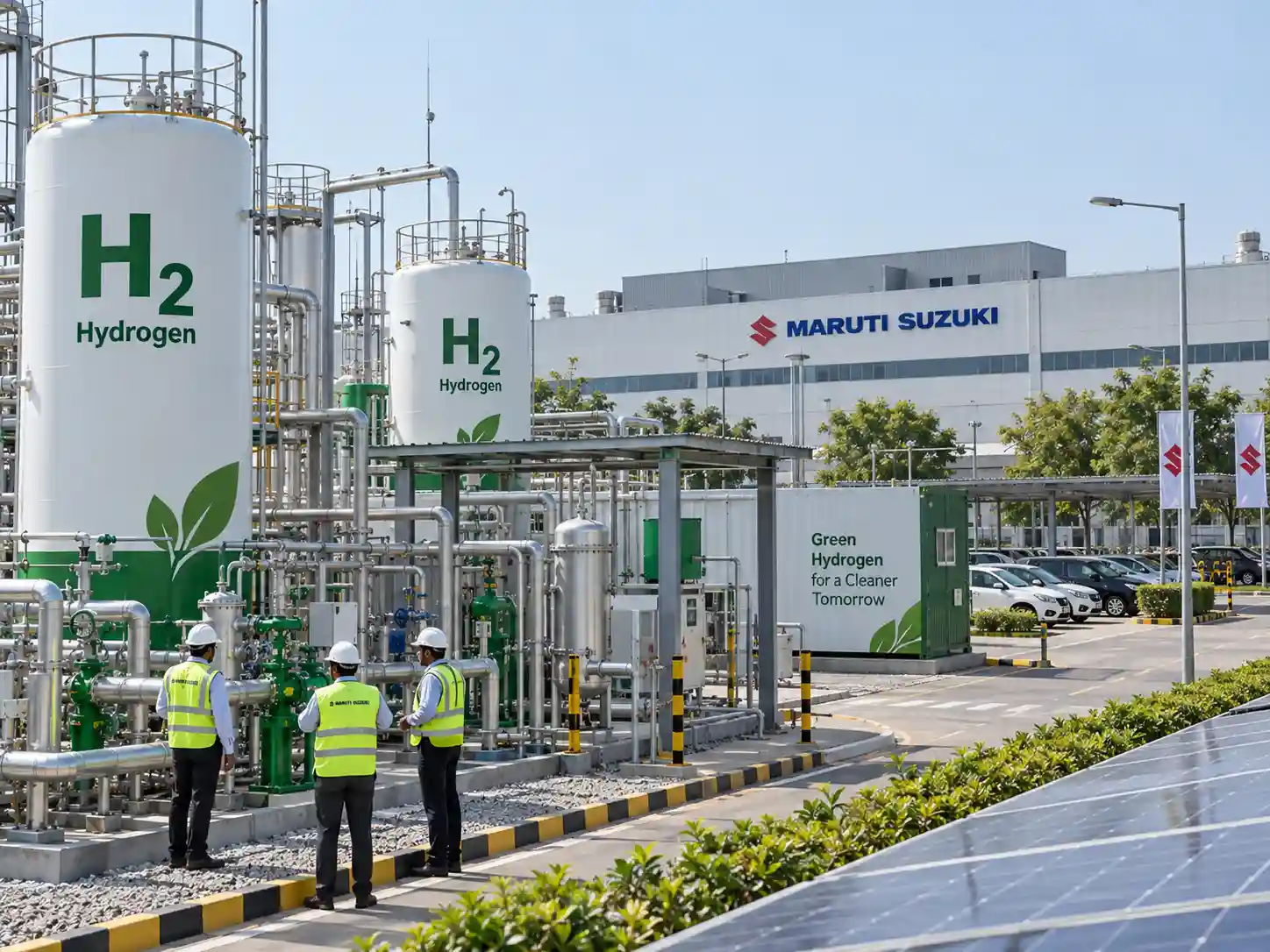

The industrial transition toward low-carbon manufacturing is gathering momentum across India’s core automotive corridors. On September 24, 2026, Maruti Suzuki India officially announced the commissioning of its first green hydrogen electrolyser plant at its major manufacturing facility in Manesar, Haryana. Operating as a focused pilot project, the installation marks a strategic shift for the country's largest passenger vehicle manufacturer, demonstrating how industrial facilities can harness renewable energy cycles to decarbonize heavy process heating and assembly operations.
Rather than focusing solely on vehicle powertrains, this initiative addresses the hidden carbon intensity behind the physical assembly lines. By converting unutilized solar electricity into storable clean fuel, the project offers a blueprint for balancing energy supply and demand within massive industrial complexes.
Maruti Suzuki’s Green Hydrogen Project
The newly operational installation at Manesar is designed to tackle a persistent engineering dilemma associated with corporate renewable energy adoption: what to do with surplus power when factory demand drops.
Large automotive manufacturing plants frequently install captive solar arrays to cover baseline daytime electricity needs. However, during weekly holidays, scheduled maintenance windows, or festive shutdowns, factory power consumption plummets while solar generation continues uninterrupted. Under typical grid setups, this excess electricity is either curtailed or fed back into the regional grid under varying tariffs. Maruti Suzuki’s new pilot project captures that otherwise wasted energy directly at the source, channeling it into an on-site hydrogen generation loop.
How the Manesar Facility Produces Green Hydrogen
At the heart of the Manesar setup is a water electrolysis system designed to split water molecules into hydrogen and oxygen using electrical current.
The operational workflow begins with treated water routed through the electrolyser unit, powered entirely by surplus photovoltaic energy generated across the plant's rooftops and open spaces. The resulting hydrogen gas is captured and routed into a dedicated buffer storage vessel. From there, the gas is compressed and held safely until required for active industrial processes, ensuring a steady, reliable internal fuel supply independent of external weather fluctuations.
Technology, Capacity and Investment
The pilot installation features a 300 kW green hydrogen electrolyser. While commercial-scale chemical refineries utilize multi-megawatt systems, a 300 kW capacity is well-suited for an industrial manufacturing pilot, allowing plant engineers to monitor performance metrics, system efficiency, and safety protocols under real-world factory conditions.
The technology integrates water treatment filtration, power rectification equipment, compression units, and safety monitoring valves. Because hydrogen gas is highly volatile, the facility incorporates multi-layered leak detection sensors and automated pressure-relief mechanisms to maintain strict workplace safety standards.
How Hydrogen Will Be Used at the Plant
Rather than utilizing pure hydrogen immediately in combustion engines or fuel cells, Maruti Suzuki has adopted a pragmatic blending approach suited for existing industrial infrastructure.
The stored green hydrogen is systematically pressure-reduced and blended directly with natural gas. This hydrogen-enriched natural gas (H-CNG style blend) is then piped directly into the factory's thermal processing units, such as paint-shop ovens and heat-treatment furnaces, where natural gas is traditionally burned as a process fuel. Introducing hydrogen into the fuel mix lowers the overall carbon content of the combustion process without requiring a total redesign of legacy heating equipment.
Environmental and Manufacturing Benefits
The primary objective of the Manesar hydrogen initiative is tangible carbon reduction. Automotive production involves energy-intensive steps like metal stamping, welding, painting, and baking, which rely heavily on fossil fuels to maintain high operating temperatures.
By substituting a portion of conventional natural gas with green hydrogen generated via zero-emission solar electricity, the plant cuts its direct greenhouse gas output. Furthermore, the project serves as an invaluable technical testing ground. Plant engineers are evaluating the long-term wear on burners, pipeline compatibility, and overall system efficiency, generating operational data that will guide future scalability.
India’s Growing Green-Hydrogen Industry
Maruti Suzuki’s deployment aligns closely with the objectives of the National Green Hydrogen Mission, an ambitious policy framework launched by the Government of India to position the country as a global hub for the production, usage, and export of green hydrogen.
Across the country, heavy industries - including steel, refining, fertilizers, and heavy manufacturing - are exploring hydrogen as a viable decarbonization pathway for hard-to-abate sectors where direct electrification is technically challenging. As domestic electrolyser manufacturing capabilities improve and renewable power tariffs stabilize, projects like the one in Manesar help build local technical expertise and supply-chain readiness.
Maruti Suzuki’s Wider Sustainability Strategy
The Manesar hydrogen plant does not exist in isolation; it forms one pillar of a comprehensive, multi-pronged decarbonization strategy detailed in the company's corporate disclosures.
Maruti Suzuki has established a target to reduce its manufacturing-related carbon footprint from approximately 615,000 tonnes down to 266,000 tonnes by fiscal year 2030-31. To achieve this, the automaker is pursuing a diverse energy mix:
- Solar and Wind Expansion: Continual increases in captive rooftop solar capacity alongside long-term third-party power purchase agreements (PPAs).
- Biogas Integration: The company is setting up a 10-tonne-per-day compressed biogas (CBG) plant at its Kharkhoda facility, scheduled for commissioning within FY 2026-27, alongside four board-approved CBG projects backed by an investment allocation of ₹561 crore.
- Energy Storage: The integration of a 1 MWh Battery Energy Storage System (BESS) to smooth out intermittent renewable power loads.
Expert and Company Views
Company leadership emphasized that long-term manufacturing competitiveness is increasingly tied to environmental metrics. Hisashi Takeuchi, Managing Director and CEO of Maruti Suzuki India, noted that India's manufacturing appeal will rely on carbon efficiency alongside traditional cost and quality metrics.
"Just like we have adopted a multi-pathway approach for products, we have also embarked on a journey of multiple renewable energy solutions for manufacturing operations," Takeuchi stated following the regulatory filing. "The commissioning of our 300 kW Green Hydrogen plant is aligned with the Government of India's Green Hydrogen Mission. With such initiatives, we are building capability today so that we can support a low-carbon and more energy-efficient manufacturing ecosystem tomorrow."
Industry analysts point out that while pilot projects have modest direct emission impacts initially, their true value lies in institutional learning. Mastering the handling, compression, and blending of hydrogen within an active automotive plant prepares engineering teams for much larger deployments as the technology matures.
Challenges and Next Steps
Scaling green hydrogen from a 300 kW pilot plant to widespread industrial integration involves overcoming clear economic and technical hurdles. Green hydrogen production remains capital-intensive, and the cost of electrolysers and specialized storage infrastructure must decline further to compete economically with conventional fossil fuels.
Additionally, maintaining strict safety protocols for high-pressure gas storage within crowded urban-industrial zones requires continuous oversight. Maruti Suzuki has indicated that future rollouts across its other manufacturing bases in Haryana and Gujarat will depend closely on the performance data and operational economics gathered from the Manesar pilot.
Conclusion
The launch of green hydrogen production at Maruti Suzuki’s Manesar plant signals a pragmatic step forward for sustainable automobile manufacturing in India. By turning idle holiday solar power into clean process fuel, the company is actively reducing its reliance on fossil-based natural gas while building foundational expertise in hydrogen technology. As the pilot progresses, it will provide vital insights into how heavy manufacturing can successfully integrate multiple renewable vectors to achieve long-term carbon neutrality.
Further reading and useful links
Reader questions
Frequently asked questions
What is the capacity of Maruti Suzuki's new green hydrogen plant?
The newly commissioned green hydrogen plant features a 300 kW electrolyser installed at the Manesar manufacturing facility.
How is the green hydrogen produced at the Manesar plant powered?
The electrolysis system is powered entirely by surplus photovoltaic (solar) electricity generated across the plant's rooftops and open spaces, particularly during periods when factory power demand drops.
How will the green hydrogen be utilized in manufacturing?
The stored green hydrogen is pressure-reduced and blended directly with natural gas. This mixture is then used in industrial thermal processing units such as paint-shop ovens and heat-treatment furnaces.
What are Maruti Suzuki's broader manufacturing carbon reduction targets?
Maruti Suzuki aims to reduce its manufacturing-related carbon footprint from approximately 615,000 tonnes down to 266,000 tonnes by fiscal year 2030-31 through solar, wind, biogas, and hydrogen initiatives.
Nexuswild welcomes factual corrections. Email [email protected] with evidence and the article URL.