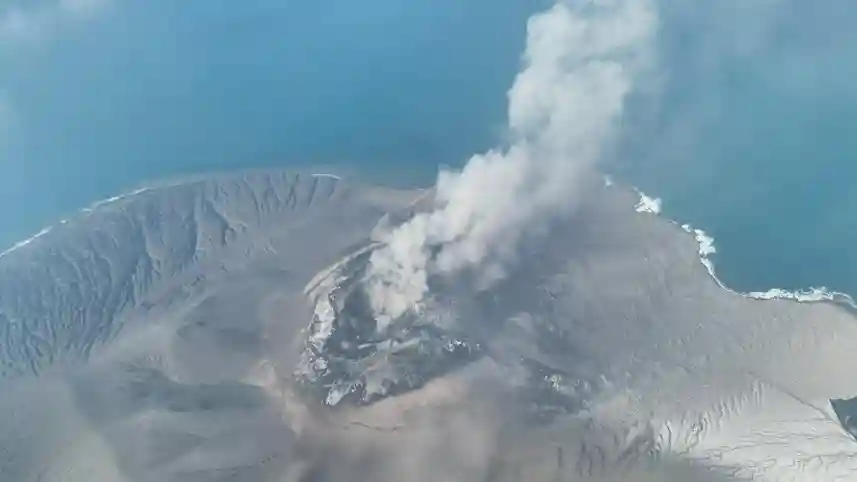

TANGERANG, Indonesia — An eruption of Indonesia's Mount Anak Krakatau caused six airports to suspend flight operations on Sunday, affecting hundreds of flights at Jakarta's main airport, after some school activities and fishing trips were halted, officials and reports said.
Soekarno-Hatta International Airport, Jakarta's main hub, suspended operations until 1:30 p.m. local time (0630 GMT) due to volcanic ash, the airport said on Instagram, stranding hundreds of passengers.
The closure affected 301 flights, including 58 international routes, airport operator Angkasa Pura said. The suspension extended an earlier halt that had itself been extended from an original 5:30 a.m. cutoff, as ash continued to affect the airfield through the morning.
Singapore Airlines said it had cancelled flights to and from Jakarta for the rest of the day.
Eruption timeline and ash plume
Anak Krakatau, located roughly halfway between the islands of Java and Sumatra in the Sunda Strait, has been erupting since late Friday, Indonesia's transport ministry said. Volcanic ash was detected at Soekarno-Hatta airport early Sunday.
Indonesia's meteorological agency, BMKG, said ash had reached as high as 20,000 feet, or about 6,000 metres, on the Java side of the volcano, with a plume rising to as much as 50,000 feet, or about 15,000 metres, on the Sumatra side and over parts of Banten province in Java.
Anak Krakatau is currently on alert Level 3, the second-highest tier in Indonesia's four-level volcano alert system, according to reports citing volcano monitoring officials.
Schools, fishing and ground-level effects
Several schools cancelled activities on Saturday after students and residents reported eye irritation from ash, while fishermen called off trips, local outlet Kompas reported.
In Cianjur, West Java, about 200 km from the volcano, police distributed masks to motorists and the local disaster management office reported ashfall in the city, urging residents to stay indoors, state news agency Antara reported.
There is no confirmation in current reporting of a formal evacuation order for communities near Anak Krakatau itself.
The precautions described so far, including mask distribution, advisories to stay indoors and reduced outdoor activity, are being characterized by authorities as protective measures against ashfall rather than a mandatory evacuation.
Official guidance
Indonesia's disaster mitigation agency, BNPB, said on Saturday there was no imminent tsunami risk from the volcano.
Spokesperson Berton Panjaitan urged the public to remain calm while staying vigilant, advising residents in the event of ashfall to wear masks and eye protection, limit outdoor activity, cover water sources and drive cautiously given reduced visibility.
Separately, reports indicate Indonesian authorities are planning cloud-seeding operations aimed at inducing rain to help clear ash from the air over affected areas, though further operational details were not immediately available.
A second eruption, elsewhere
About 850 km away, Mount Semeru in East Java also erupted on Sunday, sending an ash column roughly 1 km above its summit, according to volcano monitoring agency PVMBG.
PVMBG advised residents to stay at least 5 km from the crater and warned of the risk of hot ash clouds and lava flows extending up to 17 km from the summit.
This is a separate volcanic event from Anak Krakatau, though both are being monitored amid Indonesia's position on the Pacific Ring of Fire, where earthquakes and eruptions are frequent.
Why volcanic ash grounds flights
Volcanic ash consists of fine, abrasive rock and glass particles that can damage jet engines, scratch cockpit windows and clog air-data sensors, while also drastically reducing visibility.
Aviation authorities typically suspend operations at airports affected by ash clouds until concentrations drop to levels considered safe for flight.
Background
Anak Krakatau, whose name means "child of Krakatau," emerged around a century ago from the area once occupied by the volcano Krakatoa, which was destroyed in a catastrophic 1883 eruption that killed more than 36,000 people in a series of tsunamis.
In 2018, an eruption and partial collapse of Anak Krakatau triggered a tsunami that killed hundreds and injured hundreds more across Java and Sumatra, without the usual earthquake warning that typically precedes such waves.
What to watch next
Authorities including BNPB, PVMBG and BMKG are continuing to monitor ash dispersion, seismic activity and any change in tsunami risk.
Flight resumption at Soekarno-Hatta and other affected airports will depend on ash conditions clearing sufficiently, according to airport and transport ministry updates.
Residents in ash-affected areas are advised to follow official guidance on mask use, indoor shelter and water-source protection until conditions improve.
Key Takeaway
Anak Krakatau's latest eruption has disrupted aviation across six Indonesian airports, including Jakarta's main hub, while ashfall has also affected schools, fishing activity and communities farther from the volcano. Authorities say there is currently no imminent tsunami risk, but flight operations and public-health precautions remain dependent on changing ash conditions.
Reader questions
Frequently asked questions
How many airports were affected by the Anak Krakatau eruption?
Six Indonesian airports suspended flight operations because of volcanic ash from Anak Krakatau, according to the reporting cited in the article.
How many flights were affected at Jakarta's main airport?
Soekarno-Hatta International Airport reported 301 affected flights, including 58 international routes.
Is there a tsunami warning after the Anak Krakatau eruption?
Indonesia's disaster mitigation agency BNPB said there was no imminent tsunami risk at the time covered by the article.
How high did Anak Krakatau's ash plume rise?
BMKG said ash reached around 20,000 feet on the Java side and up to 50,000 feet on the Sumatra side and over parts of Banten province.
Why does volcanic ash cause airports to close?
Volcanic ash can damage jet engines, scratch cockpit windows, clog aircraft sensors and reduce visibility, making flight operations unsafe.
Was Mount Semeru's eruption connected to Anak Krakatau?
No. Mount Semeru's eruption in East Java was a separate volcanic event, although both were being monitored by Indonesian authorities.
Nexuswild welcomes factual corrections. Email contact@nexuswild.com with evidence and the article URL.