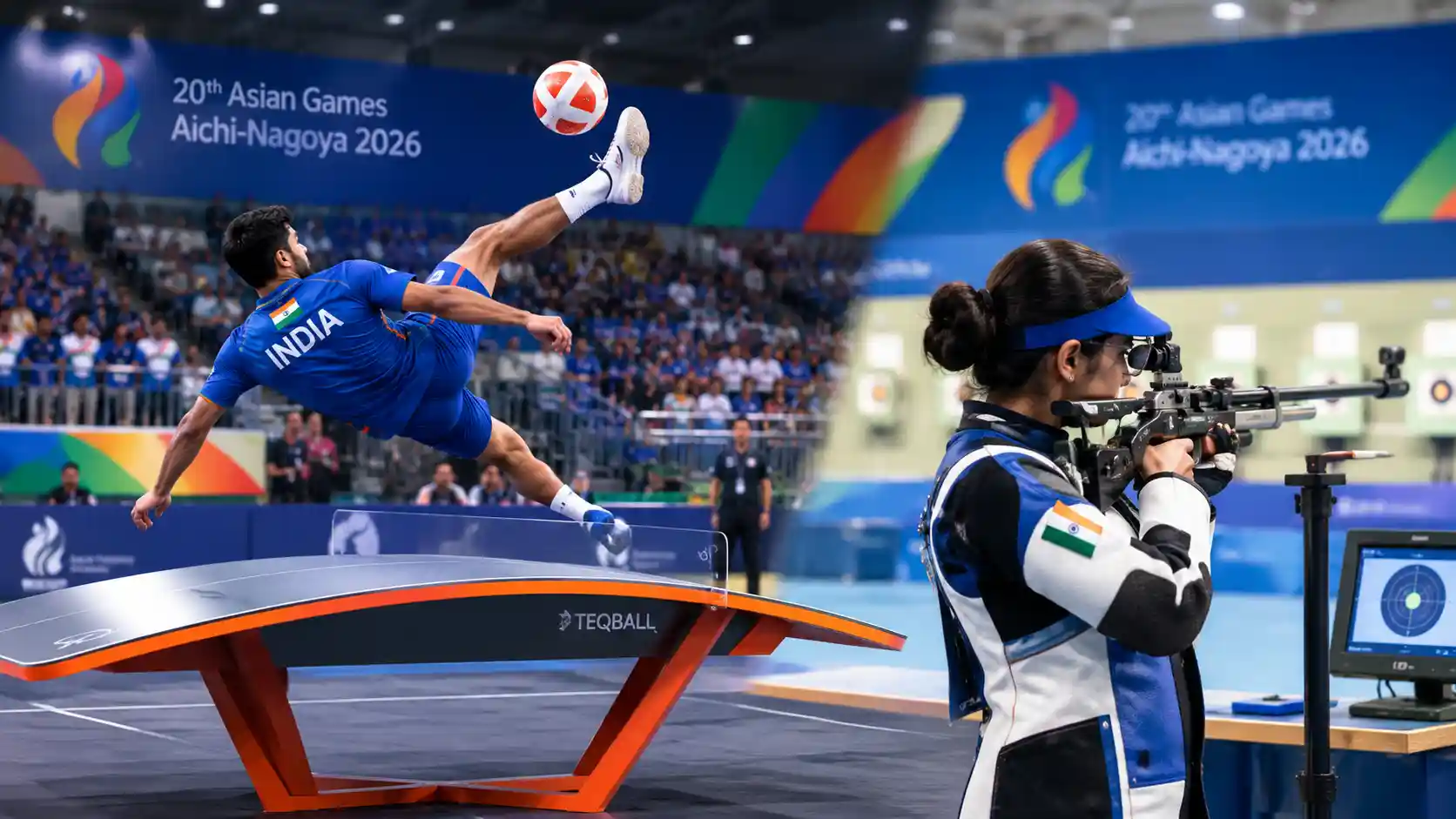

India's campaign at the 2026 Asian Games in Aichi-Nagoya, Japan, has opened with two contrasting storylines: a historic run in teqball, a sport making its continental debut, and an immediate return to form in shooting, one of India's most consistently productive disciplines at the Games. As of September 20, 2026, two days into competition and on the day of the official opening ceremony, India's shooters had already delivered two silver medals, while teqball debutant Quimcy Joaquim Dsouza had come within one match of the country's first-ever medal in the sport before falling in the semifinals.
The 20th Asian Games are being held across Aichi Prefecture and the city of Nagoya, Japan, from September 19 to October 4, 2026, marking India's twentieth appearance at the continental multi-sport event. India has fielded a contingent of 508 athletes across 37 sports, according to figures compiled for India's official Asian Games participation record, with competition in several sports, including teqball and shooting, beginning ahead of the formal opening ceremony held on September 19.
India's Opening Campaign
India's first athletes in action at these Games were its teqball players, who began competing on September 17, two days before the opening ceremony. Teqball is one of six sports making its debut at the Aichi-Nagoya Asian Games, alongside mixed martial arts, padel, surfing, BMX freestyle and virtual taekwondo, reflecting organizers' effort to broaden the Games' sporting programme with newer, rapidly growing disciplines.
Shooting, by contrast, is a long-established fixture of the Asian Games, marking its nineteenth consecutive appearance at the event since 1954. India sent a 30-member shooting squad to compete across 28 events at the Aichi Prefectural Shooting Range in Toyota, Aichi Prefecture, with competition running from September 20 to October 1, 2026. Shooting has historically been one of India's most productive sports at the Asian Games, a trend that continued immediately on the opening day of competition in Aichi-Nagoya.
By the time of the opening ceremony on September 19, India's campaign had already produced significant storylines without a confirmed medal, as Dsouza's near-miss in teqball played out on the same day. India's contingent for the opening ceremony was led by flag bearers Manu Bhaker, one of India's leading shooters, and wrestler-turned-kabaddi player Pawan Sehrawat, who replaced shot putter Tajinderpal Singh Toor as India's second flag bearer for the event.
Teqball at the Asian Games: A Sport Making Its Continental Debut
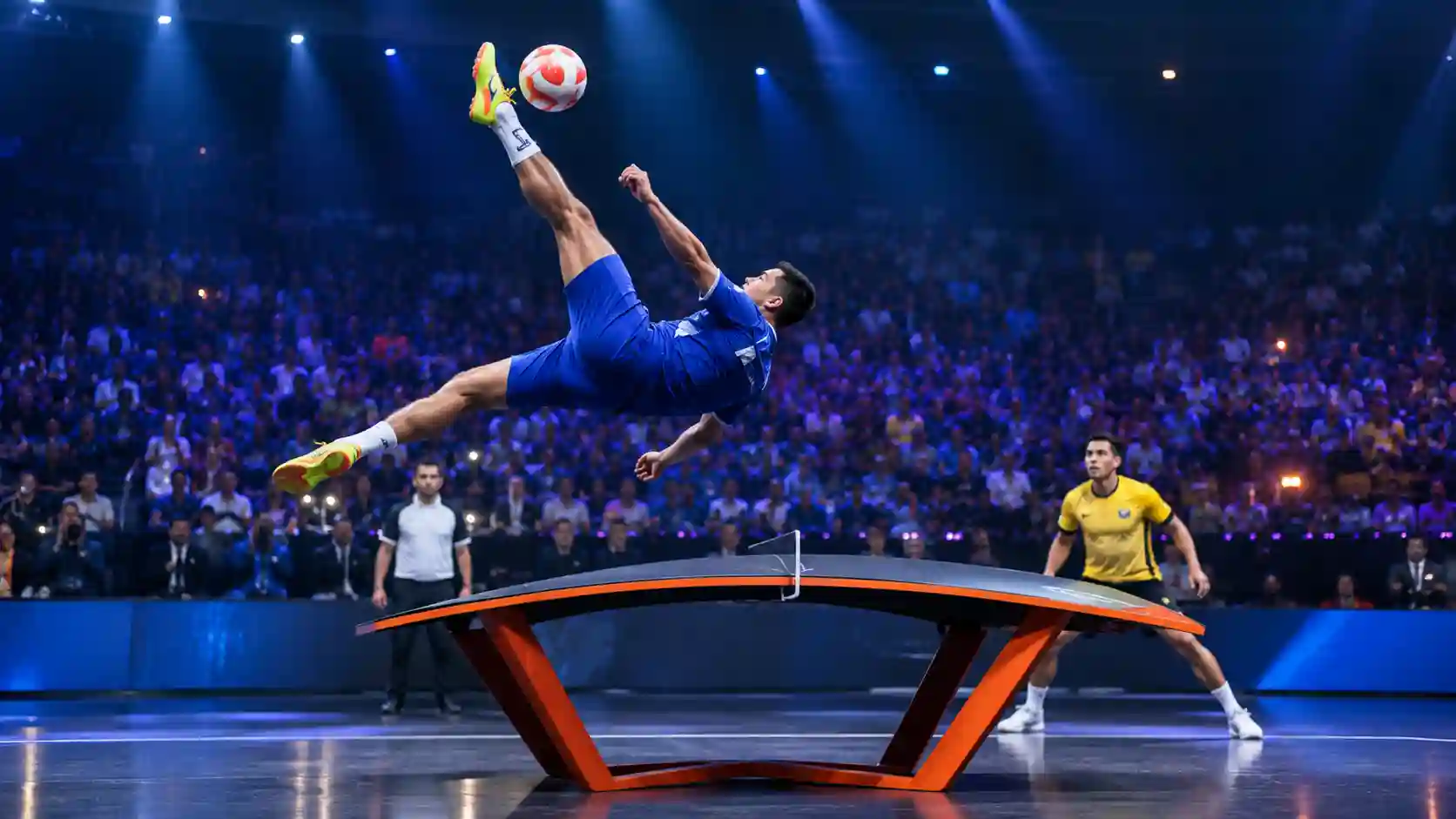
Teqball is a football-based sport played on a specially designed curved table, on which two players or pairs use only their feet, thighs, chest, shoulders or head, without hands or arms, to return the ball over the table's raised centre. The sport was invented in Hungary in 2014 by football enthusiasts Gabor Borsanyi, Gyorgy Gattyan and Viktor Huszar, and has since expanded rapidly across international multi-sport events. According to the International Teqball Federation, known as FITEQ, teqball's inclusion in the Aichi-Nagoya Asian Games followed its earlier appearances as a medal sport at the 2025 Asian Youth Games in Bahrain and the Southeast Asian Games in Thailand.
At the 2026 Asian Games, teqball features five medal events, men's and women's singles, men's and women's doubles, and mixed doubles, all contested between September 17 and 20 at the Nagoya City Higashi Sports Center. Each event follows a round-robin group stage, with placement in the group determining whether players advance directly to the semifinals, proceed to the quarterfinals, or enter a repechage round for a second chance to reach the bronze medal match.
India's Teqball Campaign
India entered three athletes in teqball at these Asian Games: Declan Marshall Gonsalves, Mohamed Anas Imran Beg and Quimcy Joaquim Dsouza. Between them, they competed across three of the sport's five medal events.
Men's Doubles: Early Exit for Gonsalves and Beg
Gonsalves and Beg, competing together in men's doubles, were India's first athletes in action at the Games when they took the table on September 17. According to a report from news agency UNI India, the Indian pair lost both of their Group B matches that day. They were beaten 10-12, 8-12 by Vietnam's Truong Giang Ba and Anh Khoa Le in a match where the first game had been tied at 10-10 before Vietnam pulled away, and were then beaten 4-12, 7-12 by South Korea's Junsuk Lee and Taebeen Lee. The two defeats ended India's campaign in men's doubles at the group stage, without a place in the quarterfinals.
Women's Singles: Dsouza's Historic Run to the Semifinals
India's most notable teqball storyline came through Quimcy Joaquim Dsouza in the women's singles event. Making her Asian Games debut, the 24-year-old player from Mumbai topped her group with two wins. She opened her campaign with a hard-fought 2-1 victory over Japan's top-seeded Yuina Sakamoto, winning 10-12, 12-11, 13-11 in a match that lasted 43 minutes at the Nagoya City Higashi Sports Center, before following it up with a 2-0 win over Cambodia's Koemyean DY, 12-9, 12-7. Topping Group A with two wins earned Dsouza a bye directly into the semifinals, bypassing the quarterfinal round entirely.
In the semifinal, played on Saturday, September 19, Dsouza faced Indonesia's Ima Sumaya, with a win guaranteeing India's first-ever teqball medal at the Asian Games. According to reporting from IANS and India.com, Dsouza made a strong start, winning the opening game 12-7, but Sumaya fought back to win the second game 12-9 and, after Dsouza built an early 4-1 lead in the decisive third game, rallied to take it 12-7 and advance to the final. The 1-2 defeat, with a final score line of 12-7, 9-12, 7-12, ended Dsouza's run for gold or silver but left her with a further opportunity at a medal through the bronze medal playoff.
Dsouza's bronze medal match was scheduled for Sunday, September 20, against Japan's Yuina Sakamoto, the same player she had defeated in her opening group match, with Sakamoto having reached the bronze medal match herself after her own semifinal defeat.
Mixed Doubles: Dsouza and Beg Reach the Bronze Medal Match
Dsouza also partnered with Beg in the mixed doubles event, where the Indian pair competed in a five-team Group A alongside the Philippines, Cambodia, Thailand and Kuwait. According to reporting from the Free Press Journal, the pair opened with a win over the Philippines' Jhoana Abulencia and Prince Agustin, before playing further group matches against Cambodia's Bun Thuonvireak and Yorn Sophornraksmey, Thailand's Dejaron Phakpong and Wongkhamchan Suphawadi, and Kuwait's Alebraheen Salman and Alfailakaw Hessah. The Indian duo finished third in their group, advancing to the knockout stage, but lost their quarterfinal to Vietnam's Gia Nghi Trinh and Hoang Minh Tan Nguyen, the same Vietnamese pairing that had eliminated India's men's doubles team earlier in the tournament.
That quarterfinal defeat sent Dsouza and Beg into the repechage round, where they defeated the Philippines' Jhoana Abulencia and Prince Agustin for a second time, this time 2-0, winning 12-3 and 12-6, according to a report from news agency UNI India. The win secured the Indian pair a place in the mixed doubles bronze medal match, also scheduled for Sunday, September 20, with their opponent still to be finalized as of the completion of the quarterfinal and repechage rounds.
With both results pending at the time of this report, Dsouza had two separate opportunities to secure India's first-ever Asian Games medal in teqball on September 20, one in women's singles and one in mixed doubles, while Gonsalves and Beg's men's doubles campaign had already concluded without advancing past the group stage.
Shooting at the Asian Games: A Proven Medal Source for India
Shooting has long been among India's stronger disciplines at the Asian Games, and the sport wasted little time adding to that record in Aichi-Nagoya. Competition at the Aichi Prefectural Shooting Range began on September 20, the same day as the Games' opening ceremony, with rifle and pistol events among the first on the schedule.
Women's 10m Air Rifle: India's First Medals of the Games
India's first medals of the 2026 Asian Games came in the women's 10m air rifle event. In the team competition, the trio of Elavenil Valarivan, Sonam Uttam Maskar and Vidarsa K Vinod combined for a total score of 1898.0 points to win silver, finishing behind China's gold-medal-winning total of 1904.2 and narrowly ahead of hosts Japan, who took bronze with 1897.1, just 0.9 points behind India. Individually, Maskar led the Indian effort in qualification with a score of 634.1, finishing third overall, while Valarivan scored 633.5 to finish seventh, and Vidarsa K Vinod scored 630.4 to finish twelfth.
The top eight qualifiers advanced to the individual final, where both Maskar and Valarivan carried India's medal hopes. Valarivan produced the stronger performance, finishing with 252.4 points to win the silver medal, finishing just 0.6 points behind Japan's Hinata Taichi, who took gold. Maskar finished sixth in the final with a score of 167.0. Vidarsa K Vinod, having finished twelfth in qualification, did not advance to the final.
Between the team and individual events, Valarivan collected two silver medals on the opening day of shooting competition alone, giving India two of its first medals at these Asian Games. Valarivan is scheduled to compete further in the Games alongside Parth Mane in the 10m air rifle mixed team event.
India's Broader Shooting Contingent
India's 30-member shooting squad for these Asian Games includes a mix of established international performers and emerging talent across rifle and pistol disciplines. Among the men's shooters confirmed for the Games are Kamaljeet, Aakash Bharadwaj and Kedarling Uchaganve in the 10m air pistol individual and team events, Anish Bhanwala in 25m rapid fire pistol, and Himanshu Dhillon, Parth Mane and Rudrankksh Patil across the 10m air rifle individual and team events. In the 50m rifle three positions event, India's men's entries include Aishwary Pratap Singh Tomar, Niraj Kumar and Rudrankksh Patil, while the women's 50m rifle three positions event features Ashi Chouksey, Vidarsa K Vinod and Tilottama Sen.
India's shooting squad for these Games also includes Olympic medallist Manu Bhaker, along with Suruchi Singh, Esha Singh and Anant Jeet Singh Naruka, reflecting a squad that blends established Olympic-level shooters with athletes competing to build their own Asian Games medal record.
India's recent history in shooting at the Asian Games provides useful context for the sport's significance to the country's overall medal tally. At the previous edition of the Games in Hangzhou, held in 2023, India's men's 10m air rifle team of Divyansh Singh Panwar, Rudrankksh Patil and Aishwary Pratap Singh Tomar won gold, part of a broader shooting medal haul that contributed to India's record overall medal tally at that edition of the Games, where the country won more than 100 medals in total.
Key Performances So Far
Taken together, the opening days of competition in Aichi-Nagoya have produced two standout individual storylines for India. In shooting, Elavenil Valarivan's two silver medals on the very first day of competition mark an immediate return on India's long-standing investment in rifle shooting as a core medal discipline at the Asian Games. In teqball, Quimcy Joaquim Dsouza's run to the semifinals of the women's singles event, in a sport India had never previously competed in at this level, stood out as one of the more notable individual performances of the Games' opening days, even before the outcome of her two bronze medal matches was known.
Dsouza's background adds further context to her performance. Before taking up teqball in 2022, she represented Maharashtra's under-19 football team, a background in football that aligns closely with the skill set required for teqball's football-based technique. She has since become a seven-time national champion in the sport and reached a career-best individual world ranking of 24 in FITEQ's rankings, having also finished ninth in the women's singles event at the 2026 World Championships prior to the Asian Games.
Upcoming Events
With shooting competition continuing through October 1, and further teqball medal matches scheduled for September 20, India's campaign in both sports remained active as of this report. Dsouza's two bronze medal matches, in women's singles against Japan's Yuina Sakamoto and in mixed doubles alongside Beg against an opponent yet to be finalized, represented India's most immediate remaining chances for a first-ever teqball medal at the Asian Games. In shooting, Valarivan's scheduled appearance in the 10m air rifle mixed team event alongside Parth Mane, along with the continuing individual and team events across India's 28-event shooting programme, offered further medal opportunities as the competition progressed through its opening week.
Beyond teqball and shooting, India's broader campaign at these Games was also under way, with the Indian women's cricket team, led by Harmanpreet Kaur, advancing to the final of the competition after a semifinal in which Shafali Verma scored a century, while India batter Smriti Mandhana became the highest run-scorer in T20 International cricket history across both men's and women's competitions during the tournament, surpassing New Zealand's Suzie Bates.
Conclusion
India's opening days at the 2026 Asian Games in Aichi-Nagoya were defined by two very different sporting narratives converging around the same broad theme: performance under pressure in individual combat-style sport formats. Shooting, one of India's most reliable medal-producing disciplines at past Asian Games, delivered immediately through Elavenil Valarivan's two silver medals in the women's 10m air rifle event. Teqball, appearing at the Asian Games for the first time, produced an equally compelling story through Quimcy Joaquim Dsouza's run to the semifinals of the women's singles competition, keeping alive India's hopes of a first-ever medal in the sport heading into her bronze medal matches on September 20. With competition in both disciplines continuing over the following days and weeks, India's campaign at these Games remained firmly focused on building on this early momentum as the broader Games schedule unfolded through early October.
Further reading and useful links
Reader questions
Frequently asked questions
What medals did India win on the opening day of the 2026 Asian Games?
India won two silver medals on the opening day in shooting. Elavenil Valarivan took silver in both the women's 10m air rifle individual event and the team event.
How did Quimcy Dsouza perform in teqball at the 2026 Asian Games?
Making her Asian Games debut, Quimcy Dsouza reached the women's singles semifinals and the mixed doubles bronze medal match, placing her in contention for India's first-ever medal in the sport.
What is teqball?
Teqball is a football-based sport played on a specially designed curved table, where players use their feet, thighs, chest, shoulders, or head to return the ball, without using hands or arms.
Who carried the flag for India at the 2026 Asian Games opening ceremony?
Shooter Manu Bhaker and wrestler-turned-kabaddi player Pawan Sehrawat led the Indian contingent as flag bearers for the Aichi-Nagoya 2026 opening ceremony.
Nexuswild welcomes factual corrections. Email [email protected] with evidence and the article URL.