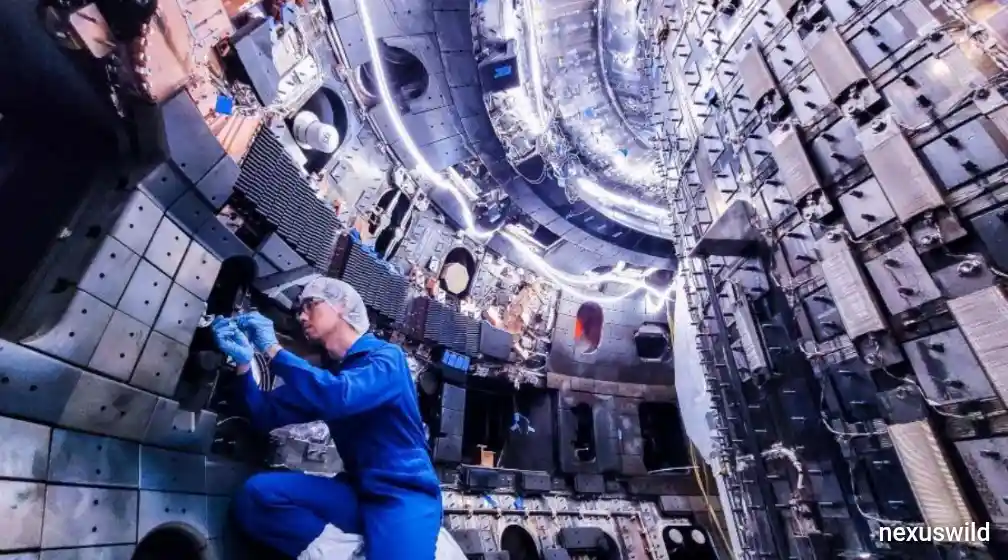

Researchers working on the DIII-D tokamak at General Atomics in San Diego have reported experimental evidence that helicon waves can drive an electrical current inside a tokamak plasma. The result, published in Physical Review Letters, provides an important proof of principle for a technology that could help future fusion reactors sustain plasma currents for longer periods without relying entirely on inductive current drive.
The research, led by J. B. Lestz and collaborators, used a high-power radio-frequency system to launch helicon waves into plasma confined by DIII-D’s magnetic field. Measurements showed power deposition in the plasma core and changes in its magnetic-safety-factor profile consistent with current being driven by the waves.
The achievement addresses one of the engineering challenges facing tokamak fusion: finding practical ways to sustain the plasma current needed for magnetic confinement during extended or steady-state operation. It does not mean that a fusion power plant has been built, that net electricity has been produced, or that continuous commercial operation has been demonstrated.
Why steady-state current drive matters
A tokamak confines extremely hot plasma inside a doughnut-shaped chamber using magnetic fields. In many tokamak configurations, an electrical current flowing through the plasma contributes to the magnetic field that helps keep the plasma confined.
Traditional inductive current drive uses a changing magnetic field, produced by a transformer-like system, to induce current in the plasma. This is effective for many experiments, but the available magnetic flux limits how long that induction can continue in a given operating cycle.
A reactor intended to operate continuously would therefore need to sustain a significant portion of its plasma current through other methods. These are called non-inductive current-drive techniques because they do not depend solely on transformer induction.
Scientists already use methods such as neutral-beam injection and other radio-frequency systems to heat plasma and drive current. The challenge is to develop options that remain effective under the high-density and high-temperature conditions expected in future reactor designs.
Helicon current drive is one candidate. The DIII-D experiment provides experimental evidence that the method can transfer energy and momentum to plasma electrons in a way that drives current.
How helicon waves work
Helicon waves are a type of radio-frequency electromagnetic wave associated with plasma physics. In the DIII-D system, a travelling-wave antenna launches waves at approximately 476 megahertz into the confined plasma.
The waves interact with electrons, transferring energy and momentum. Under suitable plasma conditions, that interaction can produce a net current in the toroidal direction around the tokamak.
This process is different from simply heating the plasma. Heating increases particle energy, while current drive must also produce a directional imbalance in electron motion. Demonstrating that the waves deposit power in the core is therefore an important step, but researchers also need measurements and modelling that establish the resulting current profile.
In the published study, the measured electron-temperature response agreed with time-dependent modelling that accounted for wave propagation and thermal transport. The calculated current profile was concentrated toward the plasma core and was consistent with the observed power-deposition pattern.
The authors also compared helicon-wave injection with discharges using a comparable amount of electron-cyclotron heating. During helicon injection, the reconstructed magnetic-safety-factor profile flattened more quickly, and sawtooth oscillations appeared earlier. These changes supported the interpretation that helicon waves were driving current rather than merely adding heat.
What the experiment actually demonstrated
The study used a megawatt-class helicon system, but that equipment rating should not be confused with a claim that all its rated power was absorbed by the plasma or converted into useful current. Power coupling, current-drive efficiency and the distribution of the driven current are separate quantities that must be measured and modelled.
The main finding was that the combined experimental observations and calculations provided strong evidence for auxiliary current drive by helicon waves. The American Physical Society designated the paper an Editors’ Suggestion, highlighting its relevance to plasma physics.
The result is an important step because helicon current drive had been proposed as a useful approach for reactor-relevant plasmas, but definitive experimental evidence had been lacking. The DIII-D work moves the concept beyond theoretical prediction and preliminary heating observations.
However, the research does not establish that helicon current drive is universally more efficient than every competing technique. Nor does it demonstrate that the approach will reduce reactor construction costs. Those outcomes depend on operating conditions, power requirements, system design and future engineering validation.
Potential role in future fusion reactors
If further experiments confirm reliable current drive under a wider range of plasma conditions, helicon systems could become one component of the non-inductive current-drive mix considered for future tokamaks. Such systems might help reactor designers maintain plasma-current profiles without relying exclusively on the limited inductive flux available from a central solenoid.
The work is relevant to long-pulse and steady-state research programmes, including efforts to develop future fusion pilot plants. It may also inform the design studies surrounding larger facilities and future reactor concepts.
But it is too early to say that the result unlocks steady-state operation for ITER or private fusion companies. ITER is an experimental international fusion project, and its operating configuration and research objectives are distinct from those of a commercial power station. Applying helicon current drive in a different device would require engineering integration, compatibility testing and validation at relevant plasma conditions.
Likewise, a successful current-drive experiment does not by itself resolve other major fusion challenges, including maintaining plasma stability, managing heat and particle exhaust, developing durable materials and producing more usable energy than the complete facility consumes.
What researchers need to establish next
The next steps include quantifying current-drive efficiency, improving confidence in the reconstructed current profile and testing how the method performs across different plasma densities, temperatures and confinement regimes. Researchers must also determine how the system can be integrated with other heating and current-drive methods.
The distinction between input power and useful plasma response will be important for future engineering decisions. A system’s commercial value depends not just on whether it can drive current, but on how much current it can sustain per unit of power, how reliably it operates and what additional equipment it requires.
These questions will determine whether helicon current drive becomes a practical part of future reactor designs or remains a specialised technique for particular plasma conditions.
A proof of principle, not a fusion power breakthrough
The General Atomics result establishes experimental evidence for a promising way to drive current in a tokamak using helicon waves. It strengthens the scientific basis for investigating non-inductive current drive and offers researchers another tool for developing long-pulse and steady-state plasma scenarios.
The broader significance lies in reducing uncertainty around one element of future fusion-reactor design. Commercial fusion still requires advances across many interacting systems, and the DIII-D result does not demonstrate continuous net-energy production.
For now, helicon current drive should be understood as a meaningful plasma-physics milestone: a proposed mechanism has received strong experimental support, and the next phase is to measure its limits, efficiency and usefulness under increasingly reactor-relevant conditions.
Nexuswild welcomes factual corrections. Email contact@nexuswild.com with evidence and the article URL.