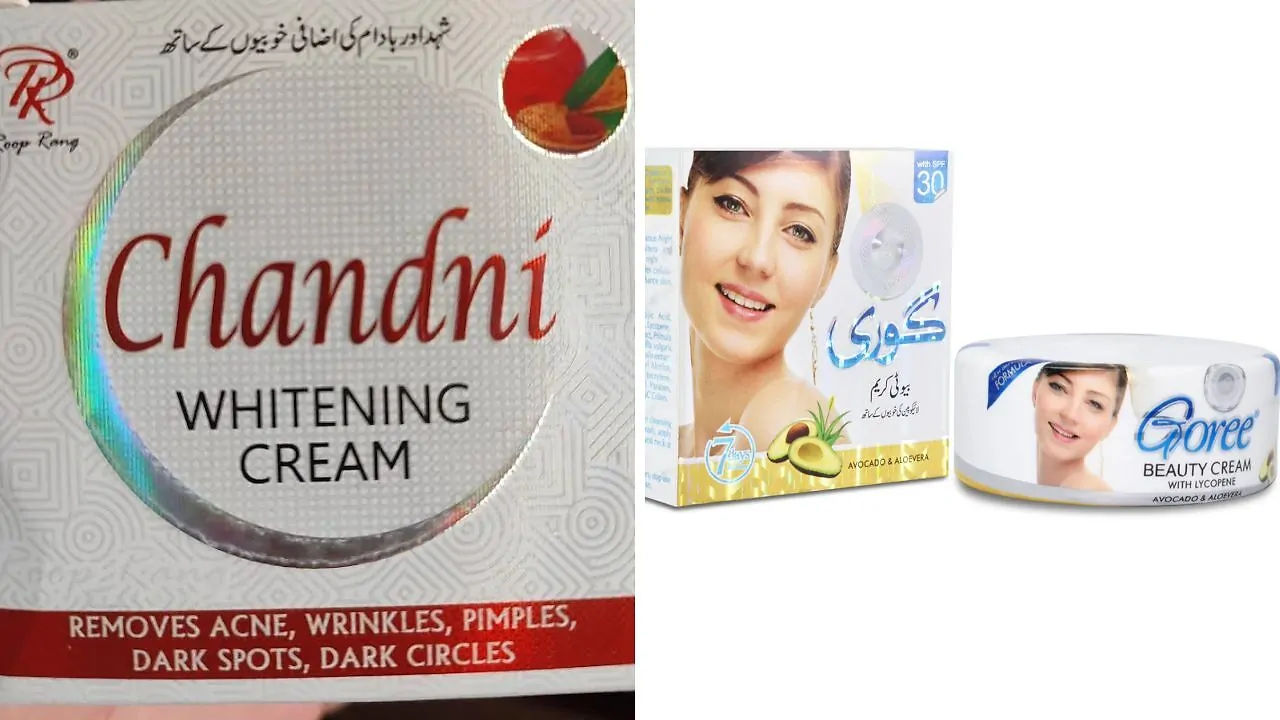

NEW DELHI, Sept. 16, 2026 - India’s national drug regulator has issued a public health alert over two Pakistan-made skin-lightening products after laboratory testing found them unauthorised for sale in India and containing heavy metals above permitted limits.
The Central Drugs Standard Control Organisation identified the products as Goree Beauty Cream and Chandni Whitening Cream. Both were listed in the regulator’s notice as “Made in Pakistan.”
CDSCO said neither product had been issued the registration certificate required for import and sale in India. The agency also said testing and analysis found excessive heavy metals beyond specified limits, creating a potential risk of toxic effects.
The public notice is dated September 8, 2026. CDSCO’s public-notice portal subsequently listed the health alert on September 14.
The warning matters for two separate reasons.
The first is product safety.
The second is legality.
Imported cosmetics cannot simply enter the Indian market because they are available through a seller or online listing. They must comply with the Cosmetics Rules, 2020, including registration requirements administered by the Central Licensing Authority.
There is also a wider trade restriction. Since May 2, 2025, India has prohibited the direct or indirect import or transit of all goods originating in or exported from Pakistan, unless the Government of India grants an exception.
That means the two creams sit at the intersection of public-health regulation, cosmetic-import rules and India’s broader prohibition on Pakistan-origin goods.
What CDSCO actually found
The strongest fact in the case comes directly from the regulator.
CDSCO said it verified through testing and analysis that Goree Beauty Cream and Chandni Whitening Cream were unauthorised and had not been issued import registration certificates by the competent authority for sale in India.
The same notice says the products contained excessive heavy metals beyond specified limits.
That language matters.
CDSCO did not merely question their paperwork.
It reported a laboratory finding related to safety.
At the same time, the notice does not publicly identify which heavy metals were detected in the two products or disclose the measured concentrations.
That limitation should be kept clear.
It would be inaccurate to state, without additional laboratory data, that the creams contained a specific metal such as mercury, lead, arsenic or cadmium.
The confirmed fact is narrower: CDSCO found heavy metals above the specified regulatory limits and warned that they could cause toxic effects.
The two products named in the alert
The regulator specifically identified Goree Beauty Cream and Chandni Whitening Cream.
The alert advises consumers not to purchase the named products.
It also advises people not to use the products, or similarly named cosmetic products, if already purchased.
That is a direct public-health recommendation.
Consumers do not need to wait for visible skin irritation before following it.
Heavy-metal exposure may not always produce an immediate or obvious reaction.
Why imported cosmetics need registration in India
India regulates cosmetics under the Drugs and Cosmetics Act, 1940 and the Cosmetics Rules, 2020.
Manufacturing and import are handled through different regulatory channels.
Domestic manufacturing is licensed by State Licensing Authorities.
Imported cosmetics are regulated through registration by the Central Licensing Authority.
CDSCO states that any cosmetic falling within the legal definition of a cosmetic must be registered, including its pack size, variants and manufacturing premises, before import.
Rule 12(1) of the Cosmetics Rules provides that no cosmetic may be imported into India unless it has been registered by the Central Licensing Authority or another authority to which that power has been delegated.
The formal process uses Form COS-1 for the application and Form COS-2 for the Import Registration Certificate.
That registration is not a branding formality.
It creates a regulatory record connecting the product, manufacturer, manufacturing site and authorised importer to the Indian market.
Without it, regulators have less assurance about identity, quality, manufacturing controls and legal accountability.
Safety standards apply separately from registration
Registration alone is not enough.
CDSCO also states that imported and manufactured cosmetics must comply with the applicable quality and safety standards under the Cosmetics Rules, including specifications referenced in the Ninth Schedule and applicable Bureau of Indian Standards requirements.
That means there are two different compliance questions.
Is the cosmetic legally registered for import?
And does the cosmetic meet the required safety and quality standards?
A product can fail either test.
In this case, the regulator says the two named creams failed both at once: they were unauthorised for import and they contained excessive heavy metals.
Pakistan-origin goods face an additional prohibition
The case has another legal layer that is unusual for a cosmetics alert.
On May 2, 2025, the Directorate General of Foreign Trade inserted paragraph 2.20A into India’s Foreign Trade Policy.
The provision prohibits direct or indirect import or transit of all goods originating in or exported from Pakistan, whether those goods would otherwise be freely importable or permitted.
The government said the restriction was imposed in the interest of national security and public policy.
Any exception requires prior approval from the Government of India.
The Commerce Ministry publicly confirmed that the prohibition applies not only to direct shipments from Pakistan but also to goods routed through other trade routes.
This is important because a product’s route does not automatically change its origin.
If a Pakistan-origin product moves through another country before reaching India, the underlying foreign-trade restriction can still apply.
The alert raises a distribution question
If Pakistan-origin cosmetics are prohibited from direct or indirect import and the two products also lacked cosmetic import registration, their presence in the Indian market raises an obvious enforcement question.
How did they reach consumers?
The CDSCO notice establishes that the products were found and tested.
It does not, in the public alert, provide a complete chain-of-custody account showing how they entered India, who imported them or which distribution route was used.
Those questions should not be filled with speculation.
Possible issues such as misdeclaration, informal imports, third-country routing or unauthorised resale require evidence in each case.
India has separately taken enforcement action in other 2026 cases involving Pakistan-origin goods routed through third countries with allegedly false declarations of origin.
That shows why country-of-origin enforcement matters.
It does not prove that the same method was used for these two cosmetic products.
Why heavy metals in cosmetics matter
Heavy metals are not a cosmetic-quality issue in the ordinary sense.
They can become a toxicology issue.
The exact health risk depends on the metal, its concentration, the amount of product used, the frequency and duration of exposure, the route of exposure and the vulnerability of the person using it.
That is why the specific laboratory result matters.
CDSCO’s notice does not disclose those details publicly for Goree Beauty Cream and Chandni Whitening Cream.
Consumers should therefore avoid both under the regulator’s advice rather than trying to judge the risk based on appearance, smell or short-term skin response.
A cream can look normal while still failing a chemical safety standard.
Skin-lightening products have a wider global safety problem
The concern around heavy metals is not unique to India.
The World Health Organization has repeatedly warned about hazardous chemicals in skin-lightening products.
WHO specifically identifies mercury-containing skin-lightening creams as a global public-health problem and notes potential effects including kidney and nervous-system damage and skin problems.
The Minamata Convention on Mercury restricts cosmetics containing mercury above 1 part per million, subject to the convention’s provisions.
That global context helps explain why regulators pay particular attention to products marketed for skin lightening or bleaching.
But it is important not to overstate the connection.
CDSCO did not say in its public alert that the two Pakistan-made creams contained mercury specifically.
WHO’s mercury warnings explain the broader category risk, not the precise chemistry of the two products named by CDSCO.
Why online availability is not proof of legality
Consumers often assume that if a product appears on a digital marketplace, social-media shop or reseller page, it must have passed regulatory checks.
That is not a safe assumption.
A listing is not an import registration certificate.
A seller description is not a laboratory test.
A product label is not proof that its declared origin, manufacturer or ingredients have been independently verified.
For imported cosmetics, Indian consumers should look for traceable regulatory and manufacturing information.
CDSCO’s own guidance states that imported cosmetics require registration with the Central Licensing Authority.
Consumers should be cautious when a product has incomplete importer information, lacks traceable registration details or appears to be sold outside normal authorised distribution channels.
What buyers should check
The first step is simple.
Do not buy or use the two products named in the CDSCO alert.
For other imported cosmetics, consumers should look for clear manufacturer details, batch information, manufacturing and expiry information where applicable, and importer or registration details required under Indian rules.
If the product makes unusually strong whitening or transformation claims, that should increase scrutiny rather than reduce it.
The same applies when packaging appears inconsistent, relabelled or incomplete.
A lower price is not evidence of a counterfeit or illegal product.
But a price that seems disconnected from authorised retail channels, combined with poor traceability, is a reasonable reason to verify before use.
What users should do if they already have one
CDSCO’s advice is not to use the named products if they have already been purchased.
A consumer who experiences irritation or other symptoms should seek medical advice.
If there is concern about repeated exposure to a potentially contaminated product, a medical professional can decide whether clinical evaluation or testing is appropriate based on the person’s symptoms and exposure history.
Consumers should not attempt to diagnose heavy-metal exposure themselves.
They also should not assume that the absence of immediate symptoms proves the product is safe.
This is not a blanket finding against all Pakistan-made cosmetics
The regulatory finding is specific.
CDSCO named two products.
The public notice does not say that every cosmetic ever manufactured in Pakistan contains excessive heavy metals.
India’s current foreign-trade policy separately prohibits Pakistan-origin imports, but that is a trade-policy rule.
It should not be confused with a laboratory conclusion about every product from that country.
Keeping those issues separate is important.
The two named creams were found unauthorised and over the specified heavy-metal limits.
The wider import prohibition is a separate legal fact.
Why the distinction between “unauthorised” and “unsafe” matters
Regulatory reporting often compresses different failures into one label.
This case should not.
“Unauthorised” means the products lacked the required import registration for legal sale in India.
“Excessive heavy metals” describes a separate safety-related laboratory finding.
A cosmetic can be unauthorised even if no dangerous ingredient has yet been identified.
A cosmetic can also be legally registered and later face action if it fails safety or quality testing.
Here, CDSCO says both failures were present together.
That is why the public-health alert is more serious than a paperwork warning.
What regulators are trying to protect
Cosmetics are used repeatedly and directly on the body.
Many products remain on the skin for hours.
Some are used daily for months or years.
That makes product identity, manufacturing control and contamination limits important even when a cosmetic is not classified as a medicine.
The regulatory model is preventive.
The goal is not to wait until large numbers of users become ill.
It is to prevent unauthorised or non-compliant products from being sold in the first place.
That is also why import registration connects a foreign manufacturer and production site to an accountable Indian regulatory process.
The strict conclusion
The CDSCO alert establishes four important facts.
Goree Beauty Cream and Chandni Whitening Cream were identified as Pakistan-made cosmetics.
Neither had the required registration certificate for import and sale in India.
CDSCO testing found heavy metals above specified limits.
And the regulator advised consumers not to purchase or use them.
There is a fifth issue beyond cosmetics regulation.
India has prohibited direct or indirect import of Pakistan-origin goods since May 2, 2025, unless an exception is approved by the government.
The result is not simply a story about two whitening creams.
It is a test of how health regulation, retail enforcement, import controls and country-of-origin rules work together when an unauthorised consumer product reaches the market.
For consumers, the immediate instruction is much simpler.
Do not use the two products named in the alert.
For regulators, the harder question is how they reached the market at all.
Reader questions
Frequently asked questions
Which cosmetic products has CDSCO warned against?
CDSCO named Goree Beauty Cream and Chandni Whitening Cream, both labelled Made in Pakistan.
Why did CDSCO issue the public health alert?
CDSCO said the two products were unauthorised for import and sale in India and that laboratory testing found heavy metals above the specified limits, creating a potential risk of toxic effects.
Did CDSCO say which heavy metals were found?
The public alert does not identify the specific heavy metals or publish their measured concentrations. It states only that heavy metals were present beyond specified limits.
Should consumers continue using the creams if they already bought them?
No. CDSCO advised consumers not to purchase the named products and not to use them, or similarly named products, if already purchased.
Do imported cosmetics need approval in India?
Yes. Under the Cosmetics Rules, 2020, imported cosmetics must be registered with the Central Licensing Authority before they can be legally imported into India.
Are imports from Pakistan currently allowed in India?
India has prohibited direct or indirect import or transit of all goods originating in or exported from Pakistan since May 2, 2025, unless a specific exception receives prior Government of India approval.
Does the CDSCO alert mean every Pakistan-made cosmetic contains heavy metals?
No. The laboratory finding in the public alert applies to the two named products. The broader Pakistan import prohibition is a separate trade-policy rule and should not be confused with a safety finding about every cosmetic made there.
Nexuswild welcomes factual corrections. Email [email protected] with evidence and the article URL.