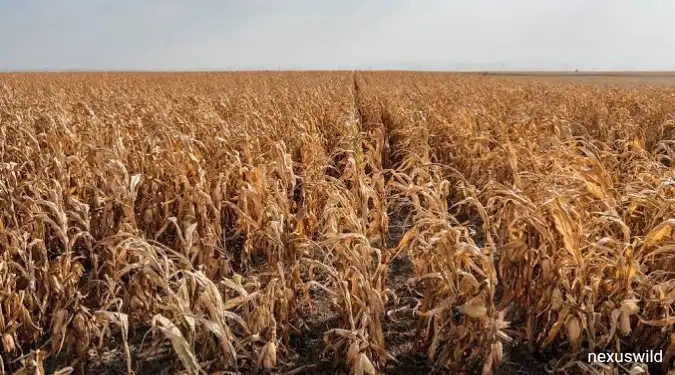

An El Niño forecast to strengthen through early 2027 is putting wheat, rice and maize harvests at risk just as food prices sit near a four-year high. Plant research on drought- and heat-tolerant varieties could cushion such shocks, but the price evidence comes mostly from models and adoption by farmers is uneven.
Article Body
A strengthening El Niño is putting global harvests at risk while food prices are already near a four-year high. Plant scientists say drought- and heat-tolerant crops could eventually soften such shocks and the price swings that follow. The evidence for that is real, but it rests largely on models, and the seeds have to reach farmers first.
The weather test
The World Meteorological Organization (WMO) said El Niño developed in early July, according to an S&P Global factbox published on 3 August. The US National Oceanic and Atmospheric Administration forecast that it may intensify from October to December and persist until April 2027. The WMO warned of lower rainfall and higher temperatures in Australia, Indonesia, India, parts of South Asia and northern South America.
Crop forecasts reflect the risk. Australia's agriculture bureau estimated 2026-27 wheat production at 26.7 million tonnes, down 26% from a year earlier, with exports falling 30.8% to 19.3 million tonnes. CERA put Brazil's soybean crop at 177 million tonnes, down 2.7%. An FAO official, quoted in Miller Magazine, said this El Niño differs from earlier ones because the planet is warmer.
History offers some reassurance. A June special report from the Crop Monitor, which tracks global crop conditions, found past El Niño events left global rice yields about 1.0% to 1.5% below trend, while soybean yields ran 1.5% to 2.0% above. Its greatest concern was Southern Africa, where the main maize season coincides with the forecast peak.
Prices have not yet moved sharply on this account. An industry analysis said El Niño had not caused a widespread food price increase by July, though FAO noted that worries about sugar output in India and Thailand slowed a fall in sugar prices. FAO's September Food Price Index reached 136.0, the highest since November 2022, according to Fastmarkets. FAO attributed that rise to shipping disruption and climate shocks, as Xinhua reported.
What the research offers
Plant breeders are working on several fronts. The International Rice Research Institute uses marker-assisted breeding to develop rice that withstands drought, flooding, heat and salinity, according to WIPO's Green Technology Book. It lists drought-tolerant varieties including Sahbhagi Dhan in India, Sahod Ulan in the Philippines and Sukha Dhan in Nepal, with average yield gains of 0.8 to 1.2 tonnes per hectare under drought. The same source said genome editing has been applied to more than 40 crops in 29 countries. That compendium is several years old.
India's public research system has released more than 750 crop varieties tolerant of abiotic stresses such as drought, salinity and heat, according to a published overview, though the text reviewed was partly garbled and the figure should be checked against the original. A review in Hapres journals says genomic selection and speed breeding are shortening development cycles for drought-tolerant maize and heat-tolerant wheat.
From yields to prices
The most-cited price evidence is an International Food Policy Research Institute (IFPRI) modelling study from 2014. It found climate change could cut maize yields by as much as 18% by 2050. It also found that adopting technologies including heat-tolerant varieties could cut food prices in developing countries almost in half by mid-century, compared with doing nothing. IFPRI's Rosegrant said no single technology would be enough, and the study did not quantify genetically modified crops.
The logic is straightforward, though this is analysis, not a reported finding. More stable yields mean fewer supply shortfalls, and fewer shortfalls mean smaller price spikes. The effect should be strongest in staples grown by rain-fed smallholders.
Adoption is the bottleneck
A scoping review of 202 papers on climate-resilient crops among small-scale producers in low- and middle-income countries found adoption rates are highly variable, despite the apparent benefits. It also reported that farmers often use such crops to cope with drought, heat, flooding and salinity, and proposed interventions to raise adoption and reduce abandonment. A variety developed in a laboratory affects prices only if enough farmers plant it.
What is not established
None of the sources reviewed estimates how much existing resilient varieties would change prices during this El Niño. The price projections come from a model that is more than a decade old, and the yield and variety figures come from reviews and compendia, some of them secondary. El Niño forecasts are probabilistic, and effects differ by region and crop. Prices also respond to energy, fertiliser and trade policy, which research on crops cannot address.
What to watch next
El Niño typically peaks between November and February, so the harvests that will test the weather forecasts are those in Southern Africa, South Asia and Australia in 2027. FAO's next Food Price Index is due on 6 November. Over the longer term, the signals to follow are public research budgets, whether farmers adopt new varieties at scale, and whether regulators approve gene-edited crops in more countries.
Nexuswild welcomes factual corrections. Email contact@nexuswild.com with evidence and the article URL.