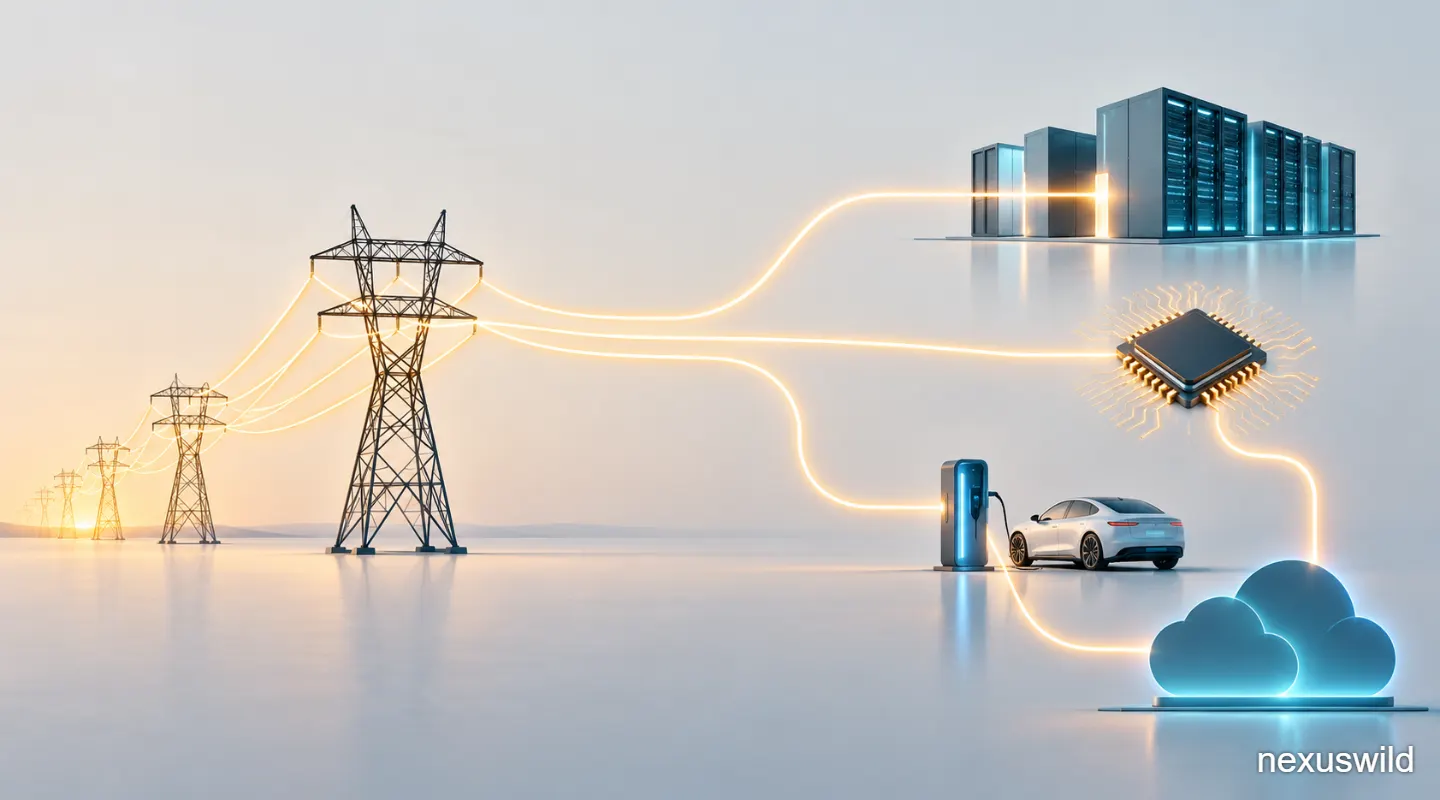

Artificial-intelligence data centres are being built with power requirements measured in hundreds of megawatts. Semiconductor factories consume electricity around the clock. Electric vehicles are shifting transport energy demand from oil toward power grids. Cloud computing continues to expand even outside AI, while factories, heat pumps and other parts of the economy are becoming more electrified.
The result is not an inevitable global electricity shortage. Power systems can add generation, strengthen transmission networks, deploy storage and make demand more flexible.
But electricity is becoming much more closely tied to how quickly the next wave of technology can actually be deployed.
The International Energy Agency says global electricity demand grew about 3% in 2025, after increasing 4.4% in 2024. Its latest five-year outlook projects average annual growth of 3.6% between 2026 and 2030, compared with 2.8% over the previous decade. Industry, electric vehicles, air conditioning and data centres are among the main drivers.
That changes the technology conversation.
Building a powerful AI model is one challenge. Finding enough reliable electricity to run the infrastructure behind it is becoming another.
AI Is Turning Data Centres Into Major Power Loads
Data centres existed long before the current AI boom.
Banks, streaming platforms, search engines, cloud services and corporate software have relied on large computing facilities for years. What AI changes is the intensity of the computing inside them.
Training and operating modern AI models require large numbers of accelerators running alongside high-speed memory, networking equipment and cooling systems. The result can be an unusually dense concentration of electricity demand in one location.
The IEA said global data-centre electricity consumption increased 17% in 2025, far faster than the roughly 3% increase in overall global electricity demand. Consumption at AI-focused facilities grew even faster. The agency currently expects global data-centre electricity use to roughly double by 2030, while power consumption associated specifically with AI-oriented facilities could triple.
Those are projections rather than guaranteed outcomes. Future demand depends on AI adoption, chip efficiency, software efficiency, construction schedules and the ability of grids to connect new facilities.
The uncertainty is visible in the United States.
A June 2026 update from Lawrence Berkeley National Laboratory estimates a reference case of 649 terawatt-hours of US data-centre electricity use in 2030, equal to about 11.8% of national electricity consumption. Its wider scenarios range from 521 TWh to 843 TWh, or roughly 9.5% to 15.3% of US electricity use.
That is not today's share. It is a scenario-based estimate for the end of the decade.
The distinction matters because data-centre forecasts have been changing quickly alongside AI hardware spending and construction plans.
Ireland Shows What Concentrated Demand Already Looks Like
At a global level, data centres still represent a relatively small share of total electricity consumption.
At the local level, the story can be very different.
Ireland offers one of the clearest real-world examples.
The country's Central Statistics Office reported that data centres consumed 7,663 GWh of metered electricity in 2025, up 10% from 2024. They accounted for 23% of all metered electricity consumption, compared with just 5% in 2015.
That is an actual measured figure, not a forecast.
It demonstrates why data centres attract so much attention from grid operators. A load that appears modest in global energy statistics can become highly significant when concentrated in a particular region.
Large computing campuses also differ from many traditional industrial facilities because they can be developed faster than major transmission infrastructure.
The IEA estimates that a new data centre may take roughly one to three years to build, while significant grid infrastructure can take five to 15 years from planning through completion.
That mismatch is becoming one of the central challenges of the AI infrastructure boom.
Cloud Computing Matters Beyond AI
It would be misleading to treat every new megawatt of data-centre demand as AI demand.
Cloud computing, digital services, enterprise applications, streaming, storage and conventional computing continue to consume substantial electricity.
Berkeley Lab's US model separates specialised AI hardware from conventional servers and other facility loads precisely because the underlying market is broader than generative AI. The laboratory's 2030 projections include servers, storage, networking and cooling as well as AI accelerators.
AI is accelerating the trend because accelerated servers can be significantly more power-dense, but the fundamental expansion of digital infrastructure was already underway.
The important shift is that computing capacity is increasingly being discussed in the same conversation as power capacity.
For developers choosing where to build a large data centre, fibre connectivity and land still matter. So do tax treatment, water availability and construction costs.
But the ability to secure hundreds of megawatts of dependable electricity can now determine whether a project is feasible at all.
Semiconductor Manufacturing Adds Another Technology Load
The technology sector consumes electricity at both ends of the AI supply chain.
Data centres use advanced processors. Making those processors is itself an energy-intensive industrial process.
Semiconductor fabrication requires highly controlled clean rooms, vacuum systems, plasma tools, pumps, air handling, water treatment and other equipment that operates continuously.
Samsung Electronics explicitly describes semiconductor manufacturing as highly energy intensive.
Its disclosed figures show that the company's Device Solutions division, which includes its semiconductor business, consumed about 30,426 GWh of electricity in 2025, up from 28,996 GWh in 2024 and 27,042 GWh in 2023.
The number covers Samsung's semiconductor division rather than one individual fabrication plant, but it gives a sense of the scale involved.
Taiwan faces a similar challenge because advanced chip manufacturing is central to its economy.
Taiwan's Ministry of Economic Affairs said in its 2026 electricity planning that expansion of the semiconductor industry, AI infrastructure and related technology manufacturing is expected to contribute to rising power demand over the next decade. The government currently projects average national electricity-demand growth of about 2.5% per year from 2026 through 2035.
Again, that 2.5% figure is a forecast, not current consumption growth.
It nevertheless illustrates why electricity policy is becoming intertwined with semiconductor industrial strategy.
A country can offer incentives for advanced fabrication plants, but those fabs also need reliable power networks capable of supporting uninterrupted operation.
Electric Vehicles Are Shifting Transport Onto the Grid
Data centres may dominate today's electricity headlines, but electric vehicles could become an even larger source of incremental power demand globally.
The IEA estimates the global electric-vehicle fleet consumed about 250 TWh of electricity in 2025, equivalent to roughly 1% of final electricity demand worldwide.
Under its current-policies scenario, EV electricity consumption could exceed 1,500 TWh by 2035, around six times the 2025 level.
Those future figures depend on vehicle adoption and policy, and therefore should not be read as a fixed outcome.
The grid challenge also depends heavily on when vehicles charge.
Millions of cars plugged in during the same evening period can put very different stress on a distribution system than the same amount of energy spread across the night or daytime solar hours.
That is why smart charging is receiving greater attention.
Charging software can shift electricity use away from peak periods, while vehicle-to-grid technology could eventually allow some vehicles to send electricity back into the system. Commercial V2G offers for private EV owners began appearing in 2025, according to the IEA, although compatible vehicles and regulatory frameworks remain limited.
The EV transition therefore creates both additional electricity demand and, potentially, a new source of grid flexibility.
The Bigger Constraint May Be the Grid
Generating enough electricity is only one half of the problem.
The power must reach the place where it is needed.
The IEA estimates that more than 2,500 GW of generation, storage and large-load projects are currently waiting in grid-connection queues around the world. The total includes renewable generation and batteries as well as large consumers such as data centres.
The agency says global annual grid investment is currently around $400 billion and would need to increase by roughly 50% by 2030 to keep pace with projected electricity demand.
That makes transmission lines, substations and transformers part of the technology infrastructure story.
A region can have abundant solar or wind resources hundreds of kilometres away from a data-centre cluster and still struggle to serve the load if transmission is congested.
Similarly, a new semiconductor plant may require an upgraded substation and additional high-voltage connections before production can begin.
The technology industry is used to scaling products quickly.
Electric grids do not usually move at software speed.
Reliability Matters as Much as Quantity
Technology companies do not simply need large volumes of electricity. They need reliable electricity.
A short interruption can disrupt industrial processes, data-centre operations or chip manufacturing.
Semiconductor manufacturers are particularly sensitive because production involves expensive equipment and tightly controlled processes. TSMC's 2025 annual filing notes that power outages, dips and surges can interrupt production schedules and identifies sufficient electricity availability as an ongoing operational concern for its manufacturing base in Taiwan.
Data centres address reliability partly through redundant utility feeds, batteries and backup generation.
But as facilities become larger, their interaction with the wider grid also becomes more complicated.
Texas grid operator ERCOT, for example, has been developing specialised models for large electronic loads, including AI data centres, because their behaviour can affect power-system stability differently from more conventional demand.
The issue is not evidence that AI facilities inherently destabilise grids.
It means grid operators increasingly need to understand how large, power-electronics-heavy loads behave when frequency or voltage conditions change.
Renewables Are Likely to Supply a Large Share of New Demand
The next technology boom does not necessarily imply a corresponding boom in fossil-fuel electricity.
The IEA expects renewable generation to rise strongly through 2030, with solar alone adding more than 600 TWh of global generation per year on average in its current outlook.
Renewables and nuclear together are projected to supply around half of global electricity generation by 2030, up from about 42% in 2025.
Technology companies are already major renewable-energy buyers.
The IEA said the technology sector accounted for about 40% of corporate renewable power-purchase agreements signed in 2025.
For data centres specifically, the agency's base case expects renewables to provide close to half of the additional electricity required through 2030.
Solar and wind have practical advantages: new projects can often be built faster than large conventional plants, and their operating costs can be competitive.
Their limitation is variability.
A data centre needs electricity at night as well as during sunny afternoons, while semiconductor fabs cannot simply stop when the wind weakens.
That is why the supply debate quickly moves from renewables alone to combinations of generation, grids, storage and flexible demand.
Natural Gas Is Playing a Near-Term Role
Natural gas remains part of that mix, particularly in the United States.
The IEA estimates gas currently provides more than 40% of the electricity physically serving US data centres and expects it to be the largest source of additional US data-centre electricity generation through 2030 in its base case.
The rapid pace of data-centre construction is also leading some developers to consider onsite gas generation where grid connections would otherwise take too long.
The IEA said in April 2026 that a growing number of onsite gas projects were being developed, particularly in the United States, although many remain at an early stage and face technical and financial hurdles.
Gas offers dispatchable generation, meaning output can be increased when needed.
But it carries fuel-price exposure and carbon emissions, which complicate corporate climate targets.
Its role therefore varies sharply by market.
Nuclear Power Is Returning to the Technology Conversation
Nuclear energy offers a different combination: very high capacity factors and low operational carbon emissions.
That has attracted increasing interest from large technology buyers seeking continuous power.
The IEA said the pipeline of conditional power-offtake agreements between data-centre operators and planned small modular reactor projects reached about 45 GW in 2026, up from 25 GW at the end of 2024.
That does not mean 45 GW of SMRs is operating today.
Most of those projects remain planned, proposed or under development.
The IEA's current outlook places a more meaningful contribution from new small modular reactors toward the end of this decade and into the 2030s rather than as an immediate solution.
Existing nuclear plants can contribute sooner, while new conventional reactors are being built in countries including China and India.
Nuclear's potential role is therefore substantial but constrained by financing, regulatory approval and long construction timelines.
Battery Storage Is Becoming the Bridge Between Supply and Demand
Storage addresses a different problem.
A battery does not create electricity. It moves electricity through time.
That can be extremely valuable when solar production peaks in the afternoon but data-centre, residential or industrial demand remains high after sunset.
Battery deployment is accelerating rapidly.
The IEA estimates 108 GW of new battery-storage capacity was added globally in 2025, 40% more than in 2024. Around 80% of those additions were utility-scale systems.
Batteries can respond extremely quickly to changes in grid conditions, making them useful for balancing supply and demand, supporting frequency and shifting renewable electricity into higher-demand periods.
They can also complement large technology loads.
The IEA says onsite battery storage is becoming increasingly important for next-generation AI data centres, particularly because some computing loads can change rapidly.
Storage is not a universal replacement for firm generation. Most current systems provide power for a limited number of hours.
But it is becoming one of the tools that allows grids to integrate more intermittent generation without sacrificing reliability.
Technology Companies May Need to Become More Flexible Power Users
There is another way to address electricity constraints: change the demand rather than only expanding supply.
Not every computing task has to happen at the exact second it is submitted.
Some data-centre workloads, such as training jobs, batch processing or data backup, may be movable across time or even between regions.
That opens the possibility of facilities reducing demand during periods when the grid is stressed and increasing computing activity when electricity is abundant.
The IEA argues that better demand flexibility could lower pressure on grids and help integrate concentrated loads including data centres and EV charging.
This model is still developing.
Many technology workloads require near-continuous availability, and companies cannot simply shut down services whenever electricity prices rise.
But even partial flexibility could matter when a facility consumes hundreds of megawatts.
Electricity Is Becoming Part of Technology Strategy
For years, technology companies could largely treat power as infrastructure that somebody else would provide.
That assumption is changing.
Data-centre developers are discussing substations, transmission queues and generation projects years before servers are installed. Semiconductor companies are securing renewable contracts and working with utilities around future factory expansions. EV companies increasingly have to think about charging infrastructure as part of the product ecosystem.
The connection is particularly visible in Taiwan.
The government now explicitly incorporates future demand from AI, data centres and semiconductor manufacturing into its long-term electricity planning.
It is visible in Ireland, where data centres already use nearly a quarter of metered electricity.
And it is visible in the United States, where data-centre growth accounts for around half of the IEA's projected increase in electricity demand through 2030.
The details differ by country, but the underlying issue is increasingly similar.
Technology growth has become power-system growth.
Conclusion
The next technology boom will still depend on better chips, faster networks and more capable software.
It will also depend on something far older: a reliable supply of electricity.
Global power demand is already rising faster than it did during much of the previous decade. AI data centres are adding unusually large and concentrated loads. Semiconductor manufacturing is expanding. Electric vehicles are moving transport demand onto power systems, while cloud computing and wider electrification continue in parallel.
None of this means electricity shortages are unavoidable.
Renewable generation is growing rapidly. Nuclear output is increasing. Natural gas provides dispatchable supply in many markets. Battery storage deployment is setting records, while smarter charging and flexible data-centre operations could reduce peak pressure.
The harder problem is coordination.
New generation must be connected to transmission networks. Transformers and substations need to arrive before large loads do. Storage must be placed where it adds value. Electricity markets have to provide incentives for reliability and flexibility without shifting excessive costs onto other consumers.
The technology sector has become extraordinarily good at scaling computation.
Its next constraint may be how quickly the physical power system beneath that computation can scale with it.
Electricity is not replacing chips, software or capital as the foundation of technology growth.
It is becoming the resource that determines how much of that technology can run at once.
Nexuswild welcomes factual corrections. Email contact@nexuswild.com with evidence and the article URL.